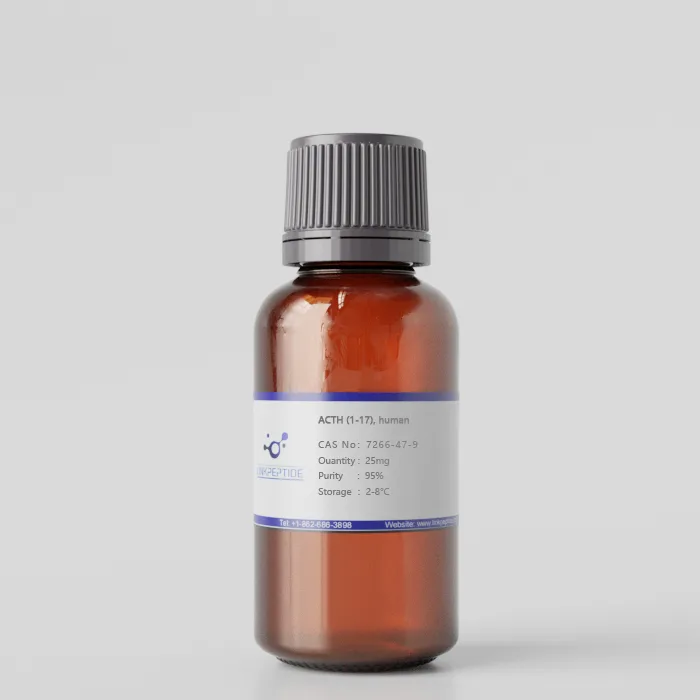
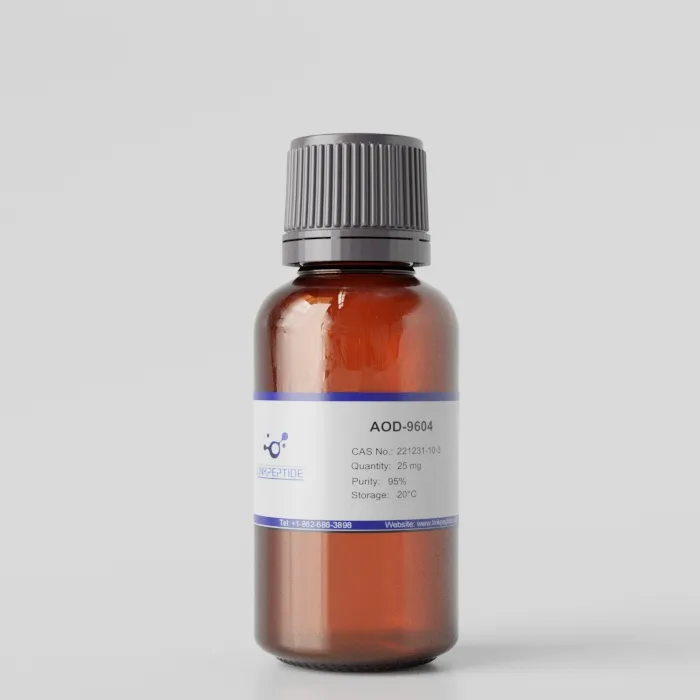
Product Name:ACTH (1-17), human
Form:TFA salt
Purity:95%
Storage:2-8 degree Celsius
Cas No:7266-47-9
Molar Mass:2093.4
Chemical Formula:C95H145N29O23S1
IUPAC Name:5-[[1-[[1-[[1-[[1-[[2-[[6-amino-1-[2-[[1-[[2-[[6-amino-1-[[6-amino-1-[(4-carbamimidamido-1-carboxybutyl)amino]-1-oxohexan-2-yl]amino]-1-oxohexan-2-yl]amino]-2-oxoethyl]amino]-3-methyl-1-oxobutan-2-yl]carbamoyl]pyrrolidin-1-yl]-1-oxohexan-2-yl]amino]-2-oxoethyl]amino]-3-(1H-indol-3-yl)-1-oxopropan-2-yl]amino]-5-carbamimidamido-1-oxopentan-2-yl]amino]-1-oxo-3-phenylpropan-2-yl]amino]-3-(1H-imidazol-4-yl)-1-oxopropan-2-yl]amino]-4-[[2-[[2-[[2-[(2-amino-3-hydroxypropanoyl)amino]-3-(4-hydroxyphenyl)propanoyl]amino]-3-hydroxypropanoyl]amino]-4-methylsulfanylbutanoyl]amino]-5-oxopentanoic acid
SMILES:CC(C)C(C(=O)NCC(=O)NC(CCCCN)C(=O)NC(CCCCN)C(=O)NC(CCCNC(=N)N)C(=O)O)NC(=O)C1CCCN1C(=O)C(CCCCN)NC(=O)CNC(=O)C(CC2=CNC3=CC=CC=C32)NC(=O)C(CCCNC(=N)N)NC(=O)C(CC4=CC=CC=C4)NC(=O)C(CC5=CNC=N5)NC(=O)C(CCC(=O)O)NC(=O)C(CCSC)NC(=O)C(CO)NC(=O)C(CC6=CC=C(C=C6)O)NC(=O)C(CO)N
InChIKey:MXNMAFWEFLFAJN-UHFFFAOYSA-N
InChI:InChI=1S/C95H145N29O23S/c1-53(2)78(91(144)109-49-75(128)111-62(22-9-12-35-96)81(134)113-63(23-10-13-36-97)82(135)117-68(93(146)147)26-16-39-106-95(102)103)123-90(143)74-27-17-40-124(74)92(145)67(24-11-14-37-98)112-76(129)48-108-80(133)71(44-56-46-107-61-21-8-7-20-59(56)61)120-83(136)64(25-15-38-105-94(100)101)114-86(139)70(42-54-18-5-4-6-19-54)119-88(141)72(45-57-47-104-52-110-57)121-84(137)65(32-33-77(130)131)115-85(138)66(34-41-148-3)116-89(142)73(51-126)122-87(140)69(118-79(132)60(99)50-125)43-55-28-30-58(127)31-29-55/h4-8,18-21,28-31,46-47,52-53,60,62-74,78,107,125-127H,9-17,22-27,32-45,48-51,96-99H2,1-3H3,(H,104,110)(H,108,133)(H,109,144)(H,111,128)(H,112,129)(H,113,134)(H,114,139)(H,115,138)(H,116,142)(H,117,135)(H,118,132)(H,119,141)(H,120,136)(H,121,137)(H,122,140)(H,123,143)(H,130,131)(H,146,147)(H4,100,101,105)(H4,102,103,106)
Sequence:Ser-Tyr-Ser-Met-Glu-His-Phe-Arg-Trp-Gly-Lys-Pro-Val-Gly-Lys-Lys-Arg
Application:ACTH (1-17), human is a bioactive N-terminal fragment of adrenocorticotropic hormone (ACTH), containing the first 17 amino acids required for melanocortin receptor interaction. Unlike full-length ACTH (1-39), this shorter peptide retains significant adrenal-stimulating activity, activating melanocortin 2 receptors (MC2R) to promote corticosteroid synthesis. It is widely used in endocrinology, neurobiology, and immunology research to study HPA axis regulation, adrenal insufficiency, and stress-related disorders. ACTH (1-17) also exhibits neuromodulatory and anti-inflammatory properties, making it a valuable tool in studies on neuroprotection, metabolic regulation, and immune responses, with potential implications in adrenal diseases and neuroimmune conditions.
Current Research:
Introduction
ACTH (1-17), human, is a truncated yet bioactive ACTH fragment that retains the N-terminal region necessary for receptor activation. This sequence includes the core functional domain for binding to melanocortin 2 receptors (MC2R) in the adrenal cortex, facilitating corticosteroid production. While full-length ACTH (1-39) is used clinically and in research, shorter fragments like ACTH (1-17) allow for more targeted studies on adrenal stimulation, neuropeptide signaling, and immune modulation.
Endocrine and Adrenal Function Research
Since ACTH (1-17) contains the essential sequence for MC2R activation, it is involved in:
Stimulating adrenal steroidogenesis, promoting the release of cortisol, aldosterone, and androgens.
HPA axis regulation, making it useful in studies of adrenal insufficiency (e.g., Addison’s disease, congenital adrenal hyperplasia).
Comparing receptor activation efficiency between ACTH (1-17) and ACTH (1-39), aiding in synthetic ACTH analog development.
Although ACTH (1-17) has reduced biological half-life compared to ACTH (1-39), its shorter sequence allows for focused studies on receptor activation and steroid biosynthesis.
Neuroendocrine and Stress Response Research
ACTH peptides influence neuroendocrine function beyond adrenal stimulation. Research findings on ACTH (1-17) include:
Effects on mood and behavior, interacting with neurotransmitter systems (dopamine, serotonin, and norepinephrine).
Role in stress adaptation, contributing to research on HPA axis dysregulation in depression, anxiety, and PTSD.
Potential neuroprotective effects, influencing studies on cognitive function and neurodegenerative diseases.
Since melanocortin receptors (MC4R, MC5R) are expressed in the brain, ACTH (1-17) may have neuromodulatory roles beyond adrenal function.
Immunomodulatory and Anti-Inflammatory Effects
ACTH peptides, including ACTH (1-17), exhibit immune-regulating properties. Research suggests that ACTH (1-17):
Suppresses pro-inflammatory cytokines (e.g., TNF-α, IL-6, IL-1β), reducing chronic inflammation.
Regulates immune cell activity, influencing macrophage and T-cell responses.
Has potential therapeutic applications in autoimmune diseases (e.g., multiple sclerosis, rheumatoid arthritis, lupus).
These immunomodulatory properties align with melanocortin-based anti-inflammatory mechanisms, making ACTH (1-17) relevant in neuroimmune research.
Potential Research and Therapeutic Applications
Due to its receptor-activating, neuroendocrine, and immune-modulating properties, ACTH (1-17) is studied for:
Adrenal dysfunction treatments, particularly in corticosteroid regulation disorders.
Neuropsychiatric research, including stress-related conditions like depression and PTSD.
Autoimmune and inflammatory disease studies, leveraging its anti-inflammatory effects.
Conclusion
ACTH (1-17), human, is a functional ACTH fragment that retains adrenal-stimulating, neuroendocrine, and immunomodulatory properties. Its ability to activate melanocortin receptors, regulate HPA axis function, and modulate immune responses makes it a valuable tool in endocrinology, neurobiology, and immunology research. Ongoing studies continue to explore its therapeutic potential in adrenal disorders, neuroprotection, and inflammatory diseases.
Get a Quote
 LinkPeptide