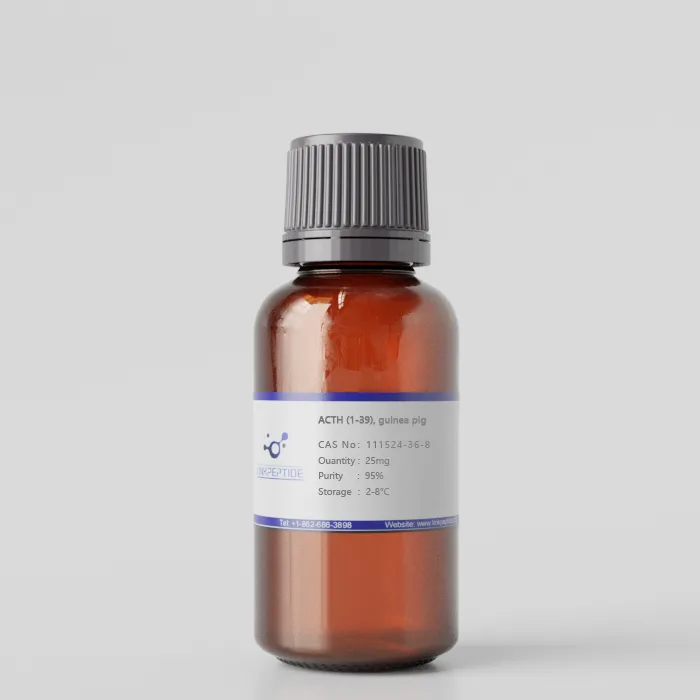
Product Name:ACTH (1-39), guinea pig
Form:TFA salt
Purity:95%
Storage:2-8 degree Celsius
Cas No:111524-36-8
Molar Mass:4529.1
Chemical Formula:C206H308N56O58S1
Sequence:Ser-Tyr-Ser-Met-Glu-His-Phe-Arg-Trp-Gly-Lys-Pro-Val-Gly-Lys-Lys-Arg-Arg-Pro-Val-Lys-Val-Tyr-Ala-Asn-Gly-Ala-Glu-Glu-Glu-Ser-Ala-Glu-Ala-Phe-Pro-Leu-Glu-Phe
Application:ACTH (1-39), Guinea Pig is a full-length adrenocorticotropic hormone (ACTH) peptide consisting of 39 amino acids, responsible for stimulating adrenal corticosteroid production via the melanocortin 2 receptor (MC2R). As a crucial component of the hypothalamic-pituitary-adrenal (HPA) axis, this peptide regulates cortisol release, immune function, and metabolic homeostasis. Species-specific variations in guinea pig ACTH structure and function make it valuable in comparative endocrinology, neurobiology, and stress physiology research. It is widely used to study adrenal function, stress adaptation, immune responses, and inflammatory modulation, particularly in guinea pig models for metabolic, neurological, and autoimmune diseases.
Current Research:
Introduction
Adrenocorticotropic hormone (ACTH (1-39), Guinea Pig) is a key neuroendocrine peptide that regulates corticosteroid synthesis through the hypothalamic-pituitary-adrenal (HPA) axis. ACTH stimulates the adrenal cortex to produce cortisol, playing a critical role in stress responses, metabolic adaptation, and immune modulation. While structurally similar to ACTH in other mammals, species-specific differences in guinea pig ACTH receptor binding and adrenal response make it a valuable model for comparative research in endocrinology, neurobiology, and immunology.
Regulation of Adrenal Function and Stress Response
ACTH (1-39) binds to melanocortin 2 receptor (MC2R) in the adrenal cortex, leading to the release of cortisol, which is essential for:
Energy metabolism regulation by modulating glucose homeostasis, lipid metabolism, and insulin sensitivity.
Stress adaptation, influencing behavioral and physiological responses to acute and chronic stress.
Inflammation control, regulating the immune system via glucocorticoid-mediated suppression of inflammatory cytokines.
Research on guinea pig ACTH (1-39) focuses on:
Comparative HPA axis function, as guinea pigs exhibit unique cortisol regulation patterns compared to rodents and primates.
Adrenal insufficiency models, assessing ACTH-stimulated cortisol release in adrenal dysfunction and endocrine disorders.
Stress-induced disease studies, investigating ACTH’s role in cardiovascular, metabolic, and neuropsychiatric disorders.
Neuroendocrine and Cognitive Research
ACTH is not only a stress hormone but also influences brain function and neurotransmitter systems. Studies in guinea pig models indicate:
Modulation of mood and cognitive function, with potential links to depression, anxiety, and PTSD research.
Impact on neuroprotection, suggesting a role in Alzheimer’s disease and cognitive decline.
Potential behavioral adaptations through interactions with dopamine, serotonin, and GABAergic pathways.
Guinea pigs are widely used in neurodevelopmental and stress-related behavioral research, making ACTH (1-39) a crucial tool for studying HPA axis dysregulation in neuropsychiatric disorders.
Immunomodulatory and Anti-Inflammatory Effects
Guinea pig ACTH (1-39) plays an important role in immune system regulation. Research suggests that ACTH:
Suppresses inflammatory cytokines (e.g., IL-6, TNF-α), helping to control chronic inflammation.
Regulates immune cell activity, impacting T-cell responses and macrophage function.
Has therapeutic potential in autoimmune diseases, including multiple sclerosis, rheumatoid arthritis, and inflammatory bowel disease (IBD).
ACTH-stimulated cortisol release in guinea pigs differs from other rodents, making them a preferred model for inflammatory disease research.
Comparative Species-Specific Differences in ACTH Function
Guinea pigs are physiologically distinct from rats, mice, and primates, leading to differences in ACTH activity and HPA axis regulation:
Guinea pigs maintain a more consistent basal cortisol level, making them a better model for chronic stress adaptation research.
ACTH receptor sensitivity in guinea pigs differs from that in rodents, affecting adrenal steroidogenesis.
Guinea pig ACTH responses resemble those in humans more closely, making them valuable for translational research.
These distinctions make ACTH (1-39) in guinea pigs an essential tool for bridging the gap between rodent models and human endocrinology studies.
Potential Research and Therapeutic Applications
Given its endocrine, neurological, and immunological roles, ACTH (1-39) in guinea pigs is widely studied in:
Adrenal disorder research, including adrenal insufficiency and HPA axis dysfunction.
Neuropsychiatric disease models, focusing on stress-related brain disorders.
Autoimmune and inflammatory disease studies, exploring immune system regulation via ACTH.
Conclusion
ACTH (1-39), Guinea Pig, is a full-length corticotropin peptide essential for studying adrenal function, stress adaptation, and immune modulation. Its unique species-specific HPA axis regulation makes it valuable for comparative endocrinology, stress physiology, and immune research. Ongoing studies continue to explore its therapeutic potential in metabolic diseases, neurodegenerative disorders, and inflammation-related conditions.
Get a Quote

 LinkPeptide