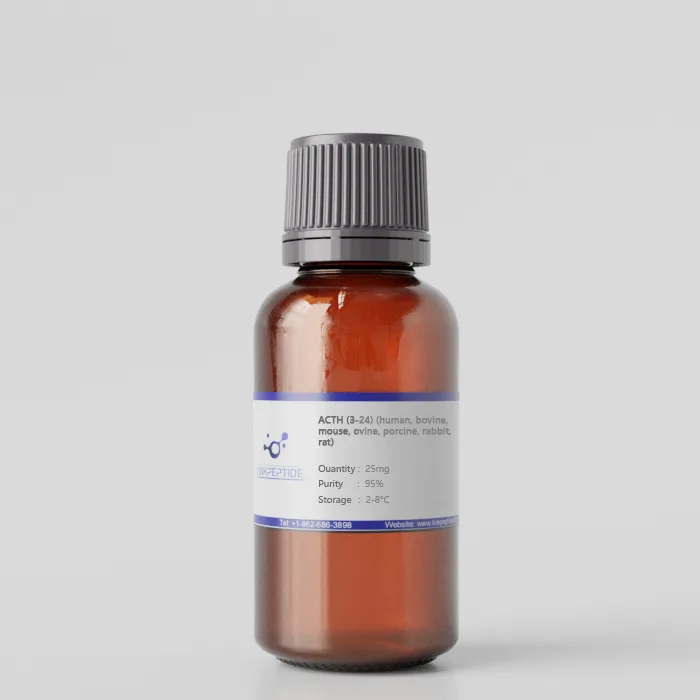
Product Name:ACTH (3-24) (human, bovine, mouse, ovine, porcine, rabbit, rat)
Form:TFA salt
Purity:95%
Storage:2-8 degree Celsius
Molar Mass:2683.2
Chemical Formula:C124H196N38O27S1
Sequence:Ser-Met-Glu-His-Phe-Arg-Trp-Gly-Lys-Pro-Val-Gly-Lys-Lys-Arg-Arg-Pro-Val-Lys-Val-Tyr-Pro
Application:ACTH (3-24) is a truncated adrenocorticotropic hormone (ACTH) fragment that retains the core bioactive sequence responsible for melanocortin receptor interactions. Found in multiple species (human, bovine, mouse, ovine, porcine, rabbit, rat), this fragment is used in research on adrenal steroidogenesis, neuroendocrine function, and immune regulation. Unlike full-length ACTH (1-39), ACTH (3-24) may act as a partial agonist or antagonist at melanocortin receptors, making it a valuable tool in adrenal disorders, stress-related conditions, and neuroimmune studies. This peptide is widely used in HPA axis research, melanocortin receptor pharmacology, and inflammatory disease models across various species.
Current Research:
Introduction
ACTH (3-24) is a bioactive ACTH fragment present in multiple species (human, bovine, mouse, ovine, porcine, rabbit, rat) that retains essential functional domains for melanocortin receptor binding. It is widely studied for its effects on adrenal function, neuroendocrine signaling, and immune modulation. Unlike full-length ACTH (1-39), ACTH (3-24) may exhibit altered receptor activity, functioning as a partial agonist or antagonist in certain contexts. This makes it an important research tool in adrenal insufficiency, stress adaptation, and inflammatory disease models.
Adrenal Function and Melanocortin Receptor Research
ACTH (3-24) interacts with melanocortin receptors (MC1R, MC2R, MC3R, MC4R, MC5R) but differs from ACTH (1-39) in its ability to stimulate corticosteroid production. Research suggests that:
ACTH (3-24) may act as a competitive antagonist at MC2R, potentially modulating adrenal glucocorticoid synthesis.
Species-specific differences exist in its receptor binding affinity, influencing adrenal function across human, bovine, mouse, ovine, porcine, rabbit, and rat models.
It plays a role in ACTH analog development, with implications for adrenal disease therapies and receptor selectivity studies.
Studies in adrenal insufficiency and Cushing’s syndrome models have explored its modulatory effects on cortisol release and stress-related endocrine responses.
Neuroendocrine and Stress-Related Research
ACTH fragments, including ACTH (3-24), influence stress-related neuroendocrine signaling. Research findings indicate:
Potential modulation of the HPA axis, affecting stress hormone regulation.
Selective effects on neurotransmitter systems, particularly dopamine and serotonin, suggesting roles in mood regulation and cognitive function.
Applications in neuropsychiatric disorders, including depression, PTSD, and chronic stress models.
ACTH (3-24) is also studied in species-specific models to understand evolutionary differences in stress adaptation and HPA axis regulation.
Immunomodulatory and Anti-Inflammatory Effects
Melanocortin peptides, including ACTH fragments, have been linked to immune modulation. ACTH (3-24) research focuses on:
Regulation of cytokine production, influencing inflammatory pathways in autoimmune diseases.
Neuroimmune interactions, particularly in neuroinflammatory conditions such as multiple sclerosis and neurodegenerative diseases.
Potential anti-inflammatory properties, making it relevant in rheumatoid arthritis, inflammatory bowel disease (IBD), and sepsis models.
Studies suggest species-dependent variations in immune modulation, making comparative research across different species an important area of study.
Potential Therapeutic Applications
Given its selective receptor activity, ACTH (3-24) is being explored in:
Adrenal function modulation, particularly in hormone-related disorders.
Neuropsychiatric treatments, including stress-related disorders and cognitive enhancement.
Inflammatory and immune disorder therapies, targeting autoimmune and inflammatory pathways.
Conclusion
ACTH (3-24) is a conserved ACTH fragment across multiple species with modified melanocortin receptor activity, making it a valuable research tool in adrenal regulation, neuroendocrine research, and immune modulation. Its potential as a partial agonist or antagonist provides unique insights into HPA axis regulation, stress adaptation, and inflammatory disease pathways. Ongoing research continues to explore its species-specific effects and therapeutic applications in endocrinology, neurobiology, and immunology.
Get a Quote
 LinkPeptide