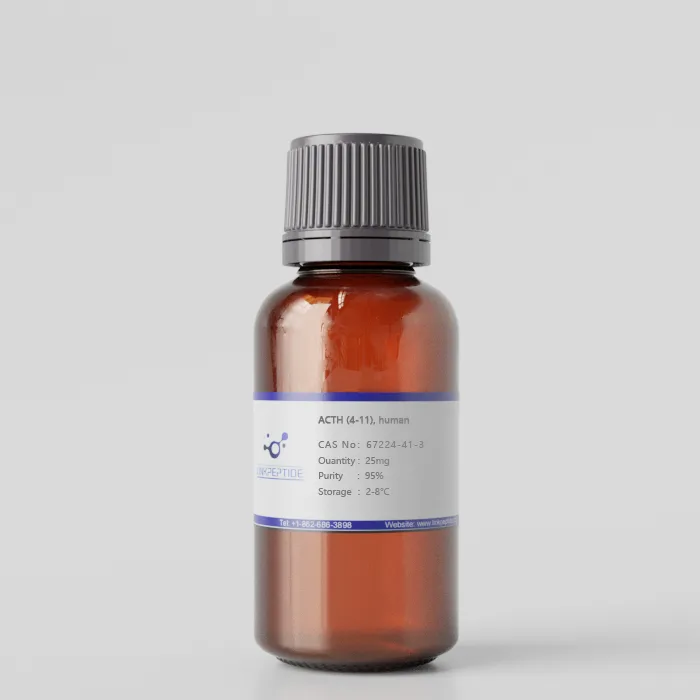
Product Name:ACTH (4-11), human
Form:free base
Purity:95%
Storage:2-8 degree Celsius
Cas No:67224-41-3
Molar Mass:1090.3
Chemical Formula:C50H71N15O11S1
IUPAC Name:(2S)-6-amino-2-[[2-[[(2S)-2-[[(2S)-2-[[(2S)-2-[[(2S)-2-[[(2S)-2-[[(2S)-2-amino-4-methylsulfanylbutanoyl]amino]-4-carboxybutanoyl]amino]-3-(1H-imidazol-5-yl)propanoyl]amino]-3-phenylpropanoyl]amino]-5-(diaminomethylideneamino)pentanoyl]amino]-3-(1H-indol-3-yl)propanoyl]amino]acetyl]amino]hexanoic acid
SMILES:CSCC[C@@H](C(=O)N[C@@H](CCC(=O)O)C(=O)N[C@@H](CC1=CN=CN1)C(=O)N[C@@H](CC2=CC=CC=C2)C(=O)N[C@@H](CCCN=C(N)N)C(=O)N[C@@H](CC3=CNC4=CC=CC=C43)C(=O)NCC(=O)N[C@@H](CCCCN)C(=O)O)N
InChIKey:ZKBNJKUZBFBIKV-YJXWTMGESA-N
InChI:InChI=1S/C50H71N15O11S/c1-77-21-18-33(52)43(69)61-36(16-17-42(67)68)46(72)65-40(24-31-26-55-28-59-31)48(74)63-38(22-29-10-3-2-4-11-29)47(73)62-35(15-9-20-56-50(53)54)45(71)64-39(23-30-25-57-34-13-6-5-12-32(30)34)44(70)58-27-41(66)60-37(49(75)76)14-7-8-19-51/h2-6,10-13,25-26,28,33,35-40,57H,7-9,14-24,27,51-52H2,1H3,(H,55,59)(H,58,70)(H,60,66)(H,61,69)(H,62,73)(H,63,74)(H,64,71)(H,65,72)(H,67,68)(H,75,76)(H4,53,54,56)/t33-,35-,36-,37-,38-,39-,40-/m0/s1
Sequence:Met-Glu-His-Phe-Arg-Trp-Gly-Lys
Application:
ACTH (4-11), human is a short bioactive fragment of adrenocorticotropic hormone (ACTH), consisting of the sequence Met-Glu-His-Phe-Arg-Trp-Gly-Lys-Pro-Val. While it does not stimulate adrenal corticosteroid release like full-length ACTH, this fragment exhibits neuromodulatory, cognitive-enhancing, and immunoregulatory properties. Research suggests that ACTH (4-11) plays a role in memory function, neuroprotection, and immune modulation, making it valuable in studies of Alzheimer’s disease, cognitive decline, neuropsychiatric disorders, and inflammatory diseases. Due to its interaction with melanocortin receptors, ACTH (4-11) is widely used in neuroscience, endocrinology, and immune-related research to explore its potential therapeutic applications.
Current Research:
Introduction
ACTH fragments have been extensively studied for their non-adrenal functions, particularly in neurological and immune system regulation. ACTH (4-11) is a truncated peptide containing an essential bioactive sequence that interacts with melanocortin receptors and neurotransmitter systems. Although it lacks the ability to stimulate adrenal glucocorticoid production, ACTH (4-11) is being investigated for its potential to enhance cognition, regulate mood, and modulate immune responses.
Neurocognitive and Memory-Enhancing Effects
Studies suggest that ACTH (4-11) has memory-enhancing properties, making it a candidate for cognitive function research. Key findings include:
Enhancement of learning and memory, particularly in models of cognitive decline and neurodegeneration.
Regulation of neurotransmitter systems, including dopamine, serotonin, and acetylcholine, which are essential for cognition and mood stabilization.
Potential applications in Alzheimer’s disease, as ACTH (4-11) may protect neurons and reduce cognitive deterioration.
Animal studies have shown that ACTH (4-11) improves memory retention and learning capacity, making it relevant for age-related cognitive disorders and neurodegenerative disease research.
Stress and Mood Regulation
ACTH fragments are known to influence the HPA axis, but ACTH (4-11) appears to have distinct effects on stress regulation. Research highlights:
Possible anxiolytic and antidepressant effects, suggesting a role in mood disorders, anxiety, and PTSD.
Modulation of stress response mechanisms, which may help reduce excessive cortisol-related damage.
These properties suggest ACTH (4-11) could be beneficial in neuropsychiatric disorders where stress and dysregulation of the HPA axis contribute to disease progression.
Neuroprotection and Neuroinflammation
ACTH (4-11) has been studied for its neuroprotective potential, particularly in conditions where oxidative stress, inflammation, and neuronal damage contribute to disease progression. Research suggests that this peptide:
Reduces neuroinflammatory markers, making it relevant for neurodegenerative diseases like Parkinson’s and Alzheimer’s.
Promotes neuronal survival and plasticity, potentially aiding in brain injury recovery and neurorehabilitation.
Influences neuroimmune interactions, which are key in multiple sclerosis and other neuroinflammatory disorders.
Immunomodulatory and Anti-Inflammatory Effects
Melanocortin peptides, including ACTH-derived fragments, play a role in immune system regulation. ACTH (4-11) has been shown to:
Inhibit pro-inflammatory cytokines (e.g., TNF-α, IL-6), reducing inflammation in autoimmune and inflammatory diseases.
Modulate immune cell function, suggesting potential applications in immune suppression and autoimmune disease research.
These findings highlight its relevance in conditions like rheumatoid arthritis, multiple sclerosis, and inflammatory bowel disease (IBD), where immune dysregulation is a major factor.
Potential Therapeutic Applications
Due to its cognitive, neuroprotective, and immunomodulatory properties, ACTH (4-11) is being explored for:
Cognitive enhancement therapies for dementia and age-related memory decline.
Treatment of neuropsychiatric disorders, including anxiety, depression, and PTSD.
Anti-inflammatory and neuroimmune therapy, particularly for autoimmune and inflammatory disorders.
Conclusion
ACTH (4-11), human, is a neuroactive and immunoregulatory peptide fragment with promising research applications in cognitive function, stress modulation, neuroprotection, and immune regulation. Its ability to influence neurotransmitter signaling, reduce neuroinflammation, and enhance memory makes it a valuable tool in neurology, psychiatry, and immunology. Ongoing studies continue to explore its therapeutic potential in neurodegenerative diseases, stress-related disorders, and inflammatory conditions.
Get a Quote
 LinkPeptide