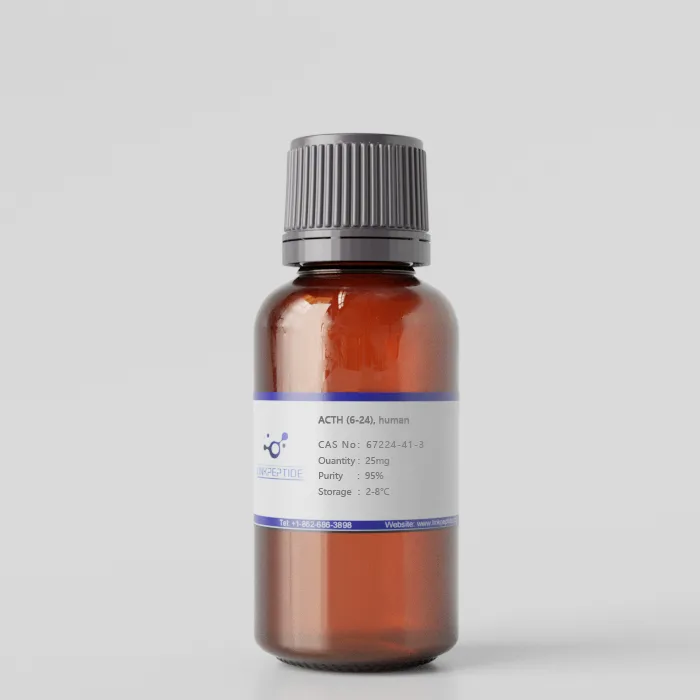
Product Name:ACTH (6-24), human
Purity:95%
Storage:2-8 degree Celsius
Cas No:67224-41-3
Molar Mass:1090.3
Chemical Formula:C50H71N15O11S1
IUPAC Name:(2S)-6-amino-2-[[2-[[(2S)-2-[[(2S)-2-[[(2S)-2-[[(2S)-2-[[(2S)-2-[[(2S)-2-amino-4-methylsulfanylbutanoyl]amino]-4-carboxybutanoyl]amino]-3-(1H-imidazol-5-yl)propanoyl]amino]-3-phenylpropanoyl]amino]-5-(diaminomethylideneamino)pentanoyl]amino]-3-(1H-indol-3-yl)propanoyl]amino]acetyl]amino]hexanoic acid
SMILES:CSCC[C@@H](C(=O)N[C@@H](CCC(=O)O)C(=O)N[C@@H](CC1=CN=CN1)C(=O)N[C@@H](CC2=CC=CC=C2)C(=O)N[C@@H](CCCN=C(N)N)C(=O)N[C@@H](CC3=CNC4=CC=CC=C43)C(=O)NCC(=O)N[C@@H](CCCCN)C(=O)O)N
InChIKey:ZKBNJKUZBFBIKV-YJXWTMGESA-N
InChI:InChI=1S/C50H71N15O11S/c1-77-21-18-33(52)43(69)61-36(16-17-42(67)68)46(72)65-40(24-31-26-55-28-59-31)48(74)63-38(22-29-10-3-2-4-11-29)47(73)62-35(15-9-20-56-50(53)54)45(71)64-39(23-30-25-57-34-13-6-5-12-32(30)34)44(70)58-27-41(66)60-37(49(75)76)14-7-8-19-51/h2-6,10-13,25-26,28,33,35-40,57H,7-9,14-24,27,51-52H2,1H3,(H,55,59)(H,58,70)(H,60,66)(H,61,69)(H,62,73)(H,63,74)(H,64,71)(H,65,72)(H,67,68)(H,75,76)(H4,53,54,56)/t33-,35-,36-,37-,38-,39-,40-/m0/s1
Sequence:His-Phe-Arg-Trp-Gly-Lys-Pro-Val-Gly-Lys-Lys-Arg-Arg-Pro-Val-Lys-Val-Tyr-Pro
Application:ACTH (6-24), human is a synthetic fragment of adrenocorticotropic hormone (ACTH) containing the core sequence essential for melanocortin receptor interactions. Unlike full-length ACTH, this truncated peptide exhibits selective activity and may function as a partial agonist or antagonist of ACTH receptors, influencing glucocorticoid regulation and neuroendocrine signaling. It is widely used in research related to HPA axis function, melanocortin receptor pharmacology, and immune modulation. ACTH (6-24) is particularly valuable in studies on adrenal disorders, neuroprotection, and inflammatory diseases, helping to elucidate the role of melanocortin peptides in endocrine, neurological, and immune system regulation.
Current Research:
Introduction
Adrenocorticotropic hormone (ACTH) regulates adrenal corticosteroid production via activation of the melanocortin 2 receptor (MC2R) in the adrenal cortex. ACTH (6-24) is a truncated ACTH fragment that retains key bioactive domains necessary for receptor binding but lacks the N-terminal sequence required for full receptor activation. This structural difference makes ACTH (6-24) a valuable tool for investigating melanocortin receptor modulation, adrenal steroidogenesis, and neuroendocrine function.
Regulation of Adrenal Function and Endocrine Research
ACTH (6-24) interacts with melanocortin receptors, particularly MC2R and MC4R, but its activity differs from full-length ACTH (1-39). Some studies suggest that ACTH (6-24) may act as a competitive antagonist or partial agonist, modulating glucocorticoid synthesis and adrenal response.
Research in this area focuses on:
Adrenal disorders, including Cushing’s syndrome, Addison’s disease, and congenital adrenal hyperplasia.
ACTH receptor selectivity and signal transduction mechanisms.
Development of ACTH-based therapeutics for adrenal insufficiency and stress-related endocrine imbalances.
Because of its modified receptor activity, ACTH (6-24) is particularly useful for exploring alternative melanocortin signaling pathways that regulate energy metabolism, stress response, and adrenal adaptation.
Neuroendocrine and Stress-Related Research
ACTH fragments, including ACTH (6-24), influence stress-related hormonal responses and neuroendocrine signaling. Studies suggest that this peptide plays a role in:
Regulating the HPA axis, which governs cortisol release, stress adaptation, and metabolic homeostasis.
Neuromodulation, affecting neurotransmitter systems such as dopamine, serotonin, and GABA.
Cognitive and behavioral responses to stress, with potential implications in depression, anxiety, and PTSD.
Because ACTH peptides are involved in melanocortin-mediated neuromodulation, researchers are exploring their potential in neurodegenerative diseases and cognitive dysfunction, such as Alzheimer’s disease and Parkinson’s disease.
Immunomodulatory and Anti-Inflammatory Properties
Melanocortin peptides, including ACTH fragments, have been identified as immune regulators, capable of modulating inflammatory pathways. ACTH (6-24) has been investigated for its ability to:
Reduce cytokine production (e.g., IL-6, TNF-α), potentially mitigating inflammatory diseases.
Modulate immune cell activity, offering therapeutic potential for autoimmune conditions such as rheumatoid arthritis and multiple sclerosis.
Regulate neuroinflammation, which is implicated in neurodegenerative diseases.
These effects highlight ACTH (6-24) as a potential therapeutic target for immune suppression, anti-inflammatory interventions, and neuroimmune research.
Potential Therapeutic Applications
Given its unique receptor activity, ACTH (6-24) is being explored in:
Selective melanocortin receptor modulation, potentially offering new treatments for adrenal dysfunction.
Neuropsychiatric and neurodegenerative disease research, particularly in stress-related disorders and neuroinflammation.
Immune and inflammatory disorder therapies, leveraging its effects on cytokine regulation and immune cell function.
Conclusion
ACTH (6-24), human, is a truncated ACTH fragment with modified melanocortin receptor interactions, making it a valuable tool in adrenal regulation, neuroendocrine research, and immune modulation. Its potential role as a selective receptor modulator opens new research avenues for endocrine disorders, neuroprotection, and inflammatory disease therapy. Ongoing studies continue to explore its therapeutic potential in metabolic regulation, stress-related conditions, and immune system disorders.
Get a Quote

 LinkPeptide