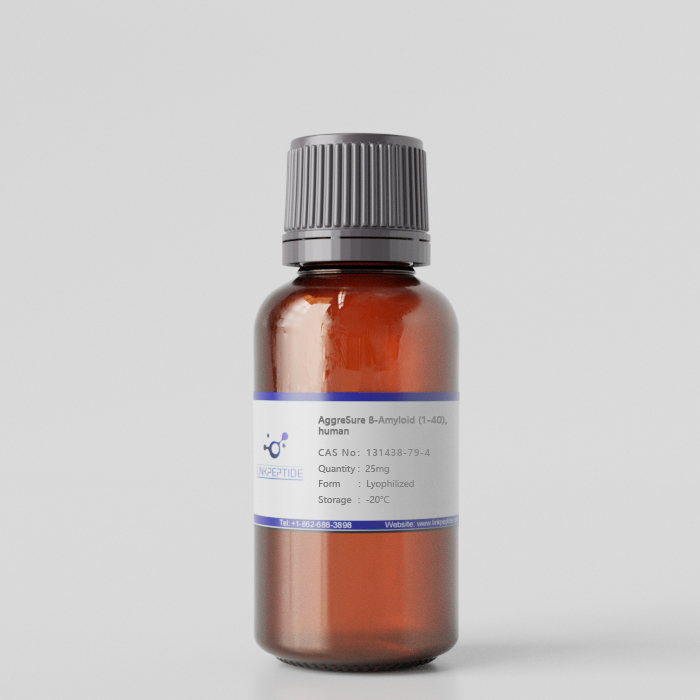
Product Name: AggreSure ß-Amyloid (1-40), human - 0.25 mg
Sequence One Letter Code: DAEFRHDSGYEVHHQKLVFFAEDVGSNKGAIIGLMVGGVV
Sequence Three Letter Code: H-Asp-Ala-Glu-Phe-Arg-His-Asp-Ser-Gly-Tyr-Glu-Val-His-His-Gln-Lys-Leu-Val-Phe-Phe-Ala-Glu-Asp-Val-Gly-Ser-Asn-Lys-Gly-Ala-Ile-Ile-Gly-Leu-Met-Val-Gly-Gly-Val-Val-OH
Cas No: 131438-79-4
Chemical Formula:C194H295N53O58S
Molecular Weight: 4330.2
Purity: 95%
Form: Lyophilized
Storage Conditions: Store at -20°C. Do not freeze-thaw reconstituted peptide.
Research Area: Alzheimer's Disease
SMILES: CC[C@H](C)[C@@H](C(=O)N[C@@H]([C@@H](C)CC)C(=O)NCC(=O)N[C@@H](CC(C)C)C(=O)N[C@@H](CCSC)C(=O)N[C@@H](C(C)C)C(=O)NCC(=O)NCC(=O)N[C@@H](C(C)C)C(=O)N[C@@H](C(C)C)C(=O)O)NC(=O)[C@H](C)NC(=O)CNC(=O)[C@H](CCCCN)NC(=O)[C@H](CC(=O)N)NC(=O)[C@H](CO)NC(=O)CNC(=O)[C@H](C(C)C)NC(=O)[C@H](CC(=O)O)NC(=O)[C@H](CCC(=O)O)NC(=O)[C@H](C)NC(=O)[C@H](CC1=CC=CC=C1)NC(=O)[C@H](CC2=CC=CC=C2)NC(=O)[C@H](C(C)C)NC(=O)[C@H](CC(C)C)NC(=O)[C@H](CCCCN)NC(=O)[C@H](CCC(=O)N)NC(=O)[C@H](CC3=CNC=N3)NC(=O)[C@H](CC4=CNC=N4)NC(=O)[C@H](C(C)C)NC(=O)[C@H](CCC(=O)O)NC(=O)[C@H](CC5=CC=C(C=C5)O)NC(=O)CNC(=O)[C@H](CO)NC(=O)[C@H](CC(=O)O)NC(=O)[C@H](CC6=CNC=N6)NC(=O)[C@H](CCCNC(=N)N)NC(=O)[C@H](CC7=CC=CC=C7)NC(=O)[C@H](CCC(=O)O)NC(=O)[C@H](C)NC(=O)[C@H](CC(=O)O)N
IUPAC: (4S)-5-[[(2S)-1-[[(2S)-1-[[(2S)-1-[[(2S)-1-[[(2S)-1-[[2-[[(2S)-1-[[(2S)-1-[[(2S)-1-[[(2S)-1-[[(2S)-1-[[(2S)-5-amino-1-[[(2S)-6-amino-1-[[(2S)-1-[[(2S)-1-[[(2S)-1-[[(2S)-1-[[(2S)-1-[[(2S)-1-[[(2S)-1-[[(2S)-1-[[2-[[(2S)-1-[[(2S)-4-amino-1-[[(2S)-6-amino-1-[[2-[[(2S)-1-[[(2S,3S)-1-[[(2S,3S)-1-[[2-[[(2S)-1-[[(2S)-1-[[(2S)-1-[[2-[[2-[[(2S)-1-[[(1S)-1-carboxy-2-methylpropyl]amino]-3-methyl-1-oxobutan-2-yl]amino]-2-oxoethyl]amino]-2-oxoethyl]amino]-3-methyl-1-oxobutan-2-yl]amino]-4-methylsulfanyl-1-oxobutan-2-yl]amino]-4-methyl-1-oxopentan-2-yl]amino]-2-oxoethyl]amino]-3-methyl-1-oxopentan-2-yl]amino]-3-methyl-1-oxopentan-2-yl]amino]-1-oxopropan-2-yl]amino]-2-oxoethyl]amino]-1-oxohexan-2-yl]amino]-1,4-dioxobutan-2-yl]amino]-3-hydroxy-1-oxopropan-2-yl]amino]-2-oxoethyl]amino]-3-methyl-1-oxobutan-2-yl]amino]-3-carboxy-1-oxopropan-2-yl]amino]-4-carboxy-1-oxobutan-2-yl]amino]-1-oxopropan-2-yl]amino]-1-oxo-3-phenylpropan-2-yl]amino]-1-oxo-3-phenylpropan-2-yl]amino]-3-methyl-1-oxobutan-2-yl]amino]-4-methyl-1-oxopentan-2-yl]amino]-1-oxohexan-2-yl]amino]-1,5-dioxopentan-2-yl]amino]-3-(1H-imidazol-4-yl)-1-oxopropan-2-yl]amino]-3-(1H-imidazol-4-yl)-1-oxopropan-2-yl]amino]-3-methyl-1-oxobutan-2-yl]amino]-4-carboxy-1-oxobutan-2-yl]amino]-3-(4-hydroxyphenyl)-1-oxopropan-2-yl]amino]-2-oxoethyl]amino]-3-hydroxy-1-oxopropan-2-yl]amino]-3-carboxy-1-oxopropan-2-yl]amino]-3-(1H-imidazol-4-yl)-1-oxopropan-2-yl]amino]-5-carbamimidamido-1-oxopentan-2-yl]amino]-1-oxo-3-phenylpropan-2-yl]amino]-4-[[(2S)-2-[[(2S)-2-amino-3-carboxypropanoyl]amino]propanoyl]amino]-5-oxopentanoic acid
INCHIKEY: FEWOUVRMGWFWIH-ILZZQXMPSA-N
INCHI:
InChI=1S/C194H295N53O58S/c1-25-102(19)158(188(299)211-87-143(256)218-124(67-94(3)4)174(285)228-123(62-66-306-24)172(283)241-152(96(7)8)186(297)209-83-140(253)206-84-145(258)240-154(98(11)12)191(302)245-157(101(17)18)193(304)305)247-192(303)159(103(20)26-2)246-162(273)104(21)215-141(254)85-207-164(275)116(47-36-38-63-195)223-181(292)133(77-139(199)252)234-185(296)137(90-249)220-144(257)88-210-187(298)153(97(9)10)242-184(295)135(79-151(269)270)235-170(281)121(56-60-147(261)262)222-161(272)106(23)217-173(284)127(69-107-41-30-27-31-42-107)231-177(288)129(71-109-45-34-29-35-46-109)237-189(300)156(100(15)16)244-183(294)125(68-95(5)6)229-166(277)117(48-37-39-64-196)224-168(279)119(54-58-138(198)251)226-178(289)130(73-111-80-202-91-212-111)233-180(291)132(75-113-82-204-93-214-113)238-190(301)155(99(13)14)243-171(282)122(57-61-148(263)264)227-175(286)126(72-110-50-52-114(250)53-51-110)219-142(255)86-208-165(276)136(89-248)239-182(293)134(78-150(267)268)236-179(290)131(74-112-81-203-92-213-112)232-167(278)118(49-40-65-205-194(200)201)225-176(287)128(70-108-43-32-28-33-44-108)230-169(280)120(55-59-146(259)260)221-160(271)105(22)216-163(274)115(197)76-149(265)266/h27-35,41-46,50-53,80-82,91-106,115-137,152-159,248-250H,25-26,36-40,47-49,54-79,83-90,195-197H2,1-24H3,(H2,198,251)(H2,199,252)(H,202,212)(H,203,213)(H,204,214)(H,206,253)(H,207,275)(H,208,276)(H,209,297)(H,210,298)(H,211,299)(H,215,254)(H,216,274)(H,217,284)(H,218,256)(H,219,255)(H,220,257)(H,221,271)(H,222,272)(H,223,292)(H,224,279)(H,225,287)(H,226,289)(H,227,286)(H,228,285)(H,229,277)(H,230,280)(H,231,288)(H,232,278)(H,233,291)(H,234,296)(H,235,281)(H,236,290)(H,237,300)(H,238,301)(H,239,293)(H,240,258)(H,241,283)(H,242,295)(H,243,282)(H,244,294)(H,245,302)(H,246,273)(H,247,303)(H,259,260)(H,261,262)(H,263,264)(H,265,266)(H,267,268)(H,269,270)(H,304,305)(H4,200,201,205)/t102-,103-,104-,105-,106-,115-,116-,117-,118-,119-,120-,121-,122-,123-,124-,125-,126-,127-,128-,129-,130-,131-,132-,133-,134-,135-,136-,137-,152-,153-,154-,155-,156-,157-,158-,159-/m0/s1
Source / Species: human
Conjugation: Unconjugated
Code Nacres: NA.26
Application: AggreSure β-Amyloid (1–40) is a pretreated form of the human Aβ(1–40) peptide designed to reliably form aggregates for experimental applications. Aβ(1–40) is one of the major amyloid species found in cerebrovascular deposits and contributes to amyloidogenesis associated with neurodegenerative disorders such as Alzheimer’s disease. This peptide preparation is quality-tested to ensure consistent aggregation competence, enabling reproducible formation of oligomers and fibrils in laboratory assays. AggreSure Aβ(1–40) is widely used in studies of amyloid aggregation kinetics, fibrillization processes, and screening of aggregation inhibitors. It also serves as a useful tool for investigating the molecular mechanisms underlying amyloid formation, protein misfolding, and amyloid-related neurotoxicity in neurodegenerative disease research.
Current Research: AggreSure β-Amyloid (1–40) is a specialized preparation of the human amyloid-β peptide Aβ(1–40) designed to reliably form aggregates for experimental applications. Amyloid-β peptides are central to research on protein misfolding and neurodegenerative disorders, particularly Alzheimer’s disease. Among the various amyloid species, Aβ(1–40) represents one of the most abundant forms found in cerebrovascular amyloid deposits, where it contributes to amyloid plaque formation and vascular amyloidosis. AggreSure Aβ(1–40) is pretreated and quality-tested to ensure consistent aggregation behavior, allowing researchers to reproducibly generate amyloid oligomers and fibrils in laboratory assays. Because aggregation kinetics of amyloid peptides can vary depending on peptide handling and preparation methods, standardized preparations such as AggreSure Aβ(1–40) help improve experimental reproducibility in studies of amyloid formation and neurodegenerative disease mechanisms. Amyloid-β Peptides and Alzheimer’s Disease Amyloid-β peptides are derived from the amyloid precursor protein (APP) through sequential enzymatic cleavage by β-secretase and γ-secretase. These cleavage events produce peptides of varying lengths, with Aβ(1–40) and Aβ(1–42) being the most common forms. Although Aβ(1–42) is often associated with plaque formation in the brain, Aβ(1–40) is the predominant species present in cerebrovascular amyloid deposits, which are characteristic of conditions such as cerebral amyloid angiopathy. The accumulation and aggregation of amyloid-β peptides contribute to pathological features associated with neurodegeneration, including: Formation of amyloid fibrils and plaques Disruption of neuronal function Induction of cellular stress responses Activation of inflammatory pathways in the brain Because of its involvement in amyloid pathology, Aβ(1–40) is widely used in research examining the molecular mechanisms of amyloid formation. Aggregation and Amyloid Formation A defining feature of amyloid-β peptides is their tendency to undergo self-assembly into aggregated structures. This process involves a series of structural transitions that lead from soluble peptide monomers to larger assemblies such as oligomers, protofibrils, and mature amyloid fibrils. Amyloid aggregation typically proceeds through several stages: Nucleation phase – initial formation of aggregation seeds Oligomer formation – small soluble peptide assemblies Protofibril growth – elongated intermediate structures Fibrillization – formation of stable amyloid fibrils These aggregated species have distinct structural and biological properties, and many studies focus on understanding how specific aggregation states influence cellular responses and neurotoxicity. Advantages of AggreSure Pretreatment One of the challenges in amyloid research is the variability of peptide aggregation depending on sample preparation conditions, storage, and experimental handling. Small differences in preparation can lead to large changes in aggregation kinetics and experimental outcomes. AggreSure β-Amyloid (1–40) is pretreated to ensure reliable aggregation competence, meaning the peptide is prepared in a way that supports consistent formation of oligomers and fibrils when used in experimental assays. Benefits of this standardized preparation include: Improved reproducibility of aggregation experiments Reliable formation of amyloid oligomers and fibrils Consistent behavior in kinetic aggregation assays Reduced variability between experimental batches These features make AggreSure Aβ(1–40) particularly useful for studies that require controlled amyloid formation. Applications in Amyloid Aggregation Studies AggreSure β-Amyloid (1–40) is widely used in experiments investigating the biochemical and biophysical processes involved in amyloid formation. Researchers use the peptide to analyze aggregation kinetics and fibrillization mechanisms under controlled conditions. Typical experimental applications include: Monitoring amyloid fibril formation using fluorescence assays Studying structural transitions during protein misfolding Characterizing oligomer and fibril morphology Investigating environmental factors that influence aggregation These studies contribute to understanding how misfolded proteins assemble into amyloid structures. Screening of Aggregation Inhibitors Another important application of AggreSure Aβ(1–40) is in screening experiments designed to identify molecules that influence amyloid aggregation. Researchers often use standardized amyloid peptides to evaluate compounds that may alter aggregation pathways. Experimental systems may analyze how candidate molecules affect: Formation of amyloid oligomers Growth of fibrillar structures Stability of amyloid assemblies Aggregation kinetics in vitro Using a consistent aggregation-competent peptide preparation improves the reliability of these screening assays. Investigating Protein Misfolding Mechanisms Amyloid aggregation is one example of protein misfolding, a process in which proteins adopt abnormal conformations that lead to self-assembly into insoluble structures. Studying these processes provides insight into broader biological questions about protein stability and folding. AggreSure Aβ(1–40) is frequently used in experiments examining: Molecular mechanisms of protein misfolding Structural properties of amyloid fibrils Factors influencing peptide aggregation pathways Cellular responses to aggregated proteins These studies contribute to the growing field of protein aggregation biology. Conclusion AggreSure β-Amyloid (1–40) is a pretreated preparation of the human amyloid-β peptide designed to ensure reliable and reproducible aggregation and fibrillization in experimental systems. As one of the major amyloid species associated with cerebrovascular deposits and amyloidogenesis, Aβ(1–40) plays an important role in research on neurodegenerative disease mechanisms. By providing a consistent aggregation-competent peptide, AggreSure Aβ(1–40) supports studies of amyloid aggregation kinetics, protein misfolding, and screening of aggregation-modulating compounds. Its reproducibility makes it a valuable tool for investigating the molecular processes underlying amyloid formation and amyloid-related neurotoxicity in neurodegenerative disease research.
Get a Quote
 LinkPeptide