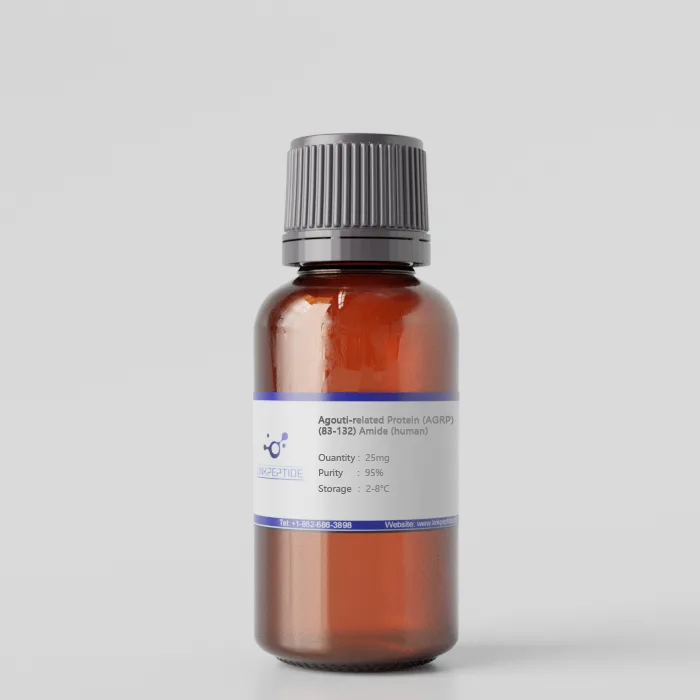
Product Name:Agouti-related Protein (AGRP) (83-132) Amide (human)
Purity:95%
Storage:2-8 degree Celsius
Molar Mass:5676.6
Chemical Formula:C235H362N76O67S11
Sequence:Ser-Ser-Arg-Arg-Cys-Val-Arg-Leu-His-Glu-Ser-Cys-Leu-Gly-Gln-Gln-Val-Pro-Cys-Cys-Asp-Pro-Cys-Ala-Thr-Cys-Tyr-Cys-Arg-Phe-Phe-Asn-Ala-Phe-Cys-Tyr-Cys-Arg-Lys-Leu-Gly-Thr-Ala-Met-Asn-Pro-Cys-Ser-Arg-Thr-NH2(Cys1&Cys4, Cys2&Cys6, Cys3&Cys9, Cys5&Cys10, Cys7&Cys8 Bridges)
Application:
Agouti-Related Protein (AGRP) (83-132) Amide (Human) is a bioactive peptide fragment derived from AGRP, a critical neuropeptide involved in appetite regulation, energy balance, and metabolic control. This fragment contains the C-terminal cystine-knot domain, essential for binding to melanocortin receptors (MC3R and MC4R), acting as an inverse agonist to block α-MSH-mediated satiety signaling. AGRP(83-132) plays a key role in obesity, cachexia, and metabolic syndrome research, with applications in appetite modulation, neuroendocrine function, and melanocortin receptor-targeted drug development. Its amide form enhances stability and receptor interaction, making it a crucial tool in metabolic and neurophysiological studies.
Current Research:
Agouti-Related Protein (AGRP) (83-132) Amide is a functionally significant peptide fragment of AGRP, a neuropeptide secreted in the arcuate nucleus of the hypothalamus that plays a major role in feeding behavior, metabolic regulation, and neuroendocrine signaling. This fragment contains the cystine-knot domain, which is crucial for high-affinity binding to melanocortin receptors (MC3R and MC4R), acting as an inverse agonist to suppress melanocortin-mediated appetite suppression.
Increased food intake (hyperphagia) due to suppression of satiety signaling.
Reduced energy expenditure, promoting fat storage and metabolic conservation.
Regulation of fasting responses, with AGRP expression rising during caloric deprivation.
This peptide is a key research tool in understanding the molecular mechanisms behind appetite stimulation and metabolic adaptation.
Obesity, where AGRP overexpression leads to chronic hyperphagia and excessive weight gain.
Cachexia and anorexia, where AGRP inhibition contributes to uncontrolled weight loss and muscle wasting.
Metabolic syndrome, affecting glucose homeostasis, insulin sensitivity, and lipid metabolism.
Studies using AGRP(83-132) focus on melanocortin receptor modulation as a strategy for treating obesity and weight-related disorders.
Leptin, which inhibits AGRP expression, reducing hunger.
Ghrelin, which stimulates AGRP production, increasing food intake.
Corticotropin-releasing hormone (CRH), linking AGRP activity to stress-induced eating behaviors.
These findings suggest AGRP plays a central role in hormonal feedback loops regulating metabolism and energy intake.
MC4R-targeted obesity treatments, aiming to counteract AGRP-induced hyperphagia.
Cachexia therapy, where AGRP modulation may restore appetite in chronic illness patients.
Neuropeptide-based drug development, focusing on melanocortin receptor modulation in metabolic diseases.
Conclusion
Agouti-Related Protein (AGRP) (83-132) Amide (Human) is a critical peptide for appetite regulation, neuroendocrine signaling, and metabolic research. Its role in melanocortin receptor interactions makes it a valuable tool in obesity, cachexia, and energy balance studies, supporting therapeutic advancements in metabolic disease management and appetite modulation.
Get a Quote
 LinkPeptide