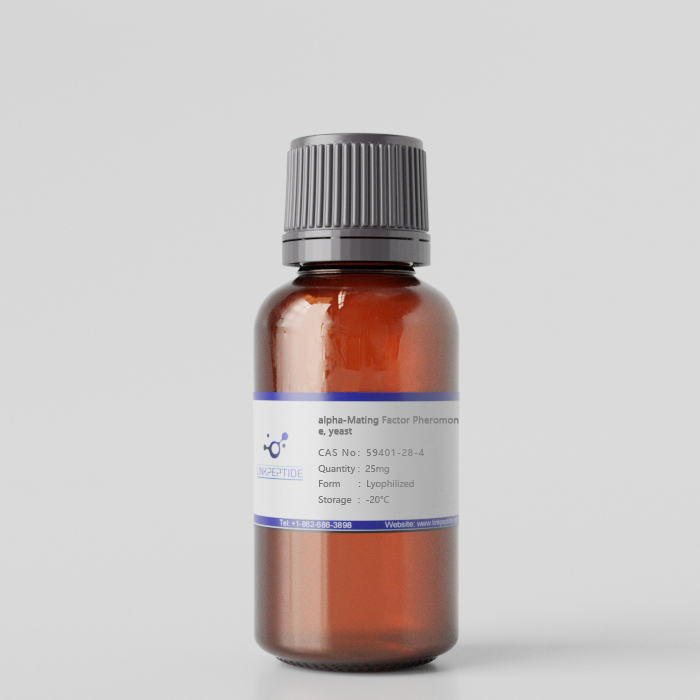
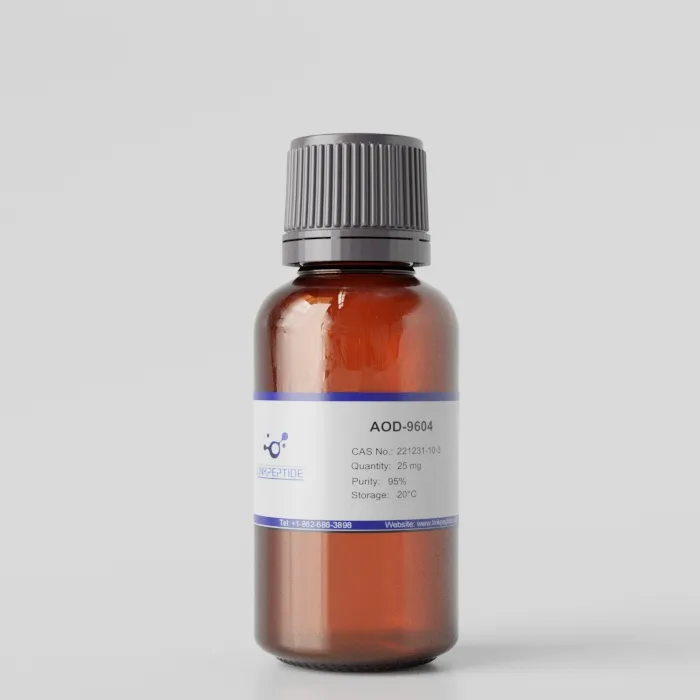
Product Name: alpha-Mating Factor Pheromone, yeast
Sequence One Letter Code: WHWLQLKPGQPMY
Sequence Three Letter Code: H-Trp-His-Trp-Leu-Gln-Leu-Lys-Pro-Gly-Gln-Pro-Met-Tyr-OH
Cas No: 59401-28-4
Chemical Formula:C82H114N20O17S
Molecular Weight: 1684.1
Purity: 95%
Form: Lyophilized
Storage Conditions: - 20 °C
Research Area: Cancer Disease Research
SMILES: CC(C)C[C@@H](C(=O)N[C@@H](CCCCN)C(=O)N1CCC[C@H]1C(=O)NCC(=O)N[C@@H](CCC(=O)N)C(=O)N2CCC[C@H]2C(=O)N[C@@H](CCSC)C(=O)N[C@@H](CC3=CC=C(C=C3)O)C(=O)O)NC(=O)[C@H](CCC(=O)N)NC(=O)[C@H](CC(C)C)NC(=O)[C@H](CC4=CNC5=CC=CC=C54)NC(=O)[C@H](CC6=CN=CN6)NC(=O)[C@H](CC7=CNC8=CC=CC=C87)N
IUPAC: (2S)-2-[[(2S)-2-[[(2S)-1-[(2S)-5-amino-2-[[2-[[(2S)-1-[(2S)-6-amino-2-[[(2S)-2-[[(2S)-5-amino-2-[[(2S)-2-[[(2S)-2-[[(2S)-2-[[(2S)-2-amino-3-(1H-indol-3-yl)propanoyl]amino]-3-(1H-imidazol-5-yl)propanoyl]amino]-3-(1H-indol-3-yl)propanoyl]amino]-4-methylpentanoyl]amino]-5-oxopentanoyl]amino]-4-methylpentanoyl]amino]hexanoyl]pyrrolidine-2-carbonyl]amino]acetyl]amino]-5-oxopentanoyl]pyrrolidine-2-carbonyl]amino]-4-methylsulfanylbutanoyl]amino]-3-(4-hydroxyphenyl)propanoic acid
INCHIKEY: SBKVPJHMSUXZTA-MEJXFZFPSA-N
INCHI:
InChI=1S/C82H114N20O17S/c1-45(2)34-61(98-76(112)63(38-49-41-89-56-17-9-7-15-53(49)56)99-77(113)64(39-50-42-87-44-91-50)96-71(107)54(84)37-48-40-88-55-16-8-6-14-52(48)55)74(110)93-57(25-27-68(85)104)72(108)97-62(35-46(3)4)75(111)95-59(18-10-11-30-83)80(116)101-31-12-19-66(101)78(114)90-43-70(106)92-60(26-28-69(86)105)81(117)102-32-13-20-67(102)79(115)94-58(29-33-120-5)73(109)100-65(82(118)119)36-47-21-23-51(103)24-22-47/h6-9,14-17,21-24,40-42,44-46,54,57-67,88-89,103H,10-13,18-20,25-39,43,83-84H2,1-5H3,(H2,85,104)(H2,86,105)(H,87,91)(H,90,114)(H,92,106)(H,93,110)(H,94,115)(H,95,111)(H,96,107)(H,97,108)(H,98,112)(H,99,113)(H,100,109)(H,118,119)/t54-,57-,58-,59-,60-,61-,62-,63-,64-,65-,66-,67-/m0/s1
Source / Species: yeast
Conjugation: Unconjugated
Code Nacres: NA.26
Application: α-Mating Factor Pheromone is a tridecapeptide produced by Saccharomyces cerevisiae that regulates yeast mating and conjugation. By binding the GPCR Ste2p, it activates a conserved G protein signaling cascade that induces cell cycle arrest and mating-specific gene expression. Because this pathway shares structural and functional similarities with mammalian GPCR systems, α-mating factor serves as a well-established model for studying receptor activation, signal transduction, and GPCR biology in yeast genetics and comparative signaling research.
Current Research: α-Mating Factor Pheromone is a tridecapeptide secreted by Saccharomyces cerevisiae MATα cells that functions as a key regulator of yeast mating and conjugation. This peptide ligand binds specifically to the Ste2p receptor, a plasma membrane–localized G protein–coupled receptor (GPCR) expressed on MATa cells. Engagement of Ste2p initiates a conserved heterotrimeric G protein signaling cascade that culminates in cell cycle arrest, polarized growth, and mating-specific gene expression. Because the yeast pheromone response pathway shares core mechanistic features with mammalian GPCR systems, α-mating factor is widely used as a model ligand in signal transduction, receptor biology, and comparative GPCR research. Biological Function in Yeast Upon secretion, α-mating factor binds Ste2p and activates the associated Gpa1–Ste4–Ste18 heterotrimeric G protein complex. Ligand binding triggers: GDP–GTP exchange on the Gα subunit (Gpa1) Release of Gβγ (Ste4/Ste18) Activation of a MAP kinase cascade (Ste11–Ste7–Fus3/Kss1) Induction of mating-specific transcription factors (e.g., Ste12) This signaling program results in: G1 cell cycle arrest Polarized cell growth (“shmoo” formation) Upregulation of mating genes Cell fusion and diploid formation The pathway represents one of the best-characterized GPCR-mediated signaling systems in eukaryotes. Structural and Signaling Relevance The α-mating factor–Ste2p interaction provides a genetically tractable model for: Ligand–receptor specificity GPCR conformational changes Receptor desensitization and internalization MAPK pathway activation Many signaling components—heterotrimeric G proteins, MAPK cascades, scaffold proteins—are evolutionarily conserved, making this system highly informative for understanding mammalian GPCR mechanisms. Research Applications 1. GPCR Activation Studies α-Mating factor is used to investigate receptor–ligand binding dynamics, receptor mutagenesis effects, and structure–function relationships in Ste2p and engineered GPCR variants. 2. Signal Transduction Analysis The yeast pheromone pathway provides a robust platform for dissecting G protein signaling, MAPK cascade regulation, and transcriptional control mechanisms. 3. Receptor Trafficking and Desensitization Ligand-induced receptor phosphorylation, ubiquitination, and endocytosis can be monitored in response to α-mating factor stimulation. 4. Synthetic Biology and Biosensor Development Engineered yeast strains utilizing the pheromone response pathway are frequently applied in synthetic biology to build GPCR-based biosensors or heterologous receptor expression systems. 5. Comparative Signaling Research Because of structural and functional parallels with mammalian GPCRs, α-mating factor serves as a simplified system for studying conserved signaling principles. Experimental Considerations Effective pathway activation depends on strain background and receptor expression levels. Dose–response studies are recommended to characterize signaling kinetics. Mutant strains lacking specific signaling components can be used to dissect pathway architecture.
Get a Quote
 LinkPeptide