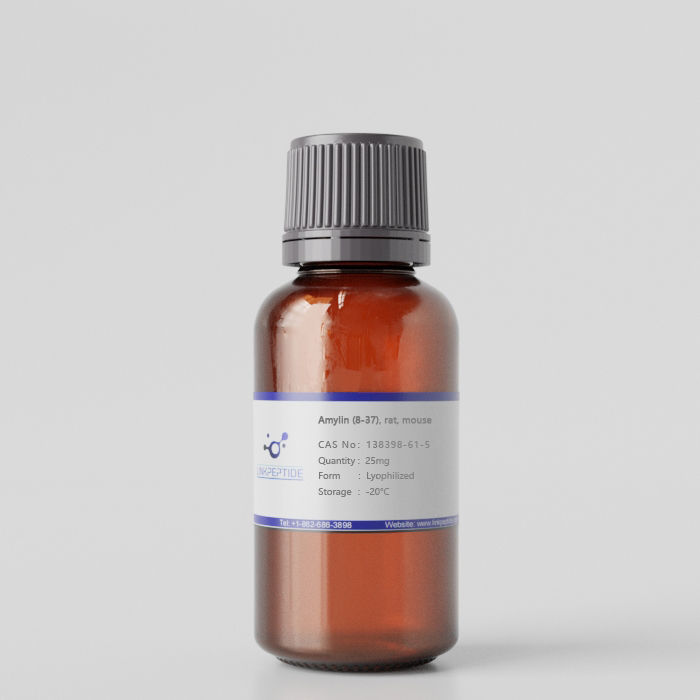
Product Name: Amylin (8-37), rat, mouse
Sequence One Letter Code: ATQRLANFLVRSSNNLGPVLPPTNVGSNTY-NH2
Sequence Three Letter Code: H-Ala-Thr-Gln-Arg-Leu-Ala-Asn-Phe-Leu-Val-Arg-Ser-Ser-Asn-Asn-Leu-Gly-Pro-Val-Leu-Pro-Pro-Thr-Asn-Val-Gly-Ser-Asn-Thr-Tyr-NH2
Cas No: 138398-61-5
Chemical Formula:C140H227N43O43
Molecular Weight: 3200.8
Purity: 95%
Form: Lyophilized
Storage Conditions: - 20 °C
Research Area: Diabetes and Metabolic Syndrome
SMILES: C[C@H]([C@@H](C(=O)N[C@@H](CC(=O)N)C(=O)N[C@@H](C(C)C)C(=O)NCC(=O)N[C@@H](CO)C(=O)N[C@@H](CC(=O)N)C(=O)N[C@@H]([C@@H](C)O)C(=O)N[C@@H](CC1=CC=C(C=C1)O)C(=O)N)NC(=O)[C@@H]2CCCN2C(=O)[C@@H]3CCCN3C(=O)[C@H](CC(C)C)NC(=O)[C@H](C(C)C)NC(=O)[C@@H]4CCCN4C(=O)CNC(=O)[C@H](CC(C)C)NC(=O)[C@H](CC(=O)N)NC(=O)[C@H](CC(=O)N)NC(=O)[C@H](CO)NC(=O)[C@H](CO)NC(=O)[C@H](CCCNC(=N)N)NC(=O)[C@H](C(C)C)NC(=O)[C@H](CC(C)C)NC(=O)[C@H](CC5=CC=CC=C5)NC(=O)[C@H](CC(=O)N)NC(=O)[C@H](C)NC(=O)[C@H](CC(C)C)NC(=O)[C@H](CCCNC(=N)N)NC(=O)[C@H](CCC(=O)N)NC(=O)[C@H]([C@@H](C)O)NC(=O)[C@H](C)N)O
IUPAC: (2S)-N-[(2S)-1-[[(2S)-1-[[(2S)-1-[[(2S)-4-amino-1-[[(2S)-1-[[(2S)-1-[[(2S)-1-[[(2S)-1-[[(2S)-1-[[(2S)-1-[[(2S)-4-amino-1-[[(2S)-4-amino-1-[[(2S)-1-[[2-[(2S)-2-[[(2S)-1-[[(2S)-1-[(2S)-2-[(2S)-2-[[(2S,3R)-1-[[(2S)-4-amino-1-[[(2S)-1-[[2-[[(2S)-1-[[(2S)-4-amino-1-[[(2S,3R)-1-[[(2S)-1-amino-3-(4-hydroxyphenyl)-1-oxopropan-2-yl]amino]-3-hydroxy-1-oxobutan-2-yl]amino]-1,4-dioxobutan-2-yl]amino]-3-hydroxy-1-oxopropan-2-yl]amino]-2-oxoethyl]amino]-3-methyl-1-oxobutan-2-yl]amino]-1,4-dioxobutan-2-yl]amino]-3-hydroxy-1-oxobutan-2-yl]carbamoyl]pyrrolidine-1-carbonyl]pyrrolidin-1-yl]-4-methyl-1-oxopentan-2-yl]amino]-3-methyl-1-oxobutan-2-yl]carbamoyl]pyrrolidin-1-yl]-2-oxoethyl]amino]-4-methyl-1-oxopentan-2-yl]amino]-1,4-dioxobutan-2-yl]amino]-1,4-dioxobutan-2-yl]amino]-3-hydroxy-1-oxopropan-2-yl]amino]-3-hydroxy-1-oxopropan-2-yl]amino]-5-carbamimidamido-1-oxopentan-2-yl]amino]-3-methyl-1-oxobutan-2-yl]amino]-4-methyl-1-oxopentan-2-yl]amino]-1-oxo-3-phenylpropan-2-yl]amino]-1,4-dioxobutan-2-yl]amino]-1-oxopropan-2-yl]amino]-4-methyl-1-oxopentan-2-yl]amino]-5-carbamimidamido-1-oxopentan-2-yl]-2-[[(2S,3R)-2-[[(2S)-2-aminopropanoyl]amino]-3-hydroxybutanoyl]amino]pentanediamide
INCHIKEY: KXIRMGRGEHRNNC-ANJGTFPLSA-N
INCHI:
InChI=1S/C140H227N43O43/c1-62(2)46-81(114(202)156-58-104(198)181-43-25-32-94(181)129(217)177-107(68(13)14)133(221)172-90(49-65(7)8)137(225)183-45-27-34-96(183)138(226)182-44-26-33-95(182)130(218)180-110(73(19)189)136(224)171-89(56-102(147)196)124(212)175-105(66(9)10)131(219)155-57-103(197)158-91(59-184)126(214)170-88(55-101(146)195)125(213)179-109(72(18)188)135(223)162-80(111(148)199)50-75-35-37-76(190)38-36-75)164-121(209)86(53-99(144)193)168-122(210)87(54-100(145)194)169-127(215)92(60-185)174-128(216)93(61-186)173-116(204)78(31-24-42-154-140(151)152)160-132(220)106(67(11)12)176-123(211)83(48-64(5)6)166-119(207)84(51-74-28-21-20-22-29-74)167-120(208)85(52-98(143)192)163-113(201)70(16)157-118(206)82(47-63(3)4)165-115(203)77(30-23-41-153-139(149)150)159-117(205)79(39-40-97(142)191)161-134(222)108(71(17)187)178-112(200)69(15)141/h20-22,28-29,35-38,62-73,77-96,105-110,184-190H,23-27,30-34,39-61,141H2,1-19H3,(H2,142,191)(H2,143,192)(H2,144,193)(H2,145,194)(H2,146,195)(H2,147,196)(H2,148,199)(H,155,219)(H,156,202)(H,157,206)(H,158,197)(H,159,205)(H,160,220)(H,161,222)(H,162,223)(H,163,201)(H,164,209)(H,165,203)(H,166,207)(H,167,208)(H,168,210)(H,169,215)(H,170,214)(H,171,224)(H,172,221)(H,173,204)(H,174,216)(H,175,212)(H,176,211)(H,177,217)(H,178,200)(H,179,213)(H,180,218)(H4,149,150,153)(H4,151,152,154)/t69-,70-,71+,72+,73+,77-,78-,79-,80-,81-,82-,83-,84-,85-,86-,87-,88-,89-,90-,91-,92-,93-,94-,95-,96-,105-,106-,107-,108-,109-,110-/m0/s1
Source / Species: rat
Conjugation: Unconjugated
Code Nacres: NA.26
Application: Amylin (8–37), rat/mouse is a truncated peptide antagonist derived from the native amylin sequence, lacking the N-terminal residues required for receptor activation. This structural modification abolishes intrinsic agonist activity while preserving receptor binding, enabling competitive inhibition of endogenous amylin signaling. In isolated muscle preparations, Amylin (8–37) blocks amylin-induced suppression of glycogen synthesis without affecting basal activity. In vivo studies demonstrate modulation of insulin sensitivity, circulating insulin levels, and lipid metabolism. The peptide is widely employed in metabolic research to investigate amylin receptor pharmacology, insulin resistance mechanisms, and glucose–lipid homeostasis. It provides a defined tool for dissecting amylin-mediated signaling pathways in rodent experimental models of diabetes and metabolic dysfunction.
Current Research: Amylin (8–37), Rat/Mouse Amylin (8–37), rat/mouse is a truncated peptide antagonist derived from the endogenous amylin (islet amyloid polypeptide, IAPP) sequence. By lacking the N-terminal residues required for receptor activation, this fragment retains receptor-binding capability but does not initiate downstream signaling. As a result, Amylin (8–37) functions as a competitive antagonist of endogenous amylin at amylin receptor complexes in rodent systems. This defined structural modification makes it a widely used pharmacological tool for dissecting amylin-mediated metabolic pathways. Amylin Receptor Biology Amylin is co-secreted with insulin from pancreatic β-cells in response to nutrient intake. It acts through receptor complexes composed of the calcitonin receptor (CTR) in association with receptor activity–modifying proteins (RAMP1, RAMP2, or RAMP3), forming functional amylin receptor subtypes. Activation of these receptors primarily stimulates G_s-mediated signaling pathways, increasing intracellular cAMP and influencing metabolic processes in peripheral tissues and the central nervous system. Physiologically, amylin suppresses glucagon secretion, slows gastric emptying, promotes satiety, and modulates skeletal muscle glucose metabolism. In skeletal muscle, amylin signaling can reduce glycogen synthesis under certain conditions, linking it to nutrient partitioning and insulin responsiveness. Mechanism of Antagonism The 8–37 truncation removes key N-terminal residues required for receptor activation while preserving binding affinity for the amylin receptor. This allows Amylin (8–37) to competitively inhibit endogenous amylin without eliciting intrinsic agonist effects. By occupying the receptor, the peptide blocks cAMP-mediated signaling cascades and downstream metabolic responses. In isolated muscle preparations, Amylin (8–37) has been shown to prevent amylin-induced suppression of glycogen synthesis while leaving basal metabolic activity unchanged. This specificity enables clear interpretation of amylin-dependent signaling effects. Applications in Metabolic Research Amylin (8–37), rat/mouse is widely used in metabolic and endocrine research to investigate: Amylin receptor pharmacology Insulin–amylin signaling interactions Regulation of glycogen synthesis in muscle Modulation of hepatic glucose production Effects on insulin sensitivity and glucose uptake In vivo studies in rodent models demonstrate that antagonism of amylin signaling can influence circulating insulin concentrations, lipid metabolism, and whole-body glucose homeostasis. These findings underscore amylin’s role as a modulator of metabolic balance. Role in Insulin Resistance and Diabetes Models Amylin signaling has been implicated in the pathophysiology of insulin resistance and type 2 diabetes. Elevated amylin levels may contribute to altered glucose utilization and dysregulated lipid metabolism in insulin-resistant states. By selectively blocking amylin receptors, Amylin (8–37) provides a defined tool for evaluating the contribution of endogenous amylin to metabolic dysfunction. In experimental diabetes models, this antagonist is used to clarify how amylin influences β-cell function, peripheral insulin action, and energy balance. It also supports studies investigating cross-talk between amylin and other metabolic hormones such as insulin, glucagon, and GLP-1. Experimental Advantages Competitive antagonist with preserved receptor-binding capacity Lack of intrinsic agonist activity Suitable for in vitro muscle and cell-based assays Applicable in rodent in vivo metabolic models Enables differentiation between amylin-dependent and basal metabolic pathways The rat/mouse sequence ensures accurate pharmacological relevance in rodent systems, where receptor subtype expression and ligand sensitivity may differ from human physiology. Research Significance Amylin (8–37), rat/mouse serves as a critical experimental reagent for dissecting amylin receptor signaling and metabolic regulation. By selectively inhibiting endogenous amylin activity, it enables mechanistic investigation of glucose–lipid homeostasis, insulin resistance pathways, and endocrine cross-regulation. Its defined antagonistic profile supports detailed exploration of amylin-mediated processes in rodent models of diabetes and metabolic dysfunction.
Get a Quote
 LinkPeptide


![[Pro3]-GIP (Rat)](https://www.linkpeptide.com/wp-content/uploads/2024/10/Pro3-GIP-Rat-jpg-2.webp "[Pro3]-GIP (Rat)")