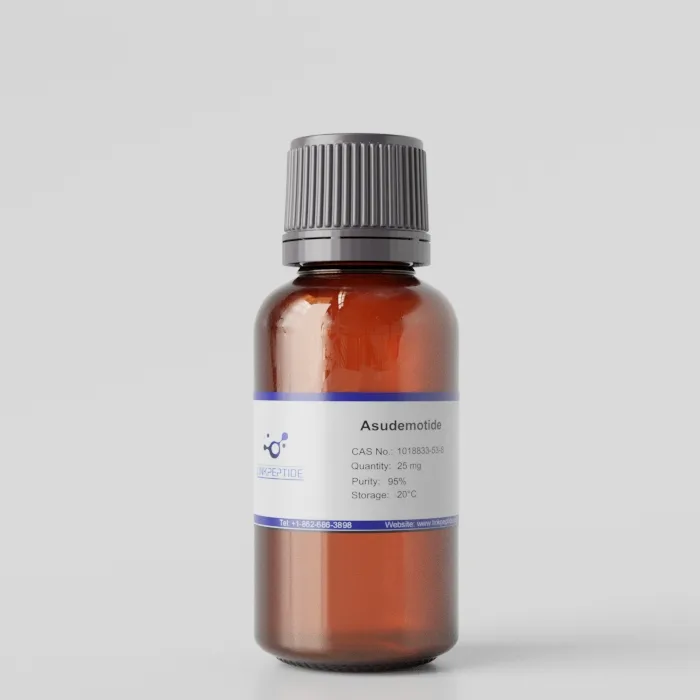
Product Name: Asudemotide
Form: Free base
CAS No: 1018833-53-8
Molar Mass: 1189.31
Chemical Formula: C58H80N10O17
Synonyms: H-DL-Glu-DL-Tyr-DL-Tyr-DL-Glu-DL-Leu-DL-Phe-DL-Val-DL-Asn-DL-xiIle-OH
Storage: Store at -20℃
Sequence: EYYELFVNX
Target: immunostimulant
Application:
Asudemotide (CAS: 1018833-53-8) is a synthetic peptide-based immunomodulator with potential applications in the treatment of autoimmune diseases and cancer. It functions by selectively targeting toll-like receptor 7 (TLR7), a pattern recognition receptor involved in the innate immune response. Activation of TLR7 by asudemotide leads to the production of pro-inflammatory cytokines and chemokines, as well as the activation of antigen-presenting cells and cytotoxic T cells. This immune activation helps to enhance anti-tumor immune responses and modulate the immune system in autoimmune diseases, promoting tolerance or immune-mediated tumor cell death. In pharmaceutical chemistry, asudemotide's targeted modulation of TLR7 represents a novel approach to immunotherapy, offering potential benefits in the treatment of various cancers and autoimmune conditions. Clinical trials are underway to evaluate its safety, efficacy, and therapeutic potential in different disease settings, with the goal of providing new treatment options for patients with unmet medical needs.
Current Research:
Asudemotide is a novel immunotherapy peptide being investigated for its potential to treat autoimmune diseases, particularly autoimmune diabetes and inflammatory conditions. As a peptide derived from the Heat Shock Protein 60 (HSP60), it leverages the body’s natural mechanisms to induce immune tolerance. The peptide specifically targets autoimmune T cells, which play a central role in the destruction of insulin-producing β-cells in Type 1 Diabetes (T1D). By modulating the immune response, Asudemotide may offer a new strategy for halting or preventing the progression of autoimmune diseases and promoting immune tolerance without broad immune suppression.
Mechanism of Action
Asudemotide works by stimulating regulatory T cells (Tregs), which are essential for maintaining immune homeostasis and preventing immune responses against the body’s own tissues. The peptide binds to Major Histocompatibility Complex (MHC) class II molecules on antigen-presenting cells (APCs), leading to the activation of Tregs and the subsequent suppression of autoreactive T cells. This is especially important in diseases like Type 1 Diabetes, where diabetogenic T cells attack the pancreatic β-cells, causing insulin deficiency. Asudemotide helps to restore immune tolerance by reducing the activity of these autoreactive cells and preventing further damage to the β-cells, thereby slowing or halting disease progression.
Indications and Uses
Asudemotide is primarily being studied as a potential treatment for Type 1 Diabetes (T1D), where it aims to stop or slow the autoimmune destruction of insulin-producing cells in the pancreas. Its ability to modulate immune responses also suggests its potential in other autoimmune disorders, such as multiple sclerosis (MS) and rheumatoid arthritis (RA), where the immune system mistakenly targets the body’s own tissues. In T1D, Asudemotide may be particularly beneficial in the early stages of the disease, before extensive β-cell loss has occurred, making it a promising tool for disease prevention or disease-modification in high-risk individuals. Additionally, Asudemotide could be used in combination with other therapies to enhance the effectiveness of treatments aimed at reversing or halting autoimmune damage.
Efficacy and Clinical Benefits
Preclinical studies have demonstrated that Asudemotide has the potential to suppress autoimmune responses and preserve β-cell function in animal models, particularly in Non-Obese Diabetic (NOD) mice, a widely used model for studying Type 1 Diabetes. These studies show that Asudemotide treatment can halt or slow the progression of β-cell destruction, which is a hallmark of Type 1 Diabetes. Clinical trials are currently underway to evaluate its efficacy and safety in humans, with promising preliminary results indicating that the peptide can induce immune tolerance in individuals at risk of developing autoimmune diabetes or in those with early-stage disease. By potentially preserving pancreatic β-cell function, Asudemotide could help reduce the need for insulin therapy and improve long-term metabolic control in patients with Type 1 Diabetes.
Safety and Tolerability
Asudemotide has been shown to have a favorable safety profile in preclinical and early clinical studies. Since it works by modulating the immune system rather than broadly suppressing it, it does not appear to carry the same risks of infection or general immune suppression as traditional immunosuppressive therapies. The most common side effects observed in clinical trials so far have been mild and transient, such as injection site reactions or temporary flu-like symptoms. However, as with any immune-modulating therapy, there is a need for ongoing monitoring of potential immune-related adverse events. Researchers are paying close attention to ensure that Asudemotide does not trigger unwanted immune responses or induce long-term immune system imbalances.
Advantages and Limitations
The major advantage of Asudemotide lies in its targeted immune-modulatory effect, which aims to restore immune tolerance to prevent autoimmune damage without broadly suppressing the immune system. This provides a more specific and potentially safer alternative to traditional immunosuppressive treatments, which can leave patients vulnerable to infections and other complications. Additionally, by targeting the underlying autoimmune response in diseases like Type 1 Diabetes, Asudemotide holds promise as a disease-modifying therapy that could slow or halt disease progression. However, its limitations include the fact that it is still in the early stages of clinical development, and further studies are needed to determine its long-term efficacy, optimal dosing, and best patient populations for treatment. Additionally, as an injectable peptide, its use may be limited by patient compliance and the need for repeated doses.
Future Directions
The future of Asudemotide lies in its continued clinical development and its potential for disease modification in autoimmune diseases like Type 1 Diabetes. Ongoing clinical trials will focus on establishing the peptide’s long-term efficacy, particularly in preserving β-cell function and delaying insulin dependence in individuals with early-stage disease. Additionally, researchers are exploring its potential in combination with other therapies, such as immune checkpoint inhibitors or biologics, to enhance its ability to modify immune responses in a broader range of autoimmune conditions. Asudemotide also holds promise for use in other autoimmune disorders, and its versatility in modulating the immune system may open the door to future applications in a variety of chronic diseases where immune tolerance is disrupted.
Reference:
World Health Organization. (2013). International nonproprietary names for pharmaceutical substances (INN): recommended INN: list 69. WHO Drug Information, 27(1), 41-93.
Get a Quote
 LinkPeptide