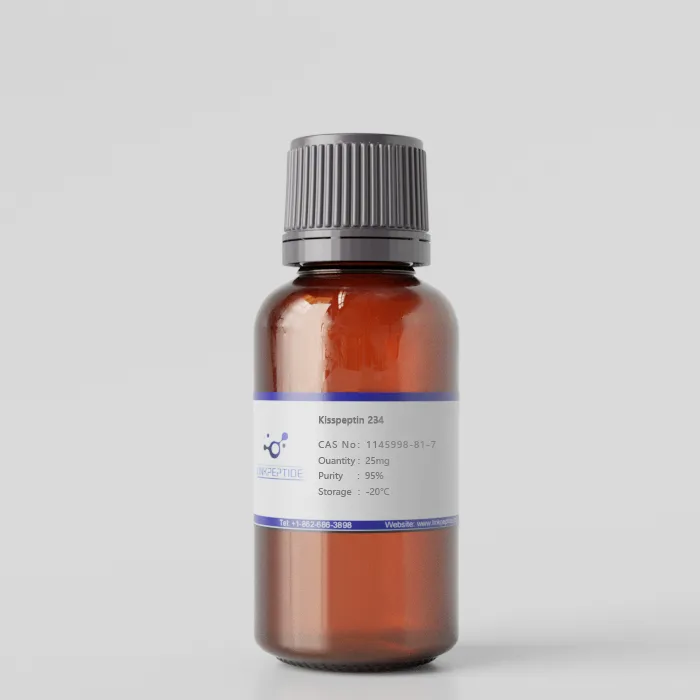
Product Name:Kisspeptin 234
CAS No:1145998-81-7
Purity:95%
Molar Mass:1295.41
Chemical Formula:C63H78N18O13
Storage:Store at -20 degrees Celsius
Sequence:Ac-ANWNGFGWRF-NH2
Target:KISS1, GPR54
Application:Kisspeptin 234 is a synthetic peptide that acts as an antagonist of the Kiss1 receptor (Kiss1R), also known as GPR54. This peptide plays a crucial role in regulating the hypothalamic-pituitary-gonadal (HPG) axis, which is vital for reproductive function. By inhibiting the activity of Kisspeptin signaling, Kisspeptin 234 can be used to explore the mechanisms behind puberty onset, fertility, and the modulation of gonadotropin-releasing hormone (GnRH) secretion. Researchers employ Kisspeptin 234 in studies related to reproductive endocrinology and fertility treatments, as well as in the investigation of reproductive disorders.
Current Research:
Kisspeptin 234 (Kp-234) is a synthetic peptide that functions as a potent antagonist of the kisspeptin receptor, GPR54 (also known as KISS1R). By inhibiting the binding and activity of endogenous kisspeptins, Kp-234 serves as a valuable tool in elucidating the physiological roles of the kisspeptin signaling pathway, particularly in reproductive endocrinology and related fields.
Mechanism of Action
Kp-234 competitively binds to GPR54, effectively blocking the receptor's interaction with natural kisspeptins. This inhibition disrupts downstream signaling cascades, notably the release of gonadotropin-releasing hormone (GnRH) and subsequent secretion of luteinizing hormone (LH) and follicle-stimulating hormone (FSH). Such modulation allows researchers to investigate the specific contributions of kisspeptin-GPR54 interactions in various physiological processes.
Applications in Research
Reproductive Physiology: Administration of Kp-234 has been shown to delay puberty onset in animal models by inhibiting kisspeptin-induced GnRH release. This effect underscores the critical role of kisspeptin signaling in initiating reproductive maturity.
Endocrine Studies: Kp-234 is utilized to assess the influence of kisspeptin on hormonal secretions, providing insights into the regulatory mechanisms governing the hypothalamic-pituitary-gonadal axis.
Pathophysiological Investigations: Research indicates that Kp-234 can modulate fibrotic pathways. For instance, in models of uremic cardiomyopathy, Kp-234 administration was associated with the activation of fibrotic TGF-β-mediated pathways, suggesting its potential involvement in fibrotic disease progression.
Pharmacological Profile
Kp-234 exhibits high affinity for GPR54, effectively inhibiting kisspeptin-induced inositol phosphate production with an IC₅₀ of approximately 7 nM. Its specificity and potency make it a reliable antagonist for in vitro and in vivo studies.
Conclusion
Kisspeptin 234 is a crucial antagonist in the study of kisspeptin signaling, offering significant insights into reproductive endocrinology and potential therapeutic targets for related disorders. Its application continues to advance our understanding of the complex regulatory mechanisms underlying human physiology.
Reference:
Get a Quote
 LinkPeptide