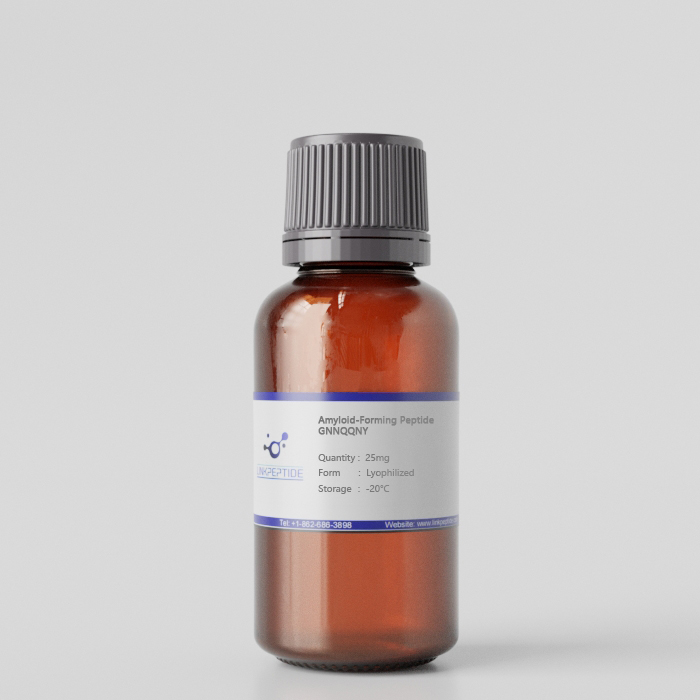
Product Name: Amyloid-Forming Peptide GNNQQNY
Sequence One Letter Code: GNNQQNY
Sequence Three Letter Code: H-Gly-Asn-Asn-Gln-Gln-Asn-Tyr-OH
Chemical Formula:C33H48N12O14
Molecular Weight: 836.9
Purity: 95%
Form: Lyophilized
Storage Conditions: - 20 °C
Research Area: Neurological Disease Research
Source / Species: yeast
Conjugation: Unconjugated
Code Nacres: NA.26
Application: GNNQQNY is a synthetic heptapeptide derived from the prion-forming domain of the yeast Sup35 protein and serves as a benchmark model for amyloid research. Owing to its minimal sequence and strong intrinsic aggregation propensity, GNNQQNY spontaneously self-assembles into highly ordered amyloid fibrils under defined experimental conditions. These fibrils exhibit well-resolved atomic structures and characteristic cross-β sheet architecture, enabling precise structural interrogation by X-ray crystallography, solid-state NMR, and cryo-EM. Notably, GNNQQNY can adopt both parallel and antiparallel β-sheet arrangements, providing a versatile system for dissecting conformational polymorphism and aggregation pathways. Its reproducible fibrillation kinetics and structural simplicity make it particularly valuable for mechanistic studies of nucleation, elongation, and early oligomer formation. As a result, GNNQQNY is extensively employed in biophysical, biochemical, and computational investigations aimed at elucidating the molecular basis of protein misfolding and amyloid-associated neurodegenerative disorders.
Current Research: Amyloid aggregation is a hallmark of many neurodegenerative disorders, including Alzheimer’s disease, Parkinson’s disease, and prion diseases. Understanding the molecular mechanisms underlying amyloid formation remains a central objective in modern protein misfolding research. Among the model systems developed to investigate these processes, the synthetic heptapeptide GNNQQNY, derived from the prion-forming domain of the yeast Sup35 protein, has emerged as one of the most extensively studied minimal amyloid-forming sequences. Due to its short length, well-defined aggregation behavior, and ability to form highly ordered fibrillar assemblies, GNNQQNY continues to serve as a benchmark model in contemporary amyloid research. Recent structural studies have leveraged GNNQQNY to elucidate the fundamental architecture of amyloid fibrils at atomic resolution. Early crystallographic analyses revealed that the peptide forms steric zipper structures, in which β-strands align into tightly interdigitated sheets stabilized by extensive hydrogen bonding and side-chain interactions. Advances in cryo-electron microscopy (cryo-EM) and solid-state NMR spectroscopy have further refined these structural insights, confirming the presence of the characteristic cross-β sheet architecture that defines amyloid fibrils. These studies demonstrate that the peptide backbone organizes into β-strands perpendicular to the fibril axis, while hydrogen bonding occurs parallel to the fibril direction, producing highly stable fibrillar assemblies. One area of active investigation involves structural polymorphism in amyloid fibrils. GNNQQNY is particularly valuable in this context because it can adopt both parallel and antiparallel β-sheet configurations, depending on environmental conditions such as pH, temperature, and ionic strength. This structural adaptability allows researchers to probe how subtle changes in molecular packing influence fibril morphology, stability, and growth kinetics. Understanding polymorphism is especially relevant to neurodegenerative diseases, where distinct amyloid conformations are believed to correlate with different disease phenotypes and pathological outcomes. Another important research focus centers on the nucleation-dependent polymerization mechanism of amyloid formation. Like many amyloidogenic peptides, GNNQQNY exhibits a characteristic sigmoidal aggregation profile consisting of a lag phase, rapid fibril growth, and a plateau stage. Researchers frequently use this system to investigate the early events that trigger nucleation, including the formation of transient oligomeric intermediates. These early aggregates are of particular interest because they are often associated with cellular toxicity in amyloid-related diseases. By monitoring fibrillation kinetics through techniques such as Thioflavin T fluorescence assays, dynamic light scattering, and atomic force microscopy, scientists can quantify how factors such as peptide concentration, solvent composition, and molecular chaperones influence nucleation rates. Computational modeling has also become an important component of current GNNQQNY research. Molecular dynamics simulations and coarse-grained modeling approaches are widely used to examine how the peptide transitions from monomeric states to oligomeric assemblies and ultimately to mature fibrils. Because the sequence is short and structurally well characterized, GNNQQNY serves as an ideal test system for validating computational models of amyloid formation. These simulations have provided valuable insights into hydrogen-bonding networks, side-chain packing interactions, and the energetic landscape that governs fibril assembly. Beyond fundamental mechanistic studies, GNNQQNY is increasingly used as a model platform for screening aggregation inhibitors and evaluating therapeutic strategies aimed at preventing amyloid formation. Small molecules, peptides, and molecular chaperones can be assessed for their ability to disrupt fibril nucleation or elongation in controlled experimental settings. Such studies help identify potential lead compounds that may ultimately inform drug discovery efforts targeting protein misfolding diseases. In summary, GNNQQNY remains a cornerstone model in amyloid research due to its minimal sequence, reproducible aggregation behavior, and well-resolved structural features. Ongoing studies continue to exploit this peptide to unravel the molecular principles governing amyloid formation, structural polymorphism, and aggregation kinetics. Insights derived from GNNQQNY systems not only advance the fundamental understanding of protein self-assembly but also contribute to broader efforts aimed at developing therapeutic interventions for amyloid-associated neurodegenerative disorders.
Get a Quote
 LinkPeptide

![LEIUROTOXIN I [R7]-](https://www.linkpeptide.com/wp-content/uploads/2024/10/LEIUROTOXIN-I-R7-jpg-2.webp "LEIUROTOXIN I [R7]-")