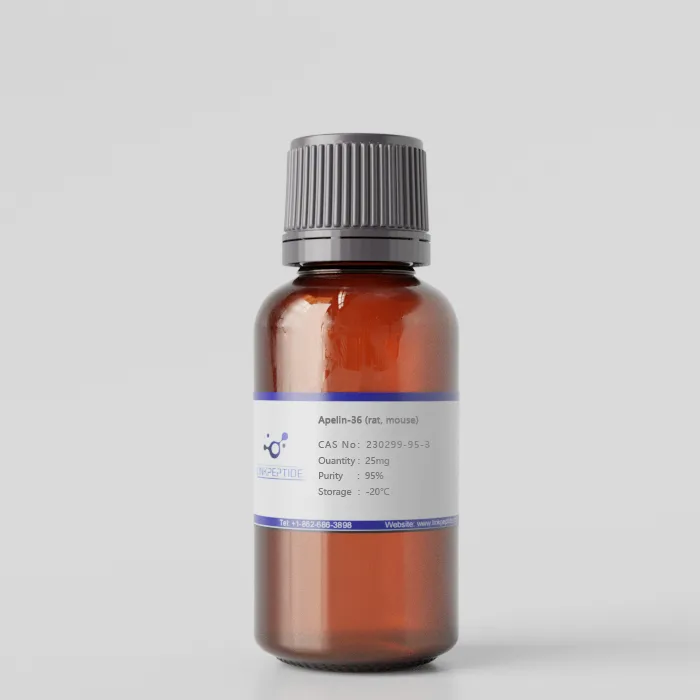
Product Name: Angiotensin III
Sequence One Letter Code: RVYIHPF
Sequence Three Letter Code: H-Arg-Val-Tyr-Ile-His-Pro-Phe-OH
Cas No: 13602-53-4
Chemical Formula:C46H66N12O9
Molecular Weight: 931.1
Purity: 95%
Form: Lyophilized
Storage Conditions: - 20 °C
Research Area: Cardiovascular Disease Research
SMILES: CC[C@H](C)[C@@H](C(=O)N[C@@H](CC1=CN=CN1)C(=O)N2CCC[C@H]2C(=O)N[C@@H](CC3=CC=CC=C3)C(=O)O)NC(=O)[C@H](CC4=CC=C(C=C4)O)NC(=O)[C@H](C(C)C)NC(=O)[C@H](CCCN=C(N)N)N
IUPAC: (2S)-2-[[(2S)-1-[(2S)-2-[[(2S,3S)-2-[[(2S)-2-[[(2S)-2-[[(2S)-2-amino-5-(diaminomethylideneamino)pentanoyl]amino]-3-methylbutanoyl]amino]-3-(4-hydroxyphenyl)propanoyl]amino]-3-methylpentanoyl]amino]-3-(1H-imidazol-5-yl)propanoyl]pyrrolidine-2-carbonyl]amino]-3-phenylpropanoic acid
INCHIKEY: QMMRCKSBBNJCMR-KMZPNFOHSA-N
INCHI:
InChI=1S/C46H66N12O9/c1-5-27(4)38(57-40(61)33(21-29-15-17-31(59)18-16-29)53-42(63)37(26(2)3)56-39(60)32(47)13-9-19-51-46(48)49)43(64)54-34(23-30-24-50-25-52-30)44(65)58-20-10-14-36(58)41(62)55-35(45(66)67)22-28-11-7-6-8-12-28/h6-8,11-12,15-18,24-27,32-38,59H,5,9-10,13-14,19-23,47H2,1-4H3,(H,50,52)(H,53,63)(H,54,64)(H,55,62)(H,56,60)(H,57,61)(H,66,67)(H4,48,49,51)/t27-,32-,33-,34-,35-,36-,37-,38-/m0/s1
Source / Species: mouse
Conjugation: Unconjugated
Code Nacres: NA.26
Application: Angiotensin III (RVYIHPF) is a bioactive heptapeptide generated from angiotensin II by aminopeptidase A–mediated N-terminal cleavage. Within the central nervous system, angiotensin III functions as a principal effector of the brain renin–angiotensin system, contributing to vasopressin release and regulation of fluid balance and blood pressure. It interacts with angiotensin receptors to mediate neuroendocrine and cardiovascular signaling. Angiotensin III is widely used in cardiovascular and neurobiology research to examine central RAS activity, peptide metabolism, and receptor-specific signaling pathways. The peptide supports mechanistic studies of blood pressure control, hormone secretion, and neurogenic regulation of cardiovascular homeostasis in experimental models.
Current Research: Angiotensin III (RVYIHPF) is a bioactive heptapeptide generated from angiotensin II through aminopeptidase A–mediated removal of the N-terminal aspartate residue. As a metabolite within the renin–angiotensin system (RAS), angiotensin III retains significant biological activity and plays a prominent role in central and peripheral cardiovascular regulation. In the brain, it is considered a principal effector peptide of the central RAS, contributing to neuroendocrine control of blood pressure and fluid homeostasis. Formation and Metabolic Pathway Within the classical RAS cascade, angiotensinogen is cleaved by renin to form angiotensin I, which is then converted to angiotensin II by angiotensin-converting enzyme (ACE). Angiotensin II can subsequently be processed by aminopeptidase A to generate angiotensin III (Ang III). Further cleavage by aminopeptidase N produces angiotensin IV. The conversion of angiotensin II to angiotensin III is not merely degradative; Ang III remains biologically active and, in certain central contexts, may be the dominant mediator of angiotensin-dependent effects. Receptor Interactions and Signaling Angiotensin III interacts primarily with angiotensin type 1 (AT1) and type 2 (AT2) receptors, both of which are class A G protein–coupled receptors. Activation of AT1 receptors triggers signaling pathways involving G_q protein coupling, phospholipase C activation, inositol trisphosphate (IP₃) production, intracellular calcium mobilization, and protein kinase C (PKC) activation. These cascades regulate vasoconstriction, hormone secretion, and sympathetic nervous system activity. In the central nervous system, Ang III–AT1 receptor signaling contributes to: Vasopressin (antidiuretic hormone) release Sympathetic tone modulation Thirst regulation Sodium appetite AT2 receptor engagement may mediate distinct signaling pathways, including nitric oxide production and counter-regulatory vascular effects. Role in Central Renin–Angiotensin System The brain RAS operates independently from the systemic circulation and influences neurogenic blood pressure control. Angiotensin III has been identified as a critical mediator of central pressor responses. Experimental evidence suggests that inhibition of aminopeptidase A, which blocks Ang III formation, attenuates centrally mediated hypertensive responses. By influencing hypothalamic and brainstem nuclei, Ang III regulates neuroendocrine outputs that modulate cardiovascular and fluid balance homeostasis. Applications in Cardiovascular and Neurobiology Research Angiotensin III is widely used in: Central microinjection studies in rodent models Vasopressin secretion assays Blood pressure regulation experiments Receptor pharmacology and antagonist profiling Peptide metabolism and enzyme specificity studies Its defined heptapeptide structure enables controlled investigation of receptor-specific responses relative to angiotensin II and angiotensin IV. Mechanistic Studies of Blood Pressure Regulation Because Ang III can replicate many pressor and neuroendocrine effects of angiotensin II in the brain, it supports mechanistic analysis of: Central AT1 receptor signaling Neurogenic hypertension models Hormone secretion dynamics Fluid and electrolyte regulation Comparative studies between Ang II and Ang III help clarify the functional hierarchy of angiotensin peptides within central regulatory circuits. Experimental Advantages Defined active metabolite of angiotensin II Retains high affinity for angiotensin receptors Suitable for central and peripheral experimental models Enables enzyme pathway and receptor subtype analysis Supports translational research in hypertension Research Significance Angiotensin III (RVYIHPF) serves as a critical tool for dissecting the functional complexity of the renin–angiotensin system. By acting as a key effector peptide within the central RAS, it supports detailed investigation of neuroendocrine signaling, vasopressin regulation, and cardiovascular homeostasis. Its use in experimental models advances understanding of blood pressure control mechanisms and peptide metabolism in both physiological and pathological conditions.
Get a Quote
 LinkPeptide

![Lys-[Des-Arg9]Bradykinin](https://www.linkpeptide.com/wp-content/uploads/2024/10/Lys-Des-Arg9Bradykinin-jpg-3.webp "Lys-[Des-Arg9]Bradykinin")