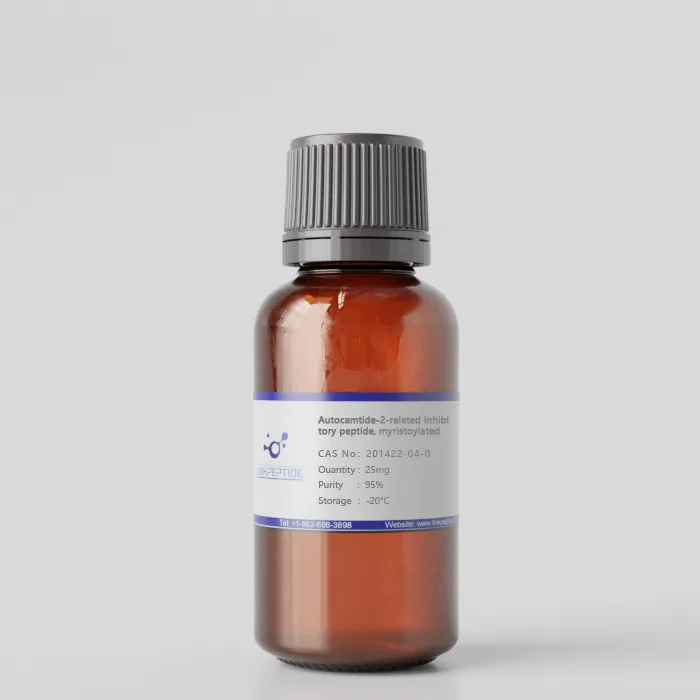
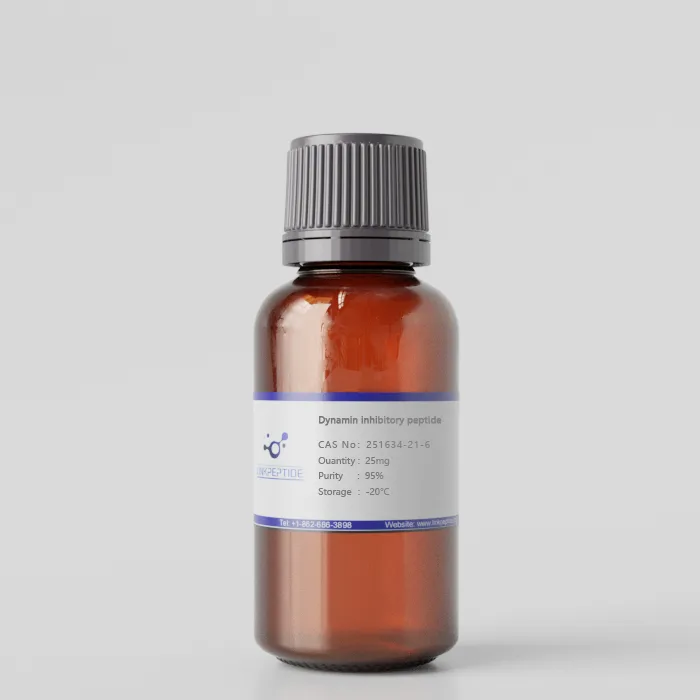
Product Name:Autocamtide-2-related inhibitory peptide, myristoylated
CAS No:201422-04-0
Purity:95%
Molar Mass:1708.1
Chemical Formula:C78H142N22O20
Storage:Store at -20 degrees Celsius
Sequence:KKALRRQEAVDAL
Target:CaMKII
Application:
Autocamtide-2-related inhibitory peptide, myristoylated (AIP) is a potent and selective inhibitor of Ca2+/calmodulin-dependent protein kinase II (CaMKII). This enzyme is crucial in regulating cellular functions such as synaptic plasticity, memory formation, and muscle contraction. The myristoylated version of AIP enhances cell permeability, enabling it to effectively inhibit CaMKII activity inside cells. AIP is widely used in research to study the role of CaMKII in various physiological processes, including cardiac function and neurobiology. It is particularly valuable for investigating conditions like cardiac hypertrophy, neurodegenerative diseases, and cognitive disorders, where dysregulated CaMKII activity plays a significant role.
Current Research:
Autocamtide-2-related inhibitory peptide, myristoylated (also known as Myr-AIP), is a synthetic, cell-permeable peptide that serves as a potent and specific inhibitor of calmodulin-dependent protein kinase II (CaMKII). The myristoylation enhances its ability to cross cell membranes, thereby increasing its efficacy in intracellular environments. Mechanism of Action Myr-AIP inhibits CaMKII by mimicking the autoinhibitory domain of the kinase, thereby preventing its activation. It exhibits an IC50 of approximately 40 nM, indicating high potency. Notably, Myr-AIP demonstrates selectivity for CaMKII over other kinases such as protein kinase C (PKC) and cAMP-dependent protein kinase (PKA), making it a valuable tool for studying CaMKII-specific signaling pathways. Research Applications Due to its specificity and cell permeability, Myr-AIP is widely used in research to investigate the physiological and pathological roles of CaMKII. It has been employed in studies exploring synaptic plasticity, learning and memory, cardiac function, and various neurological disorders. For instance, pretreatment with Myr-AIP has been shown to block the reinstatement of morphine-seeking behavior in vivo, highlighting its potential in addiction research. Handling and Storage Myr-AIP is typically supplied as a lyophilized powder and should be stored at -20 degrees Celsius to maintain stability. Upon reconstitution, aliquots should be prepared to avoid repeated freeze-thaw cycles, which can degrade the peptide. It is recommended to handle the peptide under conditions that minimize exposure to moisture and light. Conclusion Autocamtide-2-related inhibitory peptide, myristoylated, is a crucial tool in biomedical research for dissecting CaMKII-related signaling pathways. Its high specificity, potency, and enhanced cell permeability make it indispensable for studies aiming to understand the diverse roles of CaMKII in cellular function and disease.
Reference:
Get a Quote
 LinkPeptide