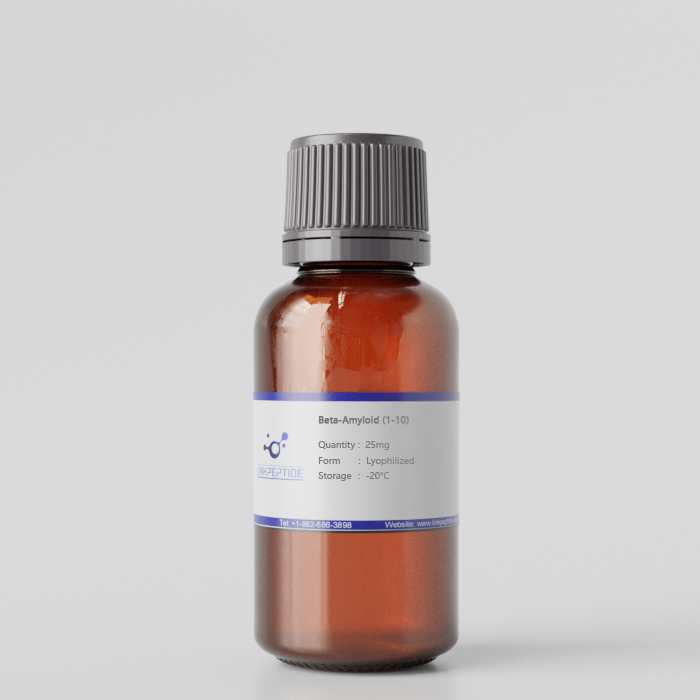
Product Name: Beta-Amyloid (1-10)
Sequence One Letter Code: DAEFRHDSGY
Sequence Three Letter Code: H-Asp-Ala-Glu-Phe-Arg-His-Asp-Ser-Gly-Tyr-OH
Chemical Formula:C51H69N15O19
Molecular Weight: 1196.3
Purity: 95%
Form: Lyophilized
Storage Conditions: - 20 °C
Research Area: Alzheimer's Disease
Source / Species: human
Conjugation: Unconjugated
Code Nacres: NA.26
Application: β-Amyloid (1–10) is a synthetic peptide corresponding to the N-terminal residues of the human amyloid-β protein. This region contains antigenic and hydrophilic determinants involved in early molecular interactions but lacks the hydrophobic C-terminal domain responsible for rapid fibril formation. Because of its improved solubility and reduced aggregation tendency, the fragment is commonly used to investigate early amyloid interactions and antibody recognition without the complications associated with extensive fibril formation. The peptide is widely applied in Alzheimer’s disease research, particularly in studies of epitope mapping, antibody binding, and immunogenicity. It also supports biochemical assays examining sequence-specific contributions to amyloid structure and molecular recognition.
Current Research: Introduction to N-Terminal Amyloid-β Fragments Amyloid-β (Aβ) peptides are central to the molecular pathology of Alzheimer’s disease and are widely studied for their role in aggregation, plaque formation, and neuronal dysfunction. These peptides originate from proteolytic processing of the amyloid precursor protein (APP) and can assemble into oligomers and fibrillar structures associated with neurodegenerative pathology. To better understand the sequence determinants that influence amyloid behavior, researchers often analyze shorter fragments representing specific functional regions of the full peptide. β-Amyloid (1–10) corresponds to the N-terminal residues of the human amyloid-β sequence and retains key structural and antigenic features while excluding the hydrophobic C-terminal region responsible for rapid fibril formation. Structural Characteristics of the β-Amyloid (1–10) Fragment The N-terminal region of amyloid-β contains several hydrophilic and antigenic determinants that participate in molecular recognition and early peptide interactions. In the β-Amyloid (1–10) fragment, these residues remain intact, preserving the sequence elements involved in antibody recognition and early binding interactions. Unlike longer amyloid fragments such as Aβ1–40 or Aβ1–42, the 1–10 segment lacks the aggregation-prone C-terminal domain that promotes β-sheet formation and fibrillogenesis. As a result, this peptide displays improved solubility and reduced aggregation tendency in experimental systems. Because it avoids rapid fibril formation, β-Amyloid (1–10) provides a useful model for investigating molecular interactions involving the N-terminal region without interference from extensive aggregation. Applications in Epitope Mapping and Antibody Recognition One of the most common uses of the β-Amyloid (1–10) peptide is in epitope mapping and antibody binding studies. The N-terminal portion of amyloid-β contains epitopes recognized by a number of antibodies used in diagnostic and therapeutic research. Synthetic peptides representing this region allow researchers to evaluate antibody specificity, binding affinity, and recognition patterns. By isolating the N-terminal segment, scientists can identify which residues contribute most strongly to antibody interactions and immune recognition. These studies play an important role in the development and validation of antibodies targeting amyloid-β peptides. Investigating Early Amyloid–Protein Interactions In addition to immunological applications, β-Amyloid (1–10) supports research into early molecular interactions involving amyloid peptides. The N-terminal domain participates in interactions with proteins, metal ions, and other biological molecules that can influence amyloid behavior. Because the peptide remains relatively soluble and does not rapidly form fibrils, it allows researchers to study sequence-specific interactions independent of mature amyloid aggregation. This makes it useful for experiments examining the initial steps of amyloid recognition and molecular association. Such studies contribute to understanding how early interactions may influence later stages of amyloid assembly. Applications in Alzheimer’s Disease Research The β-Amyloid (1–10) fragment is widely used in Alzheimer’s disease research, particularly in studies focused on immune recognition and biochemical characterization of amyloid peptides. Its defined length and improved solubility make it a convenient tool for examining antigenic properties of the amyloid N-terminus. Researchers frequently incorporate this peptide into immunogenicity studies, antibody binding assays, and biochemical analyses aimed at identifying the structural features responsible for amyloid recognition. These experiments help clarify how specific regions of the amyloid-β sequence contribute to molecular interactions relevant to neurodegenerative disease. Studying Sequence-Specific Contributions to Amyloid Structure Short peptides such as β-Amyloid (1–10) are valuable for dissecting sequence-specific contributions to amyloid structure and function. By focusing on a defined segment of the peptide, researchers can determine how individual residues influence molecular recognition and structural behavior. This approach enables controlled investigation of amyloid properties without the complexity of full-length peptides that rapidly assemble into fibrils. Conclusion β-Amyloid (1–10) is a synthetic N-terminal fragment of the amyloid-β peptide that preserves key hydrophilic and antigenic determinants while lacking the aggregation-prone C-terminal region. Its improved solubility and reduced aggregation tendency make it particularly useful for epitope mapping, antibody binding assays, and studies of early amyloid interactions. Widely applied in Alzheimer’s disease research, the peptide supports biochemical and immunological investigations exploring amyloid recognition, molecular interactions, and sequence-specific determinants of amyloid structure. By enabling focused analysis of the amyloid N-terminal region, β-Amyloid (1–10) remains an important reagent for studying amyloid biology and immune responses associated with neurodegenerative disease.
Get a Quote
 LinkPeptide

![[Phe1Ψ(CH2-NH)Gly2]Nociceptin(1-13)NH2](https://www.linkpeptide.com/wp-content/uploads/2024/10/Phe1¶aCH2-NHGly2Nociceptin1-13NH2-jpg.webp "[Phe1Ψ(CH2-NH)Gly2]Nociceptin(1-13)NH2")
![SCYLLATOXIN [Tyr2]-](https://www.linkpeptide.com/wp-content/uploads/2024/10/SCYLLATOXIN-Tyr2-jpg-2.webp "SCYLLATOXIN [Tyr2]-")