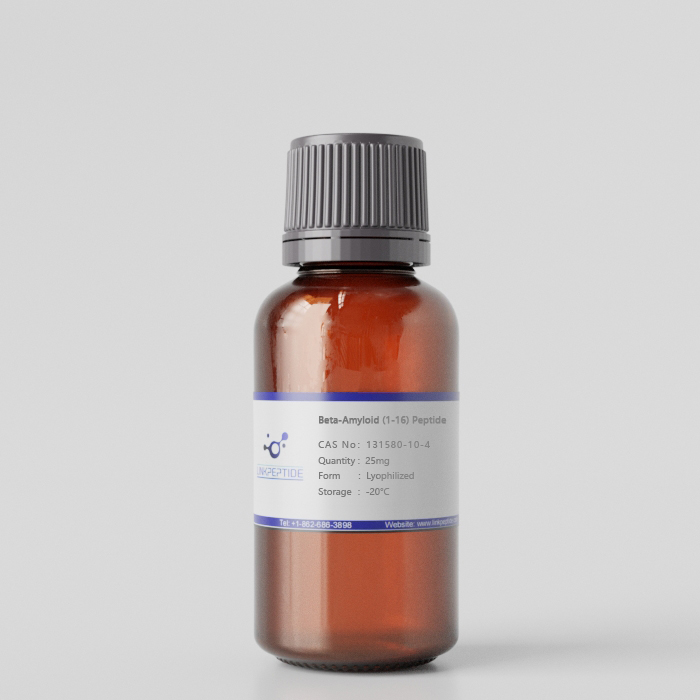
Product Name: Beta-Amyloid (1-16) Peptide
Sequence One Letter Code: DAEFRHDSGYEVHHQK
Sequence Three Letter Code: H-Asp-Ala-Glu-Phe-Arg-His-Asp-Ser-Gly-Tyr-Glu-Val-His-His-Gln-Lys-OH
Cas No: 131580-10-4
Chemical Formula:C84H119N27O28
Molecular Weight: 1955.1
Purity: 95%
Form: Lyophilized
Storage Conditions: - 20 °C
Research Area: Alzheimer's Disease
SMILES: CC(C)C(C(=O)NC(CC1=CNC=N1)C(=O)NC(CC2=CNC=N2)C(=O)NC(CCC(=O)N)C(=O)NC(CCCCN)C(=O)O)NC(=O)C(CCC(=O)O)NC(=O)C(CC3=CC=C(C=C3)O)NC(=O)CNC(=O)C(CO)NC(=O)C(CC(=O)O)NC(=O)C(CC4=CNC=N4)NC(=O)C(CCCNC(=N)N)NC(=O)C(CC5=CC=CC=C5)NC(=O)C(CCC(=O)O)NC(=O)C(C)NC(=O)C(CC(=O)O)N
IUPAC: 6-amino-2-[[5-amino-2-[[2-[[2-[[2-[[2-[[2-[[2-[[2-[[2-[[2-[[2-[[2-[[2-[2-[(2-amino-3-carboxypropanoyl)amino]propanoylamino]-4-carboxybutanoyl]amino]-3-phenylpropanoyl]amino]-5-carbamimidamidopentanoyl]amino]-3-(1H-imidazol-4-yl)propanoyl]amino]-3-carboxypropanoyl]amino]-3-hydroxypropanoyl]amino]acetyl]amino]-3-(4-hydroxyphenyl)propanoyl]amino]-4-carboxybutanoyl]amino]-3-methylbutanoyl]amino]-3-(1H-imidazol-4-yl)propanoyl]amino]-3-(1H-imidazol-4-yl)propanoyl]amino]-5-oxopentanoyl]amino]hexanoic acid
INCHIKEY: PKSRFXGDLPWBBS-UHFFFAOYSA-N
INCHI:
InChI=1S/C84H119N27O28/c1-41(2)68(82(137)109-59(30-47-35-92-40-97-47)80(135)107-57(28-45-33-90-38-95-45)78(133)102-51(18-21-62(87)114)73(128)104-54(83(138)139)12-7-8-24-85)111-75(130)53(20-23-65(118)119)103-76(131)55(27-44-14-16-48(113)17-15-44)99-63(115)36-94-71(126)61(37-112)110-81(136)60(32-67(122)123)108-79(134)58(29-46-34-91-39-96-46)106-72(127)50(13-9-25-93-84(88)89)101-77(132)56(26-43-10-5-4-6-11-43)105-74(129)52(19-22-64(116)117)100-69(124)42(3)98-70(125)49(86)31-66(120)121/h4-6,10-11,14-17,33-35,38-42,49-61,68,112-113H,7-9,12-13,18-32,36-37,85-86H2,1-3H3,(H2,87,114)(H,90,95)(H,91,96)(H,92,97)(H,94,126)(H,98,125)(H,99,115)(H,100,124)(H,101,132)(H,102,133)(H,103,131)(H,104,128)(H,105,129)(H,106,127)(H,107,135)(H,108,134)(H,109,137)(H,110,136)(H,111,130)(H,116,117)(H,118,119)(H,120,121)(H,122,123)(H,138,139)(H4,88,89,93)
Source / Species: human
Conjugation: Unconjugated
Code Nacres: NA.26
Application: Beta-Amyloid (1–16) represents the N-terminal region of the amyloid-β peptide and plays a critical role in metal ion binding and oxidative chemistry. Histidine residues within this sequence coordinate metal ions such as Cu²⁺ and Zn²⁺, which are abundant in amyloid plaques. These interactions contribute to reactive oxygen species generation, oxidative stress, and peptide modification. Aβ (1–16) is widely used to study metal-dependent toxicity, redox biology, and mechanisms of oxidative damage in neurodegeneration. It provides a focused model for investigating how metal binding influences amyloid behavior, aggregation, and protein oxidation processes associated with Alzheimer’s disease.
Current Research: β-Amyloid (1–16) represents the N-terminal segment of the full-length amyloid-β peptide and is a critical region responsible for metal ion coordination and redox activity. Although shorter than aggregation-prone isoforms such as Aβ (1–42), this fragment plays a central role in metal-dependent biochemical processes that contribute to oxidative stress and neurodegeneration in Alzheimer’s disease (AD). Because of its well-defined metal-binding properties, Aβ (1–16) is widely used as a focused model for studying metal–peptide interactions, redox chemistry, and oxidative damage mechanisms. Structural Features and Metal-Binding Properties The Aβ (1–16) sequence contains multiple histidine residues (His6, His13, His14) that serve as key ligands for coordinating metal ions. These residues enable the peptide to bind biologically relevant transition metals such as: Copper (Cu²⁺) Zinc (Zn²⁺) Iron (Fe³⁺/Fe²⁺) These metal ions are found at elevated concentrations in amyloid plaques and are thought to play an important role in modulating amyloid behavior and toxicity. The coordination of metal ions by Aβ (1–16) forms stable complexes that influence both peptide conformation and chemical reactivity. Role in Redox Chemistry and Oxidative Stress One of the most significant consequences of metal binding to Aβ (1–16) is the promotion of redox reactions. In particular, copper-bound Aβ can participate in redox cycling between Cu²⁺ and Cu⁺, leading to the generation of reactive oxygen species (ROS). These processes can result in: Production of hydrogen peroxide (H₂O₂) Formation of hydroxyl radicals (•OH) Oxidative modification of proteins, lipids, and nucleic acids The accumulation of ROS contributes to oxidative stress, a major factor in neuronal damage and disease progression in Alzheimer’s disease. Influence on Amyloid Behavior and Aggregation Although Aβ (1–16) does not form fibrils on its own like longer isoforms, its interaction with metal ions can influence the behavior of full-length amyloid peptides. Metal binding can: Modulate aggregation kinetics of Aβ (1–40) and Aβ (1–42) Promote formation of metal-stabilized oligomers Alter peptide conformation and stability These effects highlight the importance of the N-terminal region in regulating amyloid assembly and toxicity. Applications in Neurodegeneration Research Aβ (1–16) is widely used as a simplified model system for studying the biochemical and biophysical aspects of amyloid–metal interactions. Its shorter length allows for precise experimental control while retaining key functional features. Common applications include: Metal-binding studies to characterize coordination chemistry Redox assays investigating ROS generation mechanisms Spectroscopic analysis of peptide–metal complexes Studies of oxidative modification and peptide stability Investigation of metal-mediated modulation of amyloid aggregation These approaches provide insights into how metal ions contribute to amyloid-associated toxicity. Role in Alzheimer’s Disease Pathology Metal dysregulation is a well-recognized feature of Alzheimer’s disease. Elevated levels of copper, zinc, and iron in amyloid plaques can enhance oxidative stress and neuronal injury through interactions with Aβ peptides. The Aβ (1–16) region is central to this process, as it: Binds and concentrates metal ions within plaques Facilitates redox reactions that generate ROS Contributes to oxidative damage in neuronal environments Understanding these mechanisms is critical for developing strategies to mitigate metal-induced toxicity in neurodegeneration. Applications in Therapeutic Research Because of its role in metal-mediated toxicity, Aβ (1–16) is also used in studies exploring therapeutic interventions. These include: Metal chelators designed to disrupt Aβ–metal interactions Antioxidants that reduce ROS-mediated damage Compounds that modulate redox activity of Aβ complexes Such studies aim to reduce oxidative stress and slow disease progression by targeting the biochemical pathways involving metal ions. A Focused Model for Metal-Dependent Amyloid Biology β-Amyloid (1–16) provides a highly targeted experimental system for investigating the interplay between metal binding, redox chemistry, and neurotoxicity. By isolating the metal-coordinating region of the peptide, researchers can dissect the molecular mechanisms underlying oxidative damage in Alzheimer’s disease. Through its use in biochemical, structural, and cellular studies, Aβ (1–16) continues to advance understanding of metal-driven amyloid pathology and oxidative stress in neurodegeneration.
Get a Quote
 LinkPeptide

![[Phe1Ψ(CH2-NH)Gly2]Nociceptin(1-13)NH2](https://www.linkpeptide.com/wp-content/uploads/2024/10/Phe1¶aCH2-NHGly2Nociceptin1-13NH2-jpg.webp "[Phe1Ψ(CH2-NH)Gly2]Nociceptin(1-13)NH2")