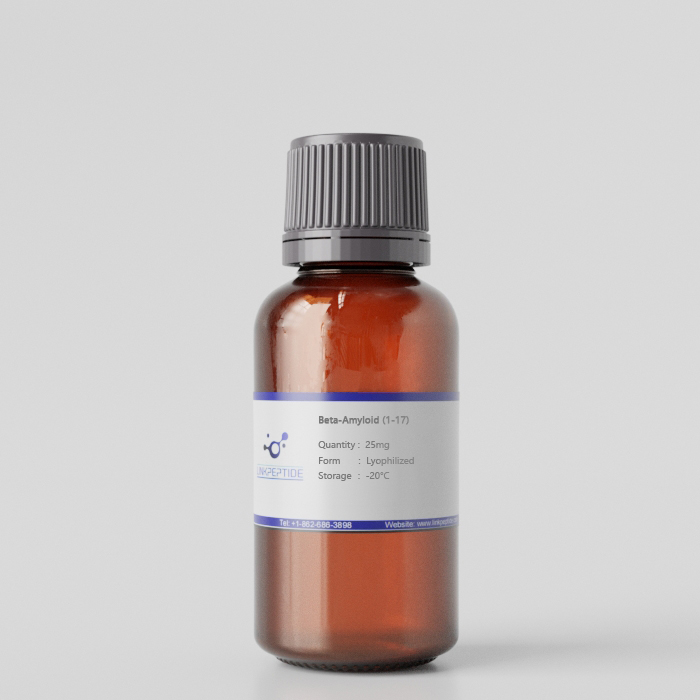
Product Name: Beta-Amyloid (1-17)
Sequence One Letter Code: DAEFRHDSGYEVHHQKL
Sequence Three Letter Code: H-Asp-Ala-Glu-Phe-Arg-His-Asp-Ser-Gly-Tyr-Glu-Val-His-His-Gln-Lys-Leu-OH
Chemical Formula:C90H130N28O29
Molecular Weight: 2068.3
Purity: 95%
Form: Lyophilized
Storage Conditions: - 20 °C
Research Area: Alzheimer's Disease
Source / Species: human
Conjugation: Unconjugated
Code Nacres: NA.26
Application: β-Amyloid (1–17) is an N-terminal fragment of the amyloid-β peptide corresponding to residues 1–17 of the full-length sequence. This region contains hydrophilic and antigenic determinants involved in early amyloid interactions but lacks the highly hydrophobic C-terminal domain responsible for rapid fibril formation. As a result, the peptide is frequently used in structural and biophysical studies to investigate early stages of amyloid assembly while maintaining improved solubility. It allows researchers to examine sequence-specific contributions to amyloid behavior without the rapid aggregation typical of longer fragments. The peptide is commonly applied in Alzheimer’s disease research, antibody recognition studies, and investigations of amyloid–protein interactions. It also supports experiments focused on peptide conformation, aggregation kinetics, and mechanisms underlying amyloid formation.
Current Research: Introduction to Amyloid-β Research Amyloid-β (Aβ) peptides are central to the molecular pathology of Alzheimer’s disease. These peptides are produced through proteolytic processing of the amyloid precursor protein (APP) and can assemble into oligomers and fibrils that accumulate in the brain. Aggregated amyloid structures are associated with neuronal toxicity, synaptic dysfunction, and progressive neurodegeneration. Understanding how amyloid peptides initiate aggregation and interact with cellular components is therefore a major focus in neuroscience and neurodegenerative disease research. To investigate the molecular determinants of amyloid assembly, researchers often study shorter peptide fragments that represent specific functional regions of the full-length sequence. One such fragment is β-Amyloid (1–17), which corresponds to the N-terminal portion of the amyloid-β peptide. Structural Features of the β-Amyloid (1–17) Fragment The β-Amyloid (1–17) peptide represents the first seventeen residues of the amyloid-β sequence. This N-terminal region contains several hydrophilic amino acids and important antigenic determinants involved in molecular recognition and early peptide interactions. Unlike longer amyloid fragments such as Aβ1–40 or Aβ1–42, the (1–17) segment lacks the highly hydrophobic C-terminal region that drives rapid fibril formation. The absence of this aggregation-prone domain significantly improves the peptide’s solubility and reduces its tendency to form insoluble fibrils under experimental conditions. Because of these properties, β-Amyloid (1–17) provides researchers with a useful model system for studying the structural and biochemical characteristics of the N-terminal domain without the complications associated with fast aggregation. Investigating Early Stages of Amyloid Assembly One of the key advantages of the β-Amyloid (1–17) fragment is its ability to support biophysical studies of early amyloid interactions. In full-length amyloid peptides, the rapid formation of oligomers and fibrils can make it difficult to analyze intermediate conformations or transient molecular interactions. The shorter N-terminal fragment allows researchers to examine sequence-specific contributions to amyloid behavior while maintaining greater experimental control. By isolating the N-terminal region, scientists can explore how individual residues participate in early recognition events and how these interactions contribute to the initiation of amyloid assembly. Such studies provide insight into the mechanisms that precede large-scale aggregation and help clarify how amyloid peptides transition from soluble monomers to structured oligomeric complexes. Applications in Alzheimer’s Disease Research The β-Amyloid (1–17) peptide is widely used in Alzheimer’s disease research, particularly in experiments designed to understand the molecular basis of amyloid formation and toxicity. Researchers use this fragment to investigate how the N-terminal region influences peptide conformation, intermolecular interactions, and the earliest steps of aggregation. Because this region contains important residues involved in metal binding and molecular recognition, it also serves as a useful model for examining how amyloid peptides interact with biological molecules such as proteins, antibodies, and small ligands. These interactions can influence amyloid stability, aggregation behavior, and biological activity. Studying the N-terminal sequence separately helps researchers identify specific structural features that contribute to amyloid behavior, which may ultimately inform strategies for therapeutic intervention. Antibody Recognition and Epitope Mapping Another important application of β-Amyloid (1–17) is in antibody recognition studies. The N-terminal region of amyloid-β contains several antigenic determinants commonly targeted by antibodies used in research and diagnostic assays. Synthetic peptides representing this region can be used for epitope mapping, antibody binding analysis, and immunological studies. Researchers often employ the peptide to evaluate antibody specificity, characterize binding affinities, or validate antibodies designed to recognize amyloid-β sequences. These experiments are particularly valuable in the development of antibody-based detection methods and therapeutic strategies targeting amyloid-β peptides. Studying Peptide Conformation and Aggregation Kinetics β-Amyloid (1–17) is also suitable for biophysical investigations of peptide conformation and aggregation kinetics. Techniques such as spectroscopy, circular dichroism, and nuclear magnetic resonance can be used to analyze the structural properties of this fragment in solution. Because the peptide does not rapidly form fibrils, researchers can observe conformational changes and transient structures that would otherwise be difficult to detect in longer amyloid fragments. This allows detailed analysis of how sequence composition influences secondary structure and intermolecular interactions. Such experiments contribute to a deeper understanding of the molecular mechanisms underlying amyloid formation and help identify factors that regulate peptide aggregation. Conclusion The β-Amyloid (1–17) peptide represents a soluble N-terminal fragment of the amyloid-β sequence that retains important structural and antigenic features while lacking the hydrophobic domain responsible for rapid fibril formation. Its improved solubility and reduced aggregation tendency make it a valuable tool for studying early stages of amyloid assembly. Widely used in Alzheimer’s disease research, antibody recognition studies, and biophysical investigations, this peptide supports experiments focused on peptide conformation, aggregation kinetics, and amyloid–protein interactions. By enabling detailed analysis of the N-terminal region of amyloid-β, β-Amyloid (1–17) continues to contribute to research aimed at understanding the molecular mechanisms of amyloid formation and neurodegenerative disease.
Get a Quote
 LinkPeptide

![SCYLLATOXIN [Tyr2]-](https://www.linkpeptide.com/wp-content/uploads/2024/10/SCYLLATOXIN-Tyr2-jpg-2.webp "SCYLLATOXIN [Tyr2]-")