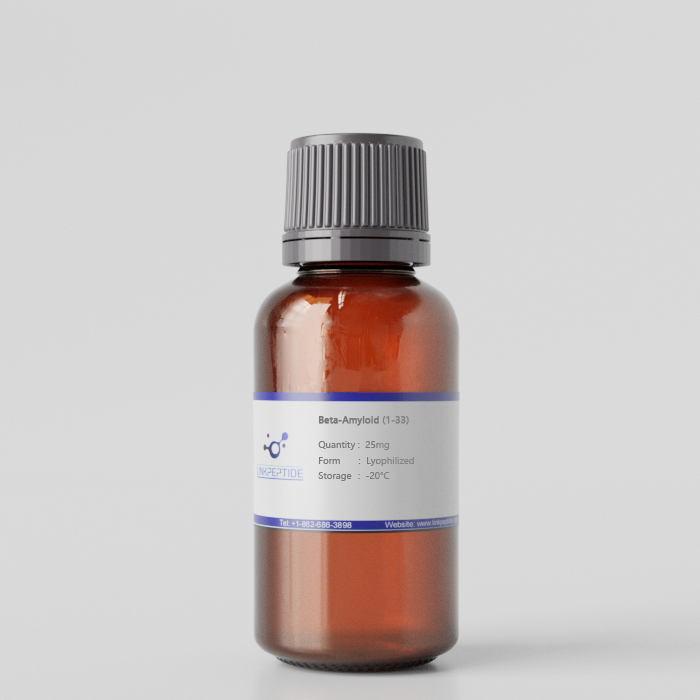
Product Name: Beta-Amyloid (1-33)
Sequence One Letter Code: DAEFRHDSGYEVHHQKLVFFAEDVGSNKGAIIG
Sequence Three Letter Code: H-Asp-Ala-Glu-Phe-Arg-His-Asp-Ser-Gly-Tyr-Glu-Val-His-His-Gln-Lys-Leu-Val-Phe-Phe-Ala-Glu-Asp-Val-Gly-Ser-Asn-Lys-Gly-Ala-Ile-Ile-Gly-OH
Chemical Formula:C164H242N46O51
Molecular Weight: 3674.2
Purity: ≥ 95%
Form: Lyophilized
Storage Conditions: - 20 °C
Source / Species: human
Conjugation: Unconjugated
Code Nacres: NA.26
Application: Beta-Amyloid (1–33) is a soluble N-terminal fragment generated by metalloendopeptidase cleavage of Alzheimer’s Aβ(1–40) at the Gly33–Leu34 bond. This processing produces Aβ(1–33) and Aβ(34–40) fragments without associated neurotoxic effects, suggesting a potential non-pathogenic pathway for amyloid metabolism. Beta-Amyloid (1–33) is widely used in Alzheimer’s disease research to investigate amyloid degradation mechanisms, peptide clearance pathways, enzymatic processing, and factors that reduce neurotoxic aggregation. This peptide is valuable for studying amyloid biology, neurodegenerative disease mechanisms, and physiological routes of beta-amyloid catabolism.
Get a Quote
 LinkPeptide

![[Nphe1]Nociceptin(1-13)NH2](https://www.linkpeptide.com/wp-content/uploads/2024/10/Nphe1Nociceptin1-13NH2-jpg-3.webp "[Nphe1]Nociceptin(1-13)NH2")