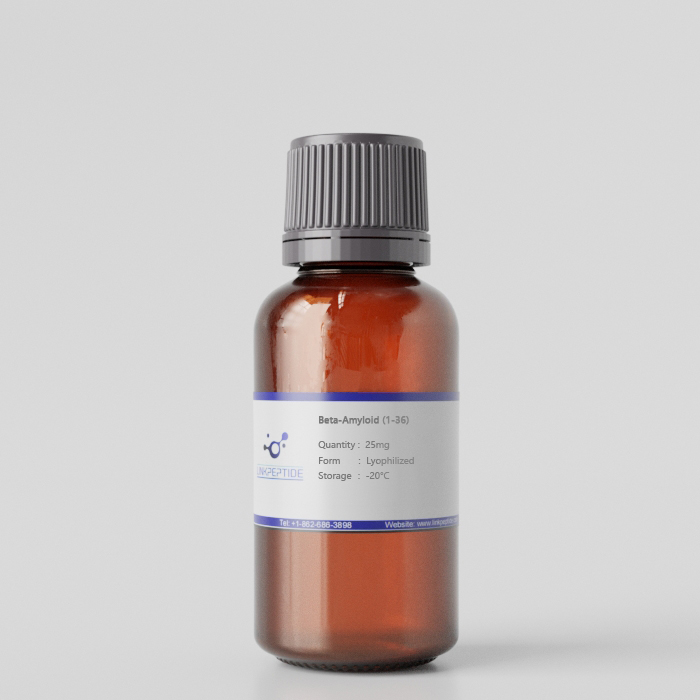
Product Name: Beta-Amyloid (1-36)
Sequence One Letter Code: DAEFRHDSGYEVHHQKLVFFAEDVGSNKGAIIGLMV
Sequence Three Letter Code: H-Asp-Ala-Glu-Phe-Arg-His-Asp-Ser-Gly-Tyr-Glu-Val-His-His-Gln-Lys-Leu-Val-Phe-Phe-Ala-Glu-Asp-Val-Gly-Ser-Asn-Lys-Gly-Ala-Ile-Ile-Gly-Leu-Met-Val-OH
Chemical Formula:C180H271N49O54S
Molecular Weight: 4017.8
Purity: 95%
Form: Lyophilized
Storage Conditions: - 20 °C
Research Area: Alzheimer's Disease
Source / Species: human
Conjugation: Unconjugated
Code Nacres: NA.26
Application: Beta-Amyloid (1–36) is a truncated amyloid-β peptide used in Alzheimer’s disease research to study amyloid processing and aggregation diversity. Generated from proteolytic cleavage of amyloid precursor protein, shorter C-terminal variants such as Aβ1–36 contribute to amyloid heterogeneity and may influence aggregation behavior and toxicity profiles. This peptide is applied in biochemical and cellular assays to investigate aggregation dynamics, structural properties, and mechanisms relevant to neurodegenerative pathology.
Current Research: Beta-Amyloid (1–36) is a truncated amyloid-β (Aβ) peptide comprising the N-terminal 36 amino acids of the canonical Aβ sequence derived from amyloid precursor protein (APP). While Aβ1–40 and Aβ1–42 are the most extensively studied isoforms in Alzheimer’s disease (AD), shorter C-terminal variants such as Aβ1–36 contribute to the molecular heterogeneity of amyloid species generated during APP processing. This peptide is widely used in AD research to investigate aggregation diversity, structural behavior, and isoform-specific biological effects. Biological Context Aβ peptides are generated by sequential cleavage of APP by β-secretase (BACE1) and γ-secretase. Variations in γ-secretase cleavage sites produce peptides of differing lengths, including Aβ1–36, Aβ1–38, Aβ1–40, and Aβ1–42. Compared with longer isoforms: Aβ1–36 lacks the highly hydrophobic C-terminal residues present in Aβ1–42. It exhibits reduced β-sheet–forming propensity. It generally shows altered aggregation kinetics and fibril morphology. These structural differences influence oligomer formation, fibrillization rates, and potential neurotoxic properties. Aggregation and Structural Properties Because C-terminal hydrophobic residues strongly drive amyloid fibrillization, truncation at position 36 can result in: Slower aggregation kinetics Reduced fibril stability Distinct oligomeric intermediates Aβ1–36 is therefore useful for comparative studies examining how C-terminal length affects: β-sheet formation Oligomer stability Cross-seeding behavior with longer Aβ isoforms Aggregate morphology under defined conditions Research Applications 1. Amyloid Processing Studies Aβ1–36 supports investigation of γ-secretase cleavage patterns and the impact of enzymatic modulation on peptide length distribution. 2. Aggregation Kinetics Analysis The peptide is employed in Thioflavin T assays, circular dichroism spectroscopy, and electron microscopy to characterize aggregation dynamics and structural transitions. 3. Isoform Interaction and Cross-Seeding Aβ1–36 can be combined with longer Aβ species to study heterotypic interactions and effects on nucleation and fibril growth. 4. Neurotoxicity and Cellular Assays Cell-based systems are used to compare cytotoxicity, oxidative stress induction, and synaptic effects between truncated and full-length Aβ isoforms. 5. Structural and Biophysical Studies Techniques such as NMR, mass spectrometry, and computational modeling are applied to examine conformational differences among Aβ variants. Experimental Considerations Preparation protocols (e.g., monomerization, solvent pre-treatment) should be standardized to ensure reproducibility in aggregation experiments. Comparative analysis with Aβ1–40 or Aβ1–42 is recommended when assessing isoform-specific effects. Storage and handling conditions can influence aggregation state and experimental outcomes.
Get a Quote
 LinkPeptide

![[Nphe1]Nociceptin(1-13)NH2](https://www.linkpeptide.com/wp-content/uploads/2024/10/Nphe1Nociceptin1-13NH2-jpg-3.webp "[Nphe1]Nociceptin(1-13)NH2")