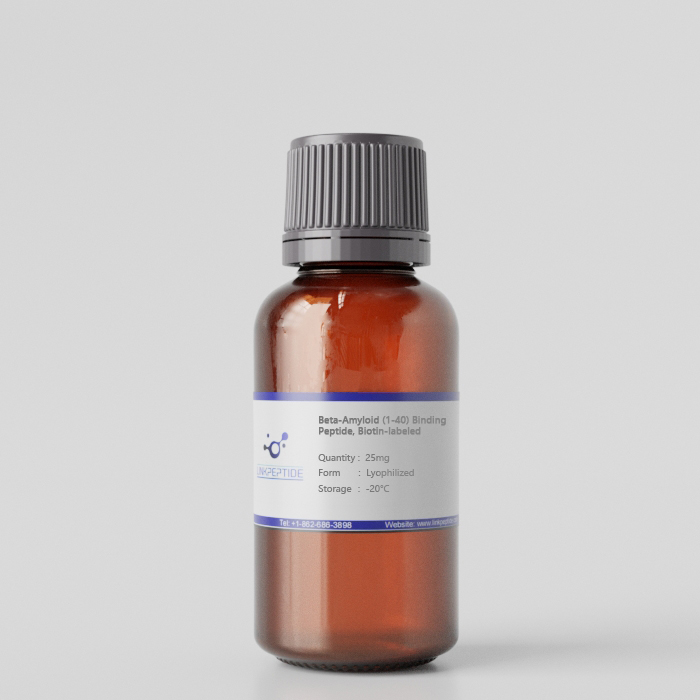
Product Name: Beta-Amyloid (1-40) Binding Peptide, Biotin-labeled
Sequence One Letter Code: Biotin-DWGKGGRWRLWPGASGKTEA
Sequence Three Letter Code: Biotin-Asp-Trp-Gly-Lys-Gly-Gly-Arg-Trp-Arg-Leu-Trp-Pro-Gly-Ala-Ser-Gly-Lys-Thr-Glu-Ala-OH
Chemical Formula:C110H161N33O29S1
Molecular Weight: 2441.9
Purity: 95%
Form: Lyophilized
Storage Conditions: - 20 °C
Research Area: Alzheimer's Disease
Source / Species: human
Conjugation: Conjugated
Conjugation Type: Biotins
Code Nacres: NA.26
Application: This biotinylated 20-amino acid peptide selectively binds aggregated β-amyloid (1–40) while exhibiting minimal affinity for monomeric forms. Designed as a targeting sequence, it enables specific recognition of amyloid fibrils and plaque-like assemblies. The biotin modification facilitates affinity capture, imaging probe development, and pull-down assays. This peptide is used in studies of amyloid–ligand interactions, plaque-targeting strategies, and development of diagnostic or delivery approaches aimed at amyloid pathology. It supports research into selective binding mechanisms and therapeutic targeting of aggregated amyloid species
Current Research: Selective recognition of aggregated β-amyloid (Aβ) species remains a central objective in Alzheimer’s disease (AD) research, as fibrillar assemblies and plaque-associated aggregates are strongly linked to disease progression and neurotoxicity. This biotinylated 20-amino acid peptide has been engineered to preferentially bind aggregated β-Amyloid (1–40) while exhibiting minimal affinity for monomeric Aβ forms. By discriminating between conformational states, the peptide provides a targeted tool for studying amyloid fibrils, plaque-like structures, and aggregation-dependent pathological mechanisms. The ability to distinguish aggregated from monomeric Aβ is critical in mechanistic and translational research. Monomeric Aβ peptides are present under physiological conditions and may serve normal biological functions, whereas oligomeric and fibrillar assemblies are associated with synaptic impairment, oxidative stress, and neuroinflammation. The targeting sequence within this 20-residue peptide is designed to recognize structural features characteristic of cross-β sheet architecture, such as repetitive β-strand alignment and exposed hydrophobic interfaces. This conformational selectivity enhances specificity for fibrils and higher-order aggregates. Biotinylation of the peptide enables robust and versatile downstream applications. The high-affinity interaction between biotin and streptavidin provides a reliable platform for affinity capture and detection. In pull-down assays, the peptide can be immobilized on streptavidin-coated beads to selectively isolate aggregated Aβ species from complex biological samples, including brain homogenates or cerebrospinal fluid. Subsequent analysis by immunoblotting, mass spectrometry, or electron microscopy allows characterization of bound amyloid assemblies and associated proteins. In imaging applications, the biotin tag supports conjugation to fluorescent streptavidin derivatives or other reporter systems. This facilitates development of amyloid-targeting probes for in vitro or ex vivo visualization of fibrillar deposits. When applied to tissue sections, the peptide can selectively label plaque-like structures, supporting studies of amyloid distribution and morphology. Compared with sequence-based Aβ antibodies, conformation-selective peptides offer an alternative approach that targets structural motifs rather than specific amino acid sequences. The peptide is also valuable for investigating amyloid–ligand interactions. By providing a defined binding interface for aggregated Aβ (1–40), it enables competitive binding assays to evaluate candidate compounds or antibodies that aim to disrupt fibril stability. Surface-based techniques such as surface plasmon resonance (SPR) or biolayer interferometry (BLI) can quantify binding kinetics and affinity parameters. These analyses contribute to understanding the structural determinants that govern selective recognition of aggregated amyloid. From a therapeutic development perspective, selective targeting of aggregated Aβ is essential to minimize interference with monomeric peptide pools and reduce off-target effects. The biotinylated 20-residue peptide serves as a prototype for plaque-targeting strategies, including nanoparticle conjugation, targeted drug delivery, and diagnostic probe design. By coupling the targeting sequence to therapeutic cargos or imaging agents, researchers can explore approaches aimed at localized intervention within amyloid-rich regions. Mechanistic studies further benefit from this peptide’s selectivity. Aggregated Aβ exhibits distinct physicochemical properties, including increased β-sheet content, altered surface charge distribution, and enhanced hydrophobic exposure. Investigating how the peptide interacts with these structural features provides insight into conformational recognition principles and the molecular architecture of amyloid fibrils. Such information informs rational design of next-generation amyloid-binding ligands with improved specificity and stability. In summary, this biotinylated 20-amino acid peptide is a conformationally selective ligand for aggregated β-Amyloid (1–40), exhibiting minimal binding to monomeric species. Its biotin modification enables affinity capture, imaging, and interaction profiling applications. By supporting studies of amyloid recognition, plaque targeting, and aggregation-specific binding mechanisms, the peptide contributes to ongoing efforts to elucidate amyloid pathology and develop targeted diagnostic and therapeutic strategies in Alzheimer’s disease research.
Get a Quote
 LinkPeptide

![Ser(OGlcNAc)]400-KWK-Tau (388-411)-KK(Biotin)-NH2](https://www.linkpeptide.com/wp-content/uploads/2026/06/SerOGlcNAc400-KWK-Tau-388-411-KKBiotin-NH2.jpg "Ser(OGlcNAc)]400-KWK-Tau (388-411)-KK(Biotin)-NH2")