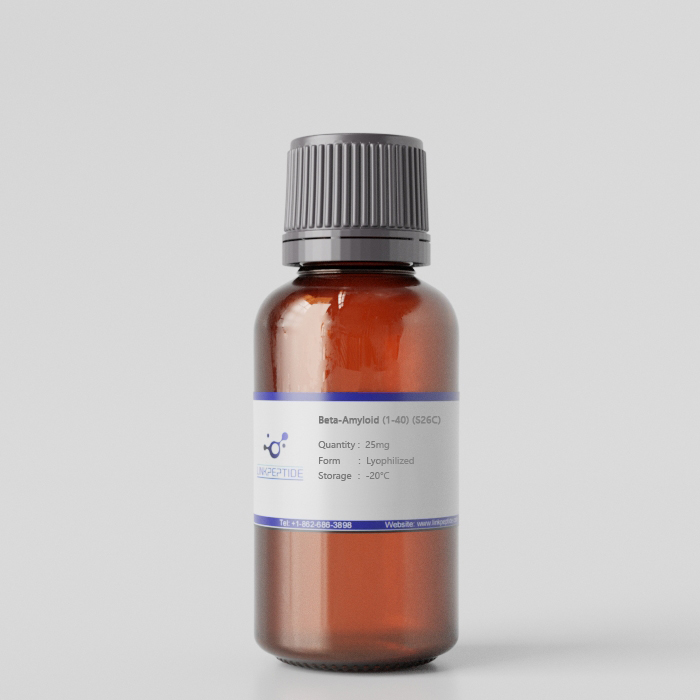
Product Name: Beta-Amyloid (1-40) (S26C)
Sequence One Letter Code: DAEFRHDSGYEVHHQKLVFFAEDVGCNKGAIIGLMVGGVV
Sequence Three Letter Code: H-Asp-Ala-Glu-Phe-Arg-His-Asp-Ser-Gly-Tyr-Glu-Val-His-His-Gln-Lys-Leu-Val-Phe-Phe-Ala-Glu-Asp-Val-Gly-Cys-Asn-Lys-Gly-Ala-Ile-Ile-Gly-Leu-Met-Val-Gly-Gly-Val-Val-OH
Chemical Formula:C194H295N53O57S2
Molecular Weight: 4346.2
Purity: 95%
Form: Lyophilized
Storage Conditions: - 20 °C
Research Area: Alzheimer's Disease
Source / Species: human
Conjugation: Unconjugated
Code Nacres: NA.26
Application: This synthetic peptide is a mutant form of β-amyloid (1–40) in which serine at position 26 is substituted with cysteine. The introduced cysteine enables reversible covalent homodimer formation through disulfide bonding, providing a controlled system for studying amyloid dimerization and oligomerization. Under reducing conditions, dimer formation can be reversed, facilitating comparative structural and kinetic analyses. This mutant peptide serves as a valuable model for investigating aggregation pathways, oligomer stability, and structure–toxicity relationships relevant to Alzheimer’s disease. It is widely applied in mechanistic studies of amyloid assembly and pathogenic conformational transitions.
Current Research: Amyloid-β (Aβ) peptides are central to the pathology of Alzheimer’s disease, where their aggregation into oligomers and fibrillar deposits contributes to neurodegeneration. While large amyloid plaques are a hallmark of the disease, increasing evidence suggests that soluble oligomeric species, particularly dimers and small aggregates, play a critical role in synaptic dysfunction and neuronal toxicity. Understanding how these oligomers form and evolve into higher-order aggregates is therefore a major focus of Alzheimer’s disease research. The β-amyloid (1–40) S26C mutant peptide provides a useful experimental model for examining early aggregation events by enabling controlled dimer formation through reversible disulfide bonding. Amyloid-β and Alzheimer’s Disease Pathology Amyloid-β peptides are generated through sequential cleavage of the amyloid precursor protein (APP) by β-secretase and γ-secretase enzymes. The resulting peptides, typically 40 or 42 amino acids in length, can self-associate to form oligomers, protofibrils, and ultimately insoluble fibrillar aggregates. Although fibrillar plaques are a defining pathological feature of Alzheimer’s disease, many studies suggest that small soluble oligomers are particularly toxic to neurons. These oligomeric assemblies can disrupt synaptic signaling, alter membrane permeability, and trigger inflammatory responses in the brain. Because oligomer formation represents a crucial early stage of amyloid aggregation, experimental systems that allow researchers to investigate the formation and stability of dimers and small oligomers are essential for understanding disease mechanisms. Design of the S26C Mutant Peptide The Aβ (1–40) S26C mutant is derived from the full-length 40-residue amyloid-β peptide but contains a single amino acid substitution: serine at position 26 is replaced by cysteine. This modification introduces a thiol-containing residue capable of forming disulfide bonds with another cysteine residue. When two S26C peptide molecules interact under oxidizing conditions, the cysteine residues can form a covalent disulfide-linked homodimer. This covalent linkage stabilizes the dimeric state, providing a controlled way to study the structure and behavior of amyloid dimers. Because the modification occurs at a defined position within the peptide sequence, the resulting dimer mimics early stages of amyloid assembly while allowing researchers to isolate and analyze specific aggregation intermediates. Reversible Control of Dimer Formation One of the major advantages of the S26C mutation is the reversible nature of disulfide bond formation. Under oxidizing conditions, the cysteine residues form a stable covalent bond that links two peptides together. However, when reducing agents are introduced, the disulfide bond can be broken, returning the peptide to its monomeric state. This reversible system allows researchers to compare the structural and biochemical properties of monomeric versus dimeric amyloid species under controlled experimental conditions. By toggling between oxidizing and reducing environments, scientists can investigate how dimerization influences aggregation kinetics, structural transitions, and biological activity. Investigating Amyloid Aggregation Pathways Amyloid aggregation is a multistep process involving nucleation, oligomer formation, and fibril growth. The S26C mutant peptide provides a valuable tool for examining early aggregation pathways, particularly the transition from monomers to small oligomers. Stabilized dimers generated through disulfide bonding can serve as defined starting points for studying how amyloid peptides assemble into larger structures. Researchers can monitor how these dimers interact with additional peptide molecules and how they influence nucleation and fibril formation. These studies help clarify the molecular mechanisms that govern amyloid assembly, an essential step in understanding the progression of Alzheimer’s disease pathology. Structural and Biophysical Studies The controlled dimerization capability of the S26C peptide makes it useful in structural and biophysical investigations. Techniques such as nuclear magnetic resonance (NMR) spectroscopy, circular dichroism, fluorescence assays, and electron microscopy often rely on well-defined peptide systems to examine aggregation behavior. By comparing monomeric and dimeric forms of the peptide, researchers can determine how dimerization influences secondary structure, β-sheet formation, and intermolecular interactions. These structural insights help reveal how early amyloid assemblies evolve into the complex fibrillar structures observed in disease. Studying Structure–Toxicity Relationships Another important application of the S26C mutant peptide is the investigation of structure–toxicity relationships. Different amyloid conformations can exhibit varying levels of biological activity and neurotoxicity. Using controlled dimer formation, scientists can assess how specific structural arrangements affect interactions with neuronal membranes, synaptic proteins, or cellular signaling pathways. These experiments contribute to understanding which amyloid species are most relevant to neurodegenerative processes. Relevance to Alzheimer’s Disease Mechanisms The ability to generate stable but reversible amyloid dimers makes the S26C mutant peptide a powerful model system for studying pathogenic conformational transitions associated with Alzheimer’s disease. By examining how dimers form, stabilize, and convert into larger oligomeric structures, researchers can gain insight into the earliest stages of amyloid pathology. Such knowledge is valuable for developing therapeutic strategies aimed at interfering with amyloid aggregation or stabilizing non-toxic peptide conformations. Conclusion The β-amyloid (1–40) S26C mutant peptide provides a controlled experimental system for studying amyloid dimerization and early aggregation events. By introducing a cysteine residue at position 26, the peptide enables reversible covalent homodimer formation through disulfide bonding, allowing researchers to analyze monomer–dimer transitions and oligomer stability. Through applications in aggregation studies, structural analysis, and investigations of amyloid toxicity, this mutant peptide supports mechanistic research into the molecular pathways underlying amyloid assembly and Alzheimer’s disease pathology.
Get a Quote
 LinkPeptide

![[Phe1Ψ(CH2-NH)Gly2]Nociceptin(1-13)NH2](https://www.linkpeptide.com/wp-content/uploads/2024/10/Phe1¶aCH2-NHGly2Nociceptin1-13NH2-jpg.webp "[Phe1Ψ(CH2-NH)Gly2]Nociceptin(1-13)NH2")