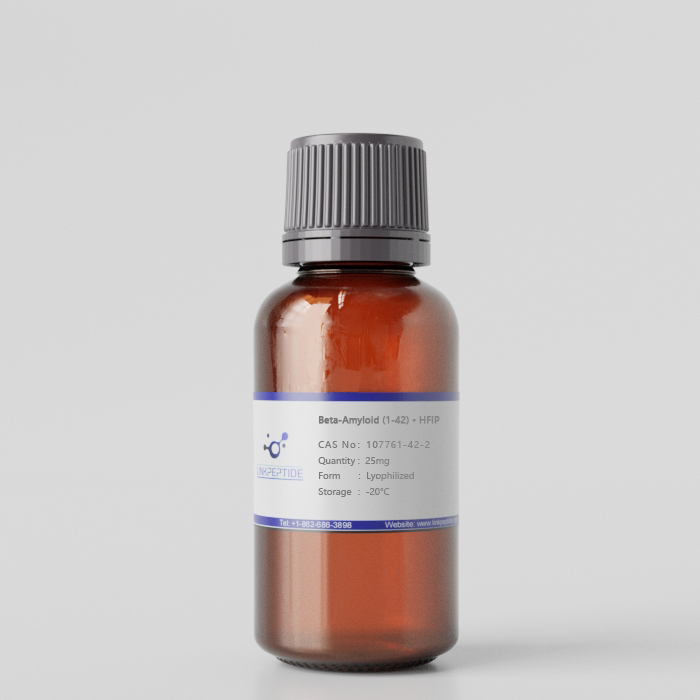
Product Name: Beta-Amyloid (1-42) • HFIP
Sequence One Letter Code: DAEFRHDSGYEVHHQKLVFFAEDVGSNKGAIIGLMVGGVVIA
Sequence Three Letter Code: H-Asp-Ala-Glu-Phe-Arg-His-Asp-Ser-Gly-Tyr-Glu-Val-His-His-Gln-Lys-Leu-Val-Phe-Phe-Ala-Glu-Asp-Val-Gly-Ser-Asn-Lys-Gly-Ala-Ile-Ile-Gly-Leu-Met-Val-Gly-Gly-Val-Val-Ile -AlaOH
Cas No: 107761-42-2
Chemical Formula:C203H311N55O60S
Molecular Weight: 4514.4
Purity: 95%
Form: Lyophilized
Storage Conditions: - 20 °C
Research Area: Neurological Disease Research
SMILES: CC[C@H](C)[C@@H](C(=O)N[C@@H]([C@@H](C)CC)C(=O)NCC(=O)N[C@@H](CC(C)C)C(=O)N[C@@H](CCSC)C(=O)N[C@@H](C(C)C)C(=O)NCC(=O)NCC(=O)N[C@@H](C(C)C)C(=O)N[C@@H](C(C)C)C(=O)N[C@@H]([C@@H](C)CC)C(=O)N[C@@H](C)C(=O)O)NC(=O)[C@H](C)NC(=O)CNC(=O)[C@H](CCCCN)NC(=O)[C@H](CC(=O)N)NC(=O)[C@H](CO)NC(=O)CNC(=O)[C@H](C(C)C)NC(=O)[C@H](CC(=O)O)NC(=O)[C@H](CCC(=O)O)NC(=O)[C@H](C)NC(=O)[C@H](CC1=CC=CC=C1)NC(=O)[C@H](CC2=CC=CC=C2)NC(=O)[C@H](C(C)C)NC(=O)[C@H](CC(C)C)NC(=O)[C@H](CCCCN)NC(=O)[C@H](CCC(=O)N)NC(=O)[C@H](CC3=CNC=N3)NC(=O)[C@H](CC4=CNC=N4)NC(=O)[C@H](C(C)C)NC(=O)[C@H](CCC(=O)O)NC(=O)[C@H](CC5=CC=C(C=C5)O)NC(=O)CNC(=O)[C@H](CO)NC(=O)[C@H](CC(=O)O)NC(=O)[C@H](CC6=CNC=N6)NC(=O)[C@H](CCCNC(=N)N)NC(=O)[C@H](CC7=CC=CC=C7)NC(=O)[C@H](CCC(=O)O)NC(=O)[C@H](C)NC(=O)[C@H](CC(=O)O)N
IUPAC: (4S)-5-[[(2S)-1-[[(2S)-1-[[(2S)-1-[[(2S)-1-[[(2S)-1-[[2-[[(2S)-1-[[(2S)-1-[[(2S)-1-[[(2S)-1-[[(2S)-1-[[(2S)-5-amino-1-[[(2S)-6-amino-1-[[(2S)-1-[[(2S)-1-[[(2S)-1-[[(2S)-1-[[(2S)-1-[[(2S)-1-[[(2S)-1-[[(2S)-1-[[2-[[(2S)-1-[[(2S)-4-amino-1-[[(2S)-6-amino-1-[[2-[[(2S)-1-[[(2S,3S)-1-[[(2S,3S)-1-[[2-[[(2S)-1-[[(2S)-1-[[(2S)-1-[[2-[[2-[[(2S)-1-[[(2S)-1-[[(2S,3S)-1-[[(1S)-1-carboxyethyl]amino]-3-methyl-1-oxopentan-2-yl]amino]-3-methyl-1-oxobutan-2-yl]amino]-3-methyl-1-oxobutan-2-yl]amino]-2-oxoethyl]amino]-2-oxoethyl]amino]-3-methyl-1-oxobutan-2-yl]amino]-4-methylsulfanyl-1-oxobutan-2-yl]amino]-4-methyl-1-oxopentan-2-yl]amino]-2-oxoethyl]amino]-3-methyl-1-oxopentan-2-yl]amino]-3-methyl-1-oxopentan-2-yl]amino]-1-oxopropan-2-yl]amino]-2-oxoethyl]amino]-1-oxohexan-2-yl]amino]-1,4-dioxobutan-2-yl]amino]-3-hydroxy-1-oxopropan-2-yl]amino]-2-oxoethyl]amino]-3-methyl-1-oxobutan-2-yl]amino]-3-carboxy-1-oxopropan-2-yl]amino]-4-carboxy-1-oxobutan-2-yl]amino]-1-oxopropan-2-yl]amino]-1-oxo-3-phenylpropan-2-yl]amino]-1-oxo-3-phenylpropan-2-yl]amino]-3-methyl-1-oxobutan-2-yl]amino]-4-methyl-1-oxopentan-2-yl]amino]-1-oxohexan-2-yl]amino]-1,5-dioxopentan-2-yl]amino]-3-(1H-imidazol-4-yl)-1-oxopropan-2-yl]amino]-3-(1H-imidazol-4-yl)-1-oxopropan-2-yl]amino]-3-methyl-1-oxobutan-2-yl]amino]-4-carboxy-1-oxobutan-2-yl]amino]-3-(4-hydroxyphenyl)-1-oxopropan-2-yl]amino]-2-oxoethyl]amino]-3-hydroxy-1-oxopropan-2-yl]amino]-3-carboxy-1-oxopropan-2-yl]amino]-3-(1H-imidazol-4-yl)-1-oxopropan-2-yl]amino]-5-carbamimidamido-1-oxopentan-2-yl]amino]-1-oxo-3-phenylpropan-2-yl]amino]-4-[[(2S)-2-[[(2S)-2-amino-3-carboxypropanoyl]amino]propanoyl]amino]-5-oxopentanoic acid
INCHIKEY: DZHSAHHDTRWUTF-SIQRNXPUSA-N
INCHI:
InChI=1S/C203H311N55O60S/c1-28-106(20)164(195(310)220-91-149(267)228-130(71-98(4)5)181(296)238-129(66-70-319-27)179(294)251-158(100(8)9)193(308)218-87-146(264)215-88-151(269)250-160(102(12)13)198(313)255-163(105(18)19)199(314)258-165(107(21)29-2)200(315)227-112(26)202(317)318)257-201(316)166(108(22)30-3)256-169(284)109(23)224-147(265)89-216-171(286)122(51-40-42-67-204)233-188(303)139(81-145(208)263)244-192(307)143(94-260)230-150(268)92-219-194(309)159(101(10)11)252-191(306)141(83-157(280)281)245-177(292)127(60-64-153(272)273)232-168(283)111(25)226-180(295)133(73-113-45-34-31-35-46-113)241-184(299)135(75-115-49-38-33-39-50-115)247-196(311)162(104(16)17)254-190(305)131(72-99(6)7)239-173(288)123(52-41-43-68-205)234-175(290)125(58-62-144(207)262)236-185(300)136(77-117-84-211-95-221-117)243-187(302)138(79-119-86-213-97-223-119)248-197(312)161(103(14)15)253-178(293)128(61-65-154(274)275)237-182(297)132(76-116-54-56-120(261)57-55-116)229-148(266)90-217-172(287)142(93-259)249-189(304)140(82-156(278)279)246-186(301)137(78-118-85-212-96-222-118)242-174(289)124(53-44-69-214-203(209)210)235-183(298)134(74-114-47-36-32-37-48-114)240-176(291)126(59-63-152(270)271)231-167(282)110(24)225-170(285)121(206)80-155(276)277/h31-39,45-50,54-57,84-86,95-112,121-143,158-166,259-261H,28-30,40-44,51-53,58-83,87-94,204-206H2,1-27H3,(H2,207,262)(H2,208,263)(H,211,221)(H,212,222)(H,213,223)(H,215,264)(H,216,286)(H,217,287)(H,218,308)(H,219,309)(H,220,310)(H,224,265)(H,225,285)(H,226,295)(H,227,315)(H,228,267)(H,229,266)(H,230,268)(H,231,282)(H,232,283)(H,233,303)(H,234,290)(H,235,298)(H,236,300)(H,237,297)(H,238,296)(H,239,288)(H,240,291)(H,241,299)(H,242,289)(H,243,302)(H,244,307)(H,245,292)(H,246,301)(H,247,311)(H,248,312)(H,249,304)(H,250,269)(H,251,294)(H,252,306)(H,253,293)(H,254,305)(H,255,313)(H,256,284)(H,257,316)(H,258,314)(H,270,271)(H,272,273)(H,274,275)(H,276,277)(H,278,279)(H,280,281)(H,317,318)(H4,209,210,214)/t106-,107-,108-,109-,110-,111-,112-,121-,122-,123-,124-,125-,126-,127-,128-,129-,130-,131-,132-,133-,134-,135-,136-,137-,138-,139-,140-,141-,142-,143-,158-,159-,160-,161-,162-,163-,164-,165-,166-/m0/s1
Source / Species: human
Conjugation: Unconjugated
Code Nacres: NA.26
Application: Beta-Amyloid (1–42), HFIP-treated is a preparation of Aβ (1–42) processed with hexafluoroisopropanol to remove pre-formed aggregates and secondary structures. HFIP disrupts β-sheet interactions, yielding a monomeric, α-helical peptide state suitable for controlled aggregation studies. Upon solvent evaporation, the peptide forms a uniform film that can be reproducibly reconstituted. This preparation improves consistency in fibrillogenesis and aggregation kinetics experiments. It is widely used in Alzheimer’s disease research to study amyloid assembly, oligomer formation, and structure-dependent neurotoxicity, providing a reliable starting point for investigating peptide aggregation mechanisms.
Current Research: β-Amyloid (1–42), HFIP-treated is a pre-processed form of the aggregation-prone Aβ (1–42) peptide, treated with hexafluoroisopropanol (HFIP) to eliminate pre-existing aggregates and secondary structures. This preparation yields a monomeric, structurally reset peptide population, enabling highly reproducible studies of amyloid assembly and aggregation. It is widely used in Alzheimer’s disease research as a standardized starting material for fibrillogenesis and oligomerization experiments. Role of HFIP in Peptide Preparation HFIP is a fluorinated solvent commonly used to disrupt intermolecular interactions and β-sheet structures in amyloid peptides. Treatment with HFIP: Breaks down pre-formed oligomers and fibrils Disrupts β-sheet-rich conformations Stabilizes the peptide in a monomeric or α-helical state Following solvent evaporation, the peptide forms a thin, uniform film, which can be re-dissolved under defined conditions to initiate aggregation in a controlled manner. Advantages of HFIP Treatment Aβ (1–42) is highly sensitive to handling conditions and can spontaneously form heterogeneous aggregates. HFIP treatment addresses this challenge by providing: A uniform monomeric starting population Reduced batch-to-batch variability Improved reproducibility in aggregation assays Controlled initiation of fibril formation This makes HFIP-treated peptide essential for experiments requiring precise control over aggregation kinetics and species distribution. Controlled Aggregation and Fibrillogenesis Once reconstituted, HFIP-treated Aβ (1–42) can be directed into specific aggregation pathways by adjusting experimental conditions such as: Solvent composition and buffer conditions Peptide concentration Temperature and incubation time This allows researchers to generate: Monomers for baseline studies Soluble oligomers associated with neurotoxicity Protofibrils and mature fibrils for structural analysis Such control is critical for dissecting the relationship between aggregation state and biological activity. Applications in Alzheimer’s Disease Research HFIP-treated Aβ (1–42) is widely used in studies investigating the molecular mechanisms of Alzheimer’s disease. Key applications include: Aggregation kinetics and fibril formation assays Characterization of oligomeric intermediates Structure–function analysis of amyloid species Cell-based assays of peptide-induced neurotoxicity Screening of aggregation inhibitors or modulators By starting from a defined monomeric state, researchers can more accurately attribute observed effects to specific aggregation stages. Studying Oligomer Formation and Toxicity Soluble oligomers of Aβ (1–42) are considered among the most neurotoxic species in Alzheimer’s disease. HFIP-treated preparations enable controlled generation of these intermediates, facilitating studies of: Synaptic dysfunction and neuronal signaling impairment Membrane interaction and disruption Oxidative stress and cellular damage pathways This level of control is essential for understanding how different aggregation states contribute to disease progression. Importance for Experimental Reproducibility One of the major challenges in amyloid research is variability in peptide aggregation behavior, which can arise from differences in peptide handling and storage. HFIP treatment helps standardize experimental conditions by: Resetting the aggregation state of the peptide Providing consistent starting material across experiments Reducing variability between laboratories This makes HFIP-treated Aβ (1–42) a preferred choice for method development, comparative studies, and high-throughput screening. A Reliable Starting Point for Amyloid Research β-Amyloid (1–42), HFIP-treated provides a well-defined and reproducible foundation for studying amyloid aggregation and its biological consequences. By eliminating pre-existing structural heterogeneity, it enables precise investigation of aggregation mechanisms, oligomer formation, and structure-dependent toxicity. As a result, this preparation remains an essential tool for advancing research into Alzheimer’s disease pathology, protein misfolding, and therapeutic strategies targeting amyloid aggregation.
Get a Quote
 LinkPeptide

![[Phe1Ψ(CH2-NH)Gly2]Nociceptin(1-13)NH2](https://www.linkpeptide.com/wp-content/uploads/2024/10/Phe1¶aCH2-NHGly2Nociceptin1-13NH2-jpg.webp "[Phe1Ψ(CH2-NH)Gly2]Nociceptin(1-13)NH2")
![LEIUROTOXIN I [R7]-](https://www.linkpeptide.com/wp-content/uploads/2024/10/LEIUROTOXIN-I-R7-jpg-2.webp "LEIUROTOXIN I [R7]-")