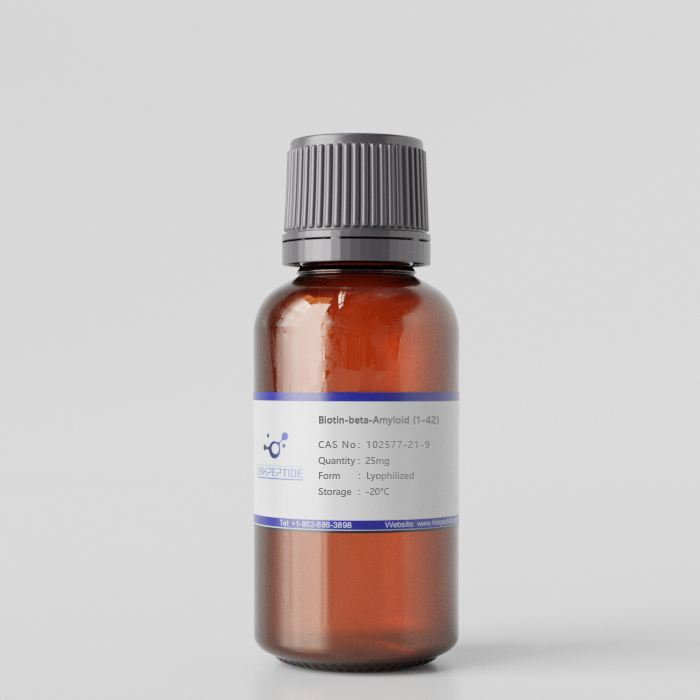
Product Name: Beta-Amyloid (1-42)-Lys(Biotin)-NH2
Sequence One Letter Code: DAEFRHDSGYEVHHQKLVFFAEDVGSNKGAIIGLMVGGVVIA-K(Biotin)-NH2
Sequence Three Letter Code: H-Asp-Ala-Glu-Phe-Arg-His-Asp-Ser-Gly-Tyr-Glu-Val-His-His-Gln-Lys-Leu-Val-Phe-Phe-Ala-Glu-Asp-Val-Gly-Ser-Asn-Lys-Gly-Ala-Ile-Ile-Gly-Leu-Met-Val-Gly-Gly-Val-Val-Ile-Ala-Lys(Biotin)-NH2
Molecular Weight: 4867.9
Purity: 95%
Form: Lyophilized
Storage Conditions: - 20 °C
Research Area: Peptide Series
Source / Species: human
Conjugation: Conjugated
Conjugation Type: Biotins
Code Nacres: NA.26
Application: Beta-Amyloid (1–42)-Lys(Biotin)-NH₂ is a biotinylated form of the 42-amino-acid amyloid-β peptide, a key component of amyloid plaques in Alzheimer’s disease. Aβ (1–42) is highly aggregation-prone and associated with neurotoxicity. The addition of a biotin group at the C-terminus enables affinity-based detection, immobilization, and interaction studies without significantly altering aggregation properties. This peptide is widely used in research to investigate amyloid-binding proteins, receptor interactions, and plaque-associated mechanisms. It is also suitable for pull-down assays and detection platforms, supporting studies of amyloid aggregation and protein interaction networks.
Current Research: β-Amyloid (1–42)-Lys(Biotin)-NH₂ is a biotinylated derivative of the 42-amino-acid amyloid-β peptide (Aβ 1–42), a central molecule in the pathology of Alzheimer’s disease (AD). This modified peptide retains the high aggregation propensity and neurotoxic characteristics of native Aβ (1–42), while incorporating a C-terminal biotin tag that enables versatile applications in affinity-based detection and interaction studies. Structural Features and Functional Design This peptide consists of: Full-length Aβ (1–42) sequence, preserving native aggregation behavior C-terminal lysine conjugated to biotin, providing an affinity handle Amidated C-terminus (-NH₂), maintaining structural stability and mimicking native peptide chemistry The placement of the biotin tag at the C-terminus is designed to minimize interference with aggregation-prone regions, allowing the peptide to retain its characteristic β-sheet formation and self-assembly properties. Aggregation and Role in Alzheimer’s Disease Aβ (1–42) is one of the most aggregation-prone amyloid species and is strongly associated with: Formation of soluble oligomers and insoluble fibrils Deposition in amyloid plaques within the brain Synaptic dysfunction and neuronal toxicity The biotinylated form preserves these properties, making it suitable for studying aggregation kinetics, oligomer formation, and structure-dependent toxicity. Advantages of Biotinylation The addition of a biotin moiety enables strong and specific binding to streptavidin or avidin, facilitating a range of experimental techniques. Key advantages include: Affinity capture of peptide–protein complexes Immobilization on assay surfaces High-sensitivity detection in biochemical assays Compatibility with pull-down, ELISA, and imaging platforms This makes the peptide particularly useful for studying amyloid interactions in a controlled and quantifiable manner. Applications in Protein Interaction Studies β-Amyloid (1–42)-Lys(Biotin)-NH₂ is widely used to identify and characterize Aβ-binding proteins and receptors. Common applications include: Pull-down assays to isolate amyloid-interacting proteins Identification of receptors and binding partners involved in Aβ signaling Proteomic analysis of amyloid-associated complexes Mapping interaction domains between Aβ and cellular targets These studies are essential for understanding how Aβ interacts with cellular components and contributes to disease mechanisms. Use in Aggregation and Mechanistic Studies The peptide is also applied in studies of amyloid assembly and aggregation behavior, including: Monitoring fibrillization and oligomerization processes Evaluating factors that influence aggregation kinetics Screening compounds that inhibit or modulate aggregation The ability to combine aggregation studies with affinity-based detection enhances experimental flexibility. Applications in Neurotoxicity and Signaling Research Because Aβ (1–42) is closely linked to neuronal dysfunction, the biotinylated peptide is used to investigate: Mechanisms of synaptic toxicity and signaling disruption Interactions with membrane receptors and transport proteins Pathways involved in neuroinflammation and oxidative stress Its detectability allows correlation between binding events and functional cellular outcomes. A Versatile Tool for Amyloid Research β-Amyloid (1–42)-Lys(Biotin)-NH₂ combines the pathological relevance of Aβ (1–42) with the experimental utility of a biotin affinity tag, making it a highly versatile reagent for Alzheimer’s disease research. By enabling detailed analysis of amyloid aggregation, protein interactions, and plaque-associated mechanisms, this peptide supports advances in understanding neurodegeneration, amyloid biology, and therapeutic target identification.
Get a Quote
 LinkPeptide