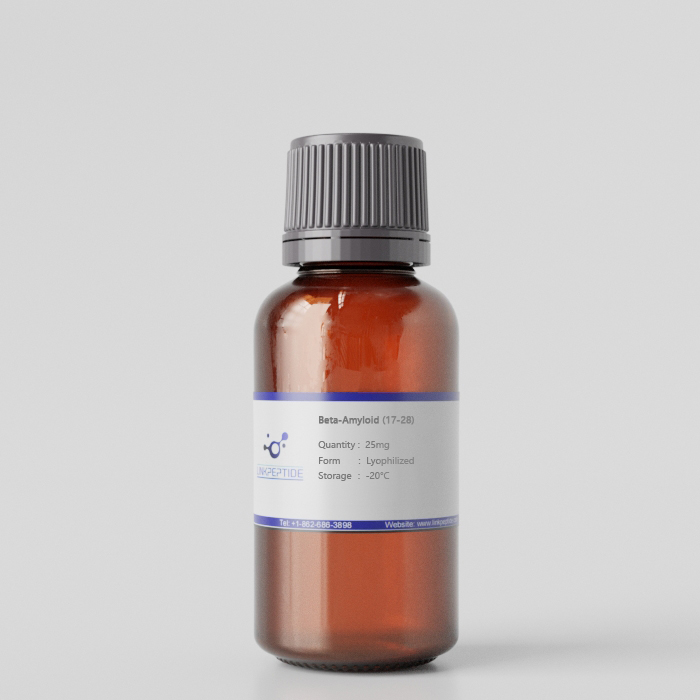
Product Name: Beta-Amyloid (17-28)
Sequence One Letter Code: LVFFAEDVGSNK
Sequence Three Letter Code: H-Leu-Val-Phe-Phe-Ala-Glu-Asp-Val-Gly-Ser-Asn-Lys-OH
Chemical Formula:C61H92N14O19
Molecular Weight: 1325.6
Purity: 95%
Form: Lyophilized
Storage Conditions: - 20 °C
Research Area: Alzheimer's Disease
Source / Species: human
Conjugation: Unconjugated
Code Nacres: NA.26
Application: β-Amyloid (17–28) is a synthetic peptide corresponding to the central hydrophobic core of the β-amyloid sequence, a region critical for aggregation and fibril stability. This segment contributes significantly to β-sheet formation and neurotoxic assembly processes associated with Alzheimer’s disease. The peptide is frequently used to study aggregation mechanisms, peptide–membrane interactions, and structure–function relationships that drive amyloid-induced neuronal dysfunction. It supports mechanistic and biophysical investigations of early aggregation events and amyloid-mediated cytotoxicity.
Current Research: β-Amyloid (Aβ) peptides are central to the molecular pathology of Alzheimer’s disease (AD), where progressive aggregation into oligomers and fibrils contributes to synaptic dysfunction and neuronal loss. Within the Aβ sequence, residues 17–28 constitute a critical segment often referred to as part of the central hydrophobic core. This region plays a decisive role in β-sheet formation, intermolecular packing, and stabilization of amyloid assemblies. β-Amyloid (17–28), a synthetic peptide corresponding to this core sequence, is widely used as a reductionist model to investigate aggregation mechanisms and structure–function relationships underlying amyloid-associated neurotoxicity. The 17–28 fragment encompasses key hydrophobic residues that promote self-association through van der Waals interactions and hydrogen bonding. In the context of full-length Aβ, this region contributes to the formation of cross-β spine structures characteristic of amyloid fibrils. Isolated β-Amyloid (17–28) retains the intrinsic propensity to adopt β-sheet conformations, particularly under aggregation-promoting conditions such as elevated peptide concentration, agitation, or the presence of membrane-mimetic environments. This makes it a tractable system for studying early nucleation events and intermolecular alignment without the complexity of longer Aβ isoforms. Biophysical analyses of β-Amyloid (17–28) frequently employ circular dichroism (CD) spectroscopy to monitor secondary structure transitions from random coil to β-sheet conformations. Thioflavin T fluorescence assays and Congo red binding experiments provide quantitative measures of amyloid-like assembly, while transmission electron microscopy and atomic force microscopy visualize fibrillar or oligomeric morphologies. Because of its shorter length, the peptide often forms well-defined aggregates that facilitate interpretation of kinetic and structural data. This fragment is particularly valuable for dissecting the contribution of the central hydrophobic domain to aggregation kinetics. Comparative studies between full-length Aβ1–40 or Aβ1–42 and truncated peptides demonstrate that residues 17–28 act as a nucleation core, lowering the energetic barrier to β-sheet stacking. Mutational analyses within this segment further reveal how specific side chains influence aggregation rate, fibril polymorphism, and stability. These experiments clarify the sequence determinants that drive pathogenic assembly pathways in AD. In addition to fibrillogenesis, β-Amyloid (17–28) is used to examine peptide–membrane interactions relevant to neuronal toxicity. The hydrophobic character of this region promotes insertion into lipid bilayers, particularly those enriched in negatively charged phospholipids or cholesterol-containing microdomains. Membrane interaction studies using liposome leakage assays, surface plasmon resonance, and fluorescence spectroscopy indicate that this segment can perturb bilayer integrity and influence membrane fluidity. Such interactions are thought to contribute to calcium dysregulation, oxidative stress, and activation of apoptotic signaling in neurons exposed to Aβ aggregates. The peptide also supports investigations into early-stage oligomer formation, which is increasingly recognized as a primary mediator of synaptic impairment. Short core fragments such as 17–28 provide simplified systems for characterizing transient oligomeric intermediates that precede fibril maturation. Nuclear magnetic resonance (NMR) spectroscopy and computational modeling have been applied to this segment to define conformational ensembles and intermolecular contacts that promote assembly. From a translational perspective, β-Amyloid (17–28) serves as a screening substrate for aggregation-modulating compounds and β-sheet–interfering agents. Small molecules, peptides, and antibodies designed to target the central hydrophobic core can be evaluated for their capacity to inhibit β-sheet formation or destabilize preformed aggregates. Because this region is central to amyloid stability, agents that effectively disrupt interactions within residues 17–28 may attenuate downstream fibril formation and cytotoxicity. In summary, β-Amyloid (17–28) represents a critical aggregation-prone segment within the Aβ sequence that drives β-sheet formation and amyloid stability. As a minimal yet functionally significant fragment, it provides a powerful tool for mechanistic, structural, and biophysical studies of amyloid assembly and membrane interactions. Its use advances understanding of early aggregation events and supports therapeutic strategies targeting the core determinants of amyloid-induced neuronal dysfunction in Alzheimer’s disease.
Get a Quote
 LinkPeptide

![[Nphe1]Nociceptin(1-13)NH2](https://www.linkpeptide.com/wp-content/uploads/2024/10/Nphe1Nociceptin1-13NH2-jpg-3.webp "[Nphe1]Nociceptin(1-13)NH2")
![[Phe1Ψ(CH2-NH)Gly2]Nociceptin(1-13)NH2](https://www.linkpeptide.com/wp-content/uploads/2024/10/Phe1¶aCH2-NHGly2Nociceptin1-13NH2-jpg.webp "[Phe1Ψ(CH2-NH)Gly2]Nociceptin(1-13)NH2")
![LEIUROTOXIN I [R7]-](https://www.linkpeptide.com/wp-content/uploads/2024/10/LEIUROTOXIN-I-R7-jpg-2.webp "LEIUROTOXIN I [R7]-")