Product Name: Beta-Amyloid (22-35)
Sequence One Letter Code: EDVGSNKGAIIGLM
Sequence Three Letter Code: H-Glu-Asp-Val-Gly-Ser-Asn-Lys-Gly-Ala-Ile-Ile-Gly-Leu-Met-OH
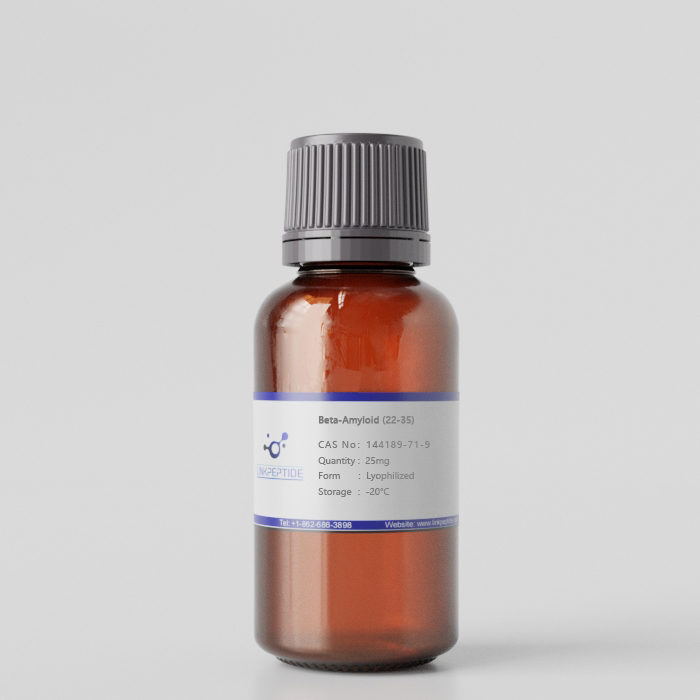
Cas No: 144189-71-9
Chemical Formula:C59H102N16O21S
Molecular Weight: 1403.7
Purity: 95%
Form: Lyophilized
Storage Conditions: - 20 °C
Research Area: Alzheimer's Disease
SMILES: CCC(C)C(C(=O)NC(C(C)CC)C(=O)NCC(=O)NC(CC(C)C)C(=O)NC(CCSC)C(=O)O)NC(=O)C(C)NC(=O)CNC(=O)C(CCCCN)NC(=O)C(CC(=O)N)NC(=O)C(CO)NC(=O)CNC(=O)C(C(C)C)NC(=O)C(CC(=O)O)NC(=O)C(CCC(=O)O)N
IUPAC: 4-amino-5-[[1-[[1-[[2-[[1-[[4-amino-1-[[6-amino-1-[[2-[[1-[[1-[[1-[[2-[[1-[(1-carboxy-3-methylsulfanylpropyl)amino]-4-methyl-1-oxopentan-2-yl]amino]-2-oxoethyl]amino]-3-methyl-1-oxopentan-2-yl]amino]-3-methyl-1-oxopentan-2-yl]amino]-1-oxopropan-2-yl]amino]-2-oxoethyl]amino]-1-oxohexan-2-yl]amino]-1,4-dioxobutan-2-yl]amino]-3-hydroxy-1-oxopropan-2-yl]amino]-2-oxoethyl]amino]-3-methyl-1-oxobutan-2-yl]amino]-3-carboxy-1-oxopropan-2-yl]amino]-5-oxopentanoic acid
INCHIKEY: KUDAPIFTNDCCFG-UHFFFAOYSA-N
INCHI:
InChI=1S/C59H102N16O21S/c1-11-30(7)47(57(93)65-25-42(79)67-36(21-28(3)4)52(88)70-35(59(95)96)18-20-97-10)75-58(94)48(31(8)12-2)74-49(85)32(9)66-41(78)24-63-51(87)34(15-13-14-19-60)69-53(89)37(22-40(62)77)72-55(91)39(27-76)68-43(80)26-64-56(92)46(29(5)6)73-54(90)38(23-45(83)84)71-50(86)33(61)16-17-44(81)82/h28-39,46-48,76H,11-27,60-61H2,1-10H3,(H2,62,77)(H,63,87)(H,64,92)(H,65,93)(H,66,78)(H,67,79)(H,68,80)(H,69,89)(H,70,88)(H,71,86)(H,72,91)(H,73,90)(H,74,85)(H,75,94)(H,81,82)(H,83,84)(H,95,96)
Source / Species: human
Conjugation: Unconjugated
Code Nacres: NA.26
Application: Beta-Amyloid (22–35) is a synthetic peptide fragment representing the hydrophobic core region of the β-amyloid sequence conserved across mammalian species. This segment plays a critical role in aggregation propensity and membrane-associated neurotoxicity. The peptide readily forms β-sheet–rich assemblies and induces oxidative stress and cellular dysfunction in neuronal models. Due to its strong aggregation characteristics, it serves as a minimal experimental model for investigating amyloid fibrillogenesis and membrane interactions. Beta-Amyloid (22–35) is widely used in neurodegeneration research to study mechanisms underlying amyloid toxicity, mitochondrial impairment, and neuronal injury. It also supports screening of aggregation inhibitors and neuroprotective compounds relevant to Alzheimer’s disease pathology.
Current Research: Beta-Amyloid (22–35) is a synthetic peptide fragment corresponding to the hydrophobic core region of the β-amyloid (Aβ) sequence, a domain highly conserved across mammalian species. This 14–residue segment encompasses a critical portion of the Aβ sequence responsible for aggregation propensity and membrane-associated cytotoxicity. Despite its truncated length, Aβ(22–35) retains the essential structural and biophysical characteristics that drive β-sheet formation and neurotoxic activity, making it a widely used minimal model for studying amyloid-related mechanisms. Structural and Biophysical Properties The 22–35 region lies within the central hydrophobic core of full-length Aβ peptides (Aβ1–40 and Aβ1–42), which are derived from proteolytic processing of amyloid precursor protein (APP). This core domain promotes self-association through hydrophobic interactions and backbone hydrogen bonding, facilitating β-sheet formation and fibril assembly. Beta-Amyloid (22–35) readily adopts β-sheet–rich conformations in solution and forms oligomers and fibrillar aggregates under physiological conditions. Its strong aggregation tendency enables reproducible in vitro modeling of amyloid fibrillogenesis without the structural complexity of full-length peptides. Because the aggregation kinetics are relatively rapid, it is particularly useful in time-course and mechanistic studies of peptide assembly. Membrane Interaction and Cytotoxic Mechanisms Aβ(22–35) exhibits pronounced membrane-binding properties due to its hydrophobic composition. It can associate with lipid bilayers, disrupt membrane integrity, and induce pore-like structures. These interactions contribute to calcium dysregulation, oxidative stress, and mitochondrial impairment in neuronal cells. Experimental evidence indicates that the peptide can: Increase reactive oxygen species (ROS) production Depolarize mitochondrial membranes Trigger apoptotic signaling pathways Impair synaptic function These features mirror key aspects of amyloid-induced neuronal injury observed in Alzheimer’s disease (AD) pathology. Applications in Neurodegeneration Research Beta-Amyloid (22–35) is extensively used in cellular and biochemical models to investigate mechanisms underlying amyloid toxicity. Common applications include: Neuronal viability assays Oxidative stress measurements Mitochondrial function analysis Calcium flux studies Lipid bilayer interaction assays Because it represents a minimal aggregation-prone motif, Aβ(22–35) provides a controlled system for dissecting structure–toxicity relationships and identifying molecular pathways contributing to neurodegeneration. Model for Amyloid Fibrillogenesis The peptide serves as a convenient experimental platform for studying amyloid formation mechanisms. Its ability to rapidly form β-sheet–rich assemblies allows researchers to monitor nucleation, elongation, and fibril maturation processes using spectroscopic methods such as circular dichroism (CD), Thioflavin T fluorescence, and electron microscopy. In addition, Aβ(22–35) supports comparative analyses of aggregation inhibitors, including small molecules, peptides, and natural compounds designed to interfere with β-sheet formation or oligomer stabilization. Screening of Neuroprotective Compounds Due to its reproducible toxicity profile in neuronal cultures, Beta-Amyloid (22–35) is widely applied in screening platforms for candidate neuroprotective agents. Compounds that reduce aggregation, mitigate oxidative stress, or protect mitochondrial integrity can be evaluated efficiently using this truncated model peptide. Such studies contribute to early-stage therapeutic research targeting amyloid-driven neurodegenerative processes. Experimental Advantages Represents the hydrophobic aggregation core of Aβ Rapid and reproducible β-sheet formation Suitable for biochemical and cell-based toxicity assays Facilitates mechanistic investigation of membrane disruption Compatible with inhibitor screening workflows Research Significance Beta-Amyloid (22–35) provides a structurally defined and experimentally tractable model for exploring amyloid aggregation and neurotoxicity. By capturing the key aggregation-driving segment of the full-length Aβ peptide, it enables focused investigation of fibrillogenesis, membrane interactions, oxidative stress pathways, and neuronal injury mechanisms relevant to Alzheimer’s disease and related neurodegenerative disorders.
Get a Quote
 LinkPeptide

![SCYLLATOXIN [Tyr2]-](https://www.linkpeptide.com/wp-content/uploads/2024/10/SCYLLATOXIN-Tyr2-jpg-2.webp "SCYLLATOXIN [Tyr2]-")