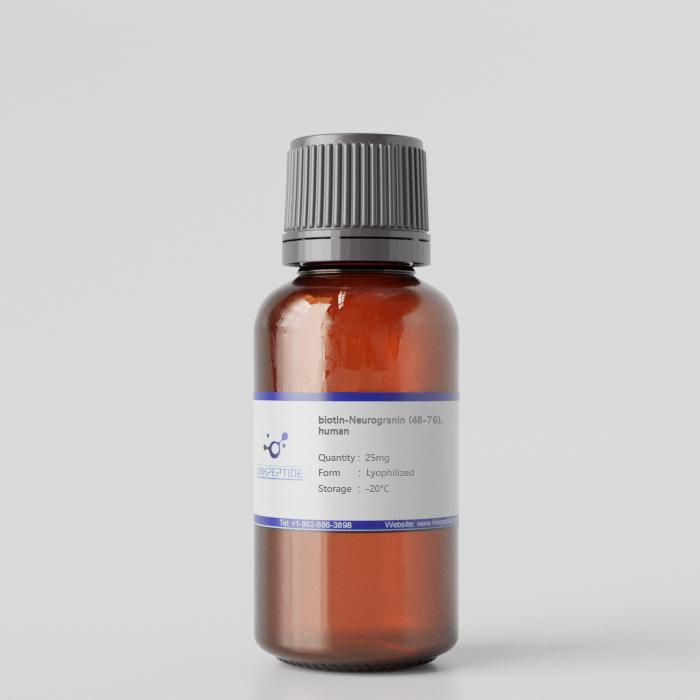
Product Name: Biotin-beta-Amyloid (1-42)
Sequence One Letter Code: Biotin-DAEFRHDSGYEVHHQKLVFFAEDVGSNKGAIIGLMVGGVVIA
Sequence Three Letter Code: Biotin-Asp-Ala-Glu-Phe-Arg-His-Asp-Ser-Gly-Tyr-Glu-Val-His-His-Gln-Lys-Leu-Val-Phe-Phe-Ala-Glu-Asp-Val-Gly-Ser-Asn-Lys-Gly-Ala-Ile-Ile-Gly-Leu-Met-Val-Gly-Gly-Val-Val-Ile-Ala-OH
Cas No: 102577-21-9
Chemical Formula:C213H325N57O62S2
Molecular Weight: 4740.4
Purity: 95%
Form: Lyophilized
Storage Conditions: - 20 °C
Research Area: Alzheimer's Disease
Source / Species: human
Conjugation: Conjugated
Conjugation Type: Biotins
Code Nacres: NA.26
Application: Biotin-β-Amyloid (1–42) is an N-terminally biotinylated derivative of the Aβ(1–42) peptide, one of the primary amyloid components of plaques found in Alzheimer’s disease. Aβ(1–42) is highly prone to aggregation and plays a central role in amyloid plaque formation and neuronal toxicity. The addition of a biotin tag enables affinity-based detection and capture using streptavidin or avidin systems, facilitating pull-down assays and interaction studies. Biotin-β-Amyloid (1–42) is widely used in biochemical and cellular assays to investigate protein–amyloid interactions, receptor binding, and mechanisms of amyloid aggregation. This peptide provides a useful tool for studying amyloid biology, screening amyloid-binding molecules, and exploring pathways involved in amyloid-mediated neurodegeneration.
Current Research: Biotin-β-Amyloid (1–42) is an N-terminally biotinylated version of the amyloid-β peptide Aβ(1–42), one of the principal peptide species associated with amyloid plaque formation in Alzheimer’s disease. Aβ(1–42) is widely studied because of its strong tendency to aggregate into oligomers and fibrils, structures that are closely linked to neuronal dysfunction and neurodegeneration. By attaching a biotin tag to the N-terminus of the peptide, researchers gain a convenient method for detecting and isolating the peptide through avidin–biotin affinity systems, making this modified peptide particularly useful for biochemical and cellular studies. Biotinylated Aβ(1–42) is therefore widely applied in experiments designed to investigate amyloid–protein interactions, receptor binding, and mechanisms of amyloid aggregation, helping scientists better understand the molecular processes associated with amyloid-related neurodegeneration. Amyloid-β and Alzheimer’s Disease Amyloid-β peptides originate from the amyloid precursor protein (APP) through sequential proteolytic cleavage by β-secretase and γ-secretase enzymes. These cleavage events generate several peptide forms, with Aβ(1–40) and Aβ(1–42) being the most prominent. Among these variants, Aβ(1–42) is particularly aggregation-prone and is strongly associated with the formation of amyloid plaques in the brain. The peptide can self-assemble into various aggregated structures, including: Soluble oligomers Protofibrils Insoluble amyloid fibrils These aggregates are thought to contribute to pathological processes such as synaptic dysfunction, neuronal stress, and inflammatory responses observed in neurodegenerative conditions. Because of its central role in amyloid pathology, Aβ(1–42) is frequently used as a model peptide in studies exploring protein misfolding and aggregation mechanisms. Biotinylation and Affinity-Based Detection The addition of biotin, a small vitamin molecule, provides a powerful method for peptide detection and isolation. Biotin binds with extremely high affinity to streptavidin and avidin proteins, forming one of the strongest known non-covalent biological interactions. By introducing a biotin tag at the N-terminus of Aβ(1–42), researchers can easily detect or capture the peptide using streptavidin-based systems. This strategy enables a variety of experimental techniques, including: Affinity pull-down assays Detection in biochemical assays Immobilization on streptavidin-coated surfaces Capture and purification of peptide-binding partners Because the biotin tag is relatively small, it generally has minimal impact on the aggregation properties of the peptide while providing a convenient handle for experimental manipulation. Studying Protein–Amyloid Interactions Biotin-β-Amyloid (1–42) is commonly used to investigate interactions between amyloid peptides and other proteins. Many cellular proteins are thought to interact with amyloid-β during disease progression, influencing processes such as aggregation, clearance, or toxicity. Using streptavidin-based pull-down assays, researchers can capture the biotinylated peptide and identify associated binding partners. These experiments help reveal proteins that interact with amyloid-β, including: Cell surface receptors Extracellular matrix proteins Molecular chaperones Enzymes involved in peptide processing Understanding these interactions provides important insight into the molecular pathways involved in amyloid formation and clearance. Applications in Receptor Binding Studies Another common use of Biotin-β-Amyloid (1–42) is in receptor binding experiments. Amyloid peptides can interact with various cell-surface receptors that may influence cellular signaling and neurotoxicity. By labeling Aβ(1–42) with biotin, researchers can track the peptide’s interaction with cellular receptors using streptavidin-based detection methods. This allows scientists to study: Binding affinity between amyloid peptides and receptors Cellular uptake or membrane association of amyloid peptides Signal transduction events triggered by peptide binding These experiments help clarify how amyloid peptides interact with neuronal cells and influence cellular responses. Screening of Amyloid-Binding Molecules Biotinylated Aβ peptides are also useful for screening experiments aimed at identifying molecules that interact with amyloid aggregates. In such assays, potential binding compounds can be evaluated for their ability to associate with or interfere with amyloid structures. Researchers may use these assays to investigate: Peptide–protein interaction dynamics Binding characteristics of candidate molecules Modulation of amyloid aggregation processes Using a biotin-labeled peptide simplifies the detection and isolation of peptide complexes in these experimental systems. Investigating Amyloid Aggregation Mechanisms Because Aβ(1–42) naturally forms oligomers and fibrils, Biotin-β-Amyloid (1–42) can also be used in studies examining aggregation behavior and amyloid assembly pathways. The biotin tag allows aggregated species to be captured and analyzed using streptavidin-based methods. These studies may focus on: Structural properties of amyloid assemblies Aggregation kinetics and fibril growth Interactions between amyloid peptides and cellular proteins Such research helps illuminate the mechanisms underlying protein misfolding and amyloid accumulation. Conclusion Biotin-β-Amyloid (1–42) is a biotinylated derivative of the aggregation-prone Aβ(1–42) peptide, a key component of amyloid plaques associated with Alzheimer’s disease. The addition of an N-terminal biotin tag enables affinity-based detection and capture using streptavidin or avidin systems, making the peptide highly useful for biochemical and cellular assays. By facilitating pull-down experiments, receptor binding studies, and investigations of amyloid aggregation, Biotin-β-Amyloid (1–42) serves as a valuable research tool for exploring protein–amyloid interactions, aggregation mechanisms, and molecular pathways involved in amyloid-mediated neurodegeneration.
Get a Quote
 LinkPeptide

![[Lys(Ac)79]-Histone H3 (69-89)-K(Biotin)](https://www.linkpeptide.com/wp-content/uploads/2026/06/LysAc79-Histone-H3-69-89-KBiotin.jpg "[Lys(Ac)79]-Histone H3 (69-89)-K(Biotin)")