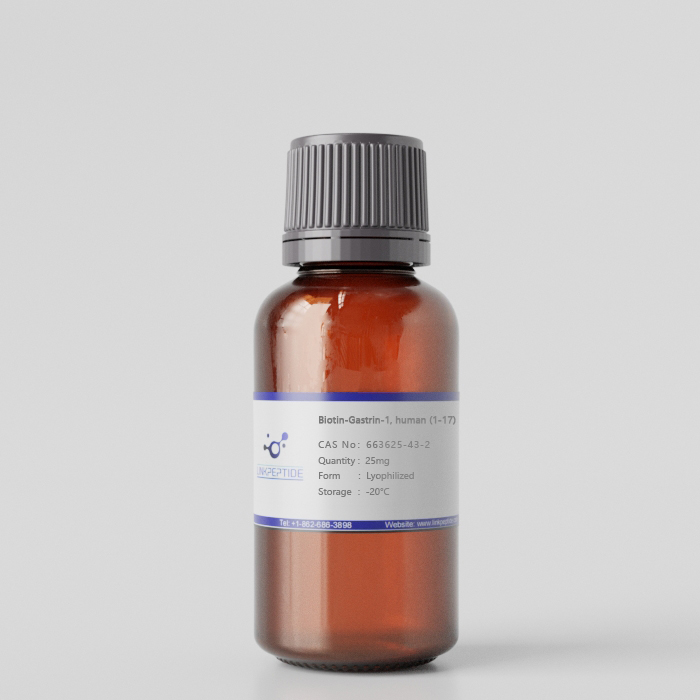
Product Name: Biotin-Gastrin-1, human (1-17)
Sequence One Letter Code: Biotin-EGPWLEEEEEAYGWMDF-NH2
Sequence Three Letter Code: Biotin-Glu-Gly-Pro-Trp-Leu-Glu-Glu-Glu-Glu-Glu-Ala-Tyr-Gly-Trp-Met-Asp-Phe-NH2
Cas No: 663625-43-2
Chemical Formula:C107H140N22O34S2
Molecular Weight: 2342.6
Purity: 95%
Form: Lyophilized
Storage Conditions: - 20 °C
Research Area: Endocrinology Disease Research
SMILES: C[C@@H](C(=O)N[C@@H](CC1=CC=C(C=C1)O)C(=O)NCC(=O)N[C@@H](CC2=CNC3=CC=CC=C32)C(=O)N[C@@H](CCSC)C(=O)N[C@@H](CC(=O)O)C(=O)N[C@@H](CC4=CC=CC=C4)C(=O)N)NC(=O)[C@H](CCC(=O)O)NC(=O)[C@H](CCC(=O)O)NC(=O)[C@H](CCC(=O)O)NC(=O)[C@H](CCC(=O)O)NC(=O)[C@H](CCC(=O)O)NC(=O)[C@H](CC(C)C)NC(=O)[C@H](CC5=CNC6=CC=CC=C65)NC(=O)[C@@H]7CCCN7C(=O)CNC(=O)[C@H](CCC(=O)O)NC(=O)CCCC[C@H]8[C@@H]9[C@H](CS8)NC(=O)N9
IUPAC: (4S)-4-[5-[(3aS,4S,6aR)-2-oxo-1,3,3a,4,6,6a-hexahydrothieno[3,4-d]imidazol-4-yl]pentanoylamino]-5-[[2-[(2S)-2-[[(2S)-1-[[(2S)-1-[[(2S)-1-[[(2S)-1-[[(2S)-1-[[(2S)-1-[[(2S)-1-[[(2S)-1-[[(2S)-1-[[2-[[(2S)-1-[[(2S)-1-[[(2S)-1-[[(2S)-1-amino-1-oxo-3-phenylpropan-2-yl]amino]-3-carboxy-1-oxopropan-2-yl]amino]-4-methylsulfanyl-1-oxobutan-2-yl]amino]-3-(1H-indol-3-yl)-1-oxopropan-2-yl]amino]-2-oxoethyl]amino]-3-(4-hydroxyphenyl)-1-oxopropan-2-yl]amino]-1-oxopropan-2-yl]amino]-4-carboxy-1-oxobutan-2-yl]amino]-4-carboxy-1-oxobutan-2-yl]amino]-4-carboxy-1-oxobutan-2-yl]amino]-4-carboxy-1-oxobutan-2-yl]amino]-4-carboxy-1-oxobutan-2-yl]amino]-4-methyl-1-oxopentan-2-yl]amino]-3-(1H-indol-3-yl)-1-oxopropan-2-yl]carbamoyl]pyrrolidin-1-yl]-2-oxoethyl]amino]-5-oxopentanoic acid
INCHIKEY: YCAQMDCEUIHYPE-CNCIPMBJSA-N
INCHI:
InChI=1S/C107H140N22O34S2/c1-54(2)43-73(124-104(160)76(47-59-50-110-64-20-11-9-18-62(59)64)126-106(162)79-21-14-41-129(79)83(133)52-112-94(150)65(28-34-84(134)135)114-81(131)23-13-12-22-80-91-78(53-165-80)127-107(163)128-91)102(158)120-70(33-39-89(144)145)100(156)119-69(32-38-88(142)143)99(155)118-68(31-37-87(140)141)98(154)117-67(30-36-86(138)139)97(153)116-66(29-35-85(136)137)96(152)113-55(3)93(149)123-74(45-57-24-26-60(130)27-25-57)95(151)111-51-82(132)115-75(46-58-49-109-63-19-10-8-17-61(58)63)103(159)121-71(40-42-164-4)101(157)125-77(48-90(146)147)105(161)122-72(92(108)148)44-56-15-6-5-7-16-56/h5-11,15-20,24-27,49-50,54-55,65-80,91,109-110,130H,12-14,21-23,28-48,51-53H2,1-4H3,(H2,108,148)(H,111,151)(H,112,150)(H,113,152)(H,114,131)(H,115,132)(H,116,153)(H,117,154)(H,118,155)(H,119,156)(H,120,158)(H,121,159)(H,122,161)(H,123,149)(H,124,160)(H,125,157)(H,126,162)(H,134,135)(H,136,137)(H,138,139)(H,140,141)(H,142,143)(H,144,145)(H,146,147)(H2,127,128,163)/t55-,65-,66-,67-,68-,69-,70-,71-,72-,73-,74-,75-,76-,77-,78-,79-,80-,91-/m0/s1
Source / Species: human
Conjugation: Conjugated
Conjugation Type: Biotins
Code Nacres: NA.26
Application: Biotin-Gastrin-1, human (1–17), is an N-terminally biotinylated peptide derived from human Gastrin-17, commonly referred to as “Little Gastrin.” Gastrin-17 is a key gastrointestinal hormone that regulates gastric acid secretion, mucosal growth, and digestive function. To enable biotin conjugation, the native N-terminal pyroglutamate residue is replaced with glutamate while preserving the biologically active core sequence. The biotin moiety facilitates affinity capture, immobilization, and sensitive detection using streptavidin-based systems in biochemical and cellular assays. This labeled peptide supports investigation of gastrin receptor binding, signal transduction pathways, and ligand–receptor interaction dynamics. It is well suited for receptor characterization, binding assays, and studies of gastric physiology and gastrointestinal signaling mechanisms in both basic research and translational applications.
Current Research: Biotin-Gastrin-1, human (1–17), is an N-terminally biotinylated derivative of human Gastrin-17, commonly known as “Little Gastrin.” Gastrin-17 is a principal gastrointestinal peptide hormone responsible for stimulating gastric acid secretion, promoting mucosal growth, and regulating digestive physiology. It exerts its biological effects primarily through activation of the cholecystokinin B/gastrin receptor (CCK2R), a G protein–coupled receptor expressed in gastric parietal cells, enterochromaffin-like cells, and certain neural and tumor tissues. In this modified construct, the native N-terminal pyroglutamate residue is replaced with glutamate to enable conjugation of the biotin moiety while preserving the biologically active core sequence required for receptor recognition. This design maintains functional integrity of the peptide’s C-terminal region, which is essential for high-affinity binding and receptor activation. As a result, the peptide retains its utility in receptor-focused assays while gaining the advantages of affinity tagging. The incorporation of biotin provides a versatile platform for affinity-based detection and immobilization. Through high-affinity interactions with streptavidin or avidin, Biotin-Gastrin-1 can be captured on coated surfaces, beads, or biosensor platforms. This enables flexible assay configurations, including solid-phase binding assays, pull-down experiments, and surface plasmon resonance studies. The biotin–streptavidin system supports sensitive and specific detection in both biochemical and cellular contexts. Biotin-Gastrin-1 is widely applied in receptor binding studies to characterize CCK2R affinity, ligand competition, and receptor density. Competitive binding assays can be performed by measuring displacement of the biotinylated peptide with unlabeled gastrin analogs or receptor antagonists. Immobilized formats further enable quantification of receptor–ligand interactions under controlled experimental conditions. These applications are particularly valuable for defining structure–activity relationships and evaluating pharmacological modulators targeting the gastrin signaling axis. In signal transduction research, the peptide supports mechanistic investigation of downstream pathways activated by gastrin receptor engagement. Activation of CCK2R typically stimulates phospholipase C, leading to inositol trisphosphate production, intracellular calcium mobilization, and protein kinase C activation. By integrating receptor binding assays with calcium flux measurements or phosphorylation analyses, researchers can correlate ligand engagement with functional signaling outputs. Beyond basic receptor pharmacology, Biotin-Gastrin-1 is relevant to studies of gastric physiology and pathophysiology. Gastrin signaling influences gastric epithelial proliferation, acid secretion regulation, and enterochromaffin-like cell activity. Dysregulated gastrin signaling has been implicated in hypergastrinemia, peptic ulcer disease, and certain gastrointestinal malignancies. The biotinylated peptide enables detailed examination of receptor expression patterns and ligand–receptor interaction dynamics in both normal and disease-associated tissues. In translational research, this reagent facilitates evaluation of therapeutic strategies targeting CCK2R. Immobilized ligand platforms can be used to screen small-molecule antagonists or antibodies designed to modulate gastrin-mediated signaling. The biotin tag enhances assay sensitivity and adaptability to microplate-based or biosensor systems suitable for high-throughput workflows. Overall, Biotin-Gastrin-1, human (1–17), provides a functionally relevant and experimentally versatile tool for investigating gastrin receptor biology. Its preserved active sequence combined with biotin-enabled affinity capture supports precise analysis of receptor binding, signal transduction, and gastrointestinal regulatory mechanisms in both fundamental and applied research settings.
Get a Quote
 LinkPeptide