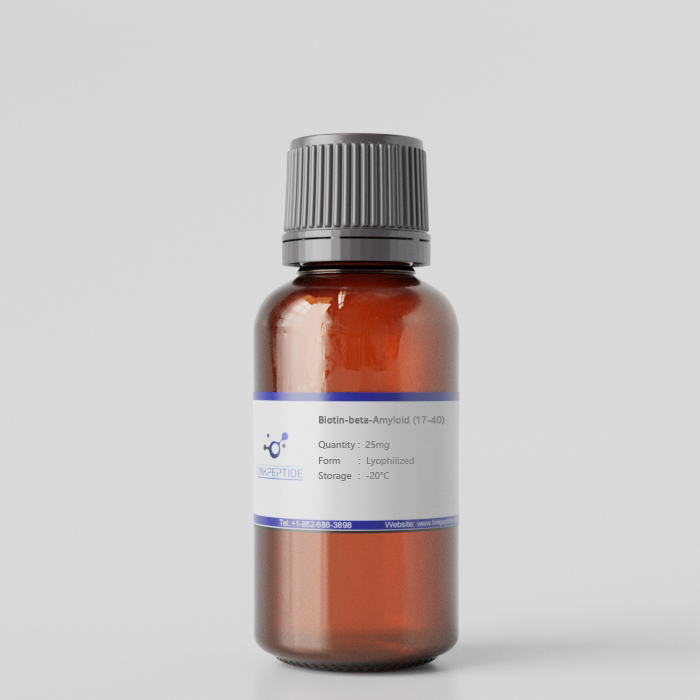
Product Name: [Lys(Ac)79]-Histone H3 (69-89)-K(Biotin)
Sequence One Letter Code: RLVREIAQDF-K(Ac)-TDLRFQSSAV-K(biotin)
Sequence Three Letter Code: H-Arg-Leu-Val-Arg-Glu-Ile-Ala-Gln-Asp-Phe-Lys(Ac)-Thr-Asp-Leu-Arg-Phe-Gln-Ser-Ser-Ala-Val-Lys(biotin)-OH
Molecular Weight: 2876.5
Purity: 95%
Form: Lyophilized
Storage Conditions: - 20 °C
Research Area: Cancer Disease Research
Source / Species: human
Conjugation: Conjugated
Conjugation Type: Biotins
Code Nacres: NA.26
Application: [Lys(Ac)79]-Histone H3 (69–89)-K(Biotin) is a synthetic histone H3 peptide encompassing residues 69–89, featuring acetylation at lysine 79 and C-terminal biotinylation. Although H3K79 acetylation has been observed in vivo, particularly in Saccharomyces cerevisiae, its functional significance in transcriptional regulation remains under investigation. The biotin tag enables affinity capture and protein interaction studies. This peptide supports research into acetylation-dependent chromatin recognition, enzyme specificity profiling, and modification-mediated recruitment of regulatory complexes. It is suitable for epigenetics studies examining histone modification crosstalk and transcriptional control mechanisms.
Current Research: [Lys(Ac)79]-Histone H3 (69–89)-K(Biotin) is a synthetic peptide spanning residues 69–89 of histone H3, containing site-specific acetylation at lysine 79 (H3K79ac) and a C-terminal biotin moiety for affinity-based applications. This region lies within the structured globular domain of histone H3 rather than the N-terminal tail, making H3K79 a distinctive modification site embedded within the nucleosome core. The peptide enables focused study of acetylation at this non-tail lysine residue and its potential regulatory functions. H3K79 is more commonly associated with methylation catalyzed by DOT1L, which correlates with transcriptional activity and plays a prominent role in leukemogenesis when aberrantly regulated. In contrast, acetylation at H3K79 has been reported less frequently and is best characterized in Saccharomyces cerevisiae, where it has been detected in vivo and linked to active chromatin states. However, the functional implications of H3K79 acetylation in higher eukaryotes remain incompletely defined, making it an area of active epigenetic research. Because H3K79 resides within the nucleosome core, its modification may influence chromatin structure through subtle alterations in histone–DNA interactions or nucleosome stability rather than through the protruding tail–reader interactions typical of other acetylation sites. Acetylation neutralizes the positive charge of lysine, potentially affecting electrostatic interactions between histone H3 and negatively charged DNA. The synthetic peptide provides a defined substrate for investigating how acetylation at this position alters binding affinity of chromatin-associated proteins. The C-terminal biotin tag facilitates immobilization on streptavidin-coated matrices, enabling pull-down assays and affinity purification of interacting proteins. Nuclear extracts can be incubated with the peptide to identify proteins that preferentially recognize or discriminate against the acetylated K79 state. Comparative experiments using unmodified or methylated H3K79 peptides allow researchers to explore modification-specific binding and potential crosstalk between acetylation and methylation at the same residue. In enzymology studies, the peptide supports profiling of histone acetyltransferase (HAT) and deacetylase (HDAC) activity. Although nucleosomal context is often required for full physiological relevance, peptide substrates provide a simplified system for initial characterization of enzyme specificity and catalytic efficiency. Screening assays may use this peptide to determine whether candidate acetyltransferases can target H3K79 and how acetylation interacts with adjacent modifications. The reagent is also valuable for antibody validation. Given the structural proximity of H3K79 to methylated forms of the same residue, ensuring specificity of antibodies recognizing H3K79ac is critical. Defined acetylated and non-acetylated peptides serve as controls in dot blot and ELISA assays to confirm selectivity and avoid cross-reactivity. In broader epigenetic research, [Lys(Ac)79]-Histone H3 (69–89)-K(Biotin) supports investigation into histone modification crosstalk. Because K79 can undergo both methylation and acetylation, studies may examine how these mutually exclusive modifications influence transcriptional elongation, chromatin accessibility, or recruitment of regulatory complexes. Understanding this interplay is particularly relevant in disease contexts where epigenetic balance is disrupted. Overall, this biotinylated, site-specifically acetylated H3 peptide provides a targeted tool for studying H3K79 acetylation biology. It enables affinity-based interaction studies, enzyme specificity assays, and analysis of modification-dependent chromatin recognition. As the functional significance of H3K79ac continues to be elucidated, this peptide supports mechanistic exploration of transcriptional regulation and epigenetic signaling within the nucleosome core.
Get a Quote
 LinkPeptide
![[Lys(Ac)79]-Histone H3 (69-89)-K(Biotin)](https://www.linkpeptide.com/wp-content/uploads/2026/06/LysAc79-Histone-H3-69-89-KBiotin.jpg)