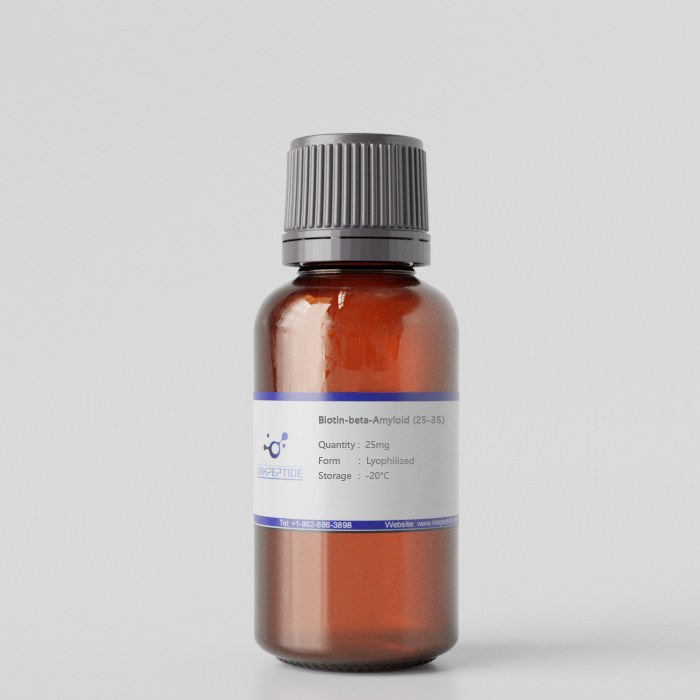
Product Name: Biotin-beta-Amyloid (25-35)
Sequence One Letter Code: Biotin-GSNKGAIIGLM
Sequence Three Letter Code: Biotin-Gly-Ser-Asn-Lys-Gly-Ala-Ile-Ile-Gly-Leu-Met-OH
Chemical Formula:C55H95N15O16S2
Molecular Weight: 1286.7
Purity: 95%
Form: Lyophilized
Storage Conditions: - 20 °C
Research Area: Alzheimer's Disease
Source / Species: human
Conjugation: Conjugated
Conjugation Type: Biotins
Code Nacres: NA.26
Application: Biotin–Beta-Amyloid (25–35) is a C-terminally biotinylated amyloid-β fragment encompassing a core region associated with aggregation and neurotoxicity. Despite its truncated length, this peptide retains amphiphilic properties and readily forms oligomers and fibrillar aggregates. These assemblies exhibit neurotrophic or neurotoxic effects depending on experimental conditions, making the fragment a practical model for studying amyloid-induced cellular responses. The biotin moiety enables affinity capture, pull-down assays, and interaction profiling with amyloid-binding proteins. This peptide is widely applied in investigations of aggregation kinetics, toxicity mechanisms, and conformational transitions relevant to Alzheimer’s disease pathology.
Current Research: Amyloid-β (Aβ) aggregation is a defining feature of Alzheimer’s disease (AD) and plays a central role in the molecular mechanisms underlying neurodegeneration. Although full-length Aβ peptides such as Aβ40 and Aβ42 are the principal components of amyloid plaques, shorter fragments derived from specific regions of the sequence are widely used in experimental models. Among these, the Aβ (25–35) fragment represents a particularly important core region associated with amyloid aggregation and neurotoxicity. When modified with a C-terminal biotin tag, the resulting Biotin–Beta-Amyloid (25–35) peptide becomes a versatile probe for studying amyloid interactions, aggregation behavior, and cellular responses relevant to Alzheimer’s disease pathology. One key area of current research focuses on the aggregation properties of the Aβ (25–35) fragment. Despite its relatively short sequence, this peptide retains the amphiphilic characteristics of the full-length amyloid-β protein and readily forms oligomeric and fibrillar structures under physiological conditions. These aggregates exhibit structural features typical of amyloid assemblies, including β-sheet–rich conformations. Because the peptide aggregates rapidly and reproducibly, it serves as a convenient experimental model for examining the kinetics of amyloid formation and the early stages of peptide self-assembly. Researchers frequently monitor aggregation using methods such as Thioflavin T fluorescence assays, circular dichroism spectroscopy, and electron microscopy. The Aβ (25–35) fragment is also widely used in studies investigating amyloid-induced neurotoxicity. Numerous experimental systems have demonstrated that oligomeric assemblies of this peptide can trigger cellular stress responses in neuronal cultures. These effects may include mitochondrial dysfunction, oxidative stress, disruption of calcium homeostasis, and activation of apoptotic signaling pathways. Because the fragment reproduces several toxic properties associated with longer Aβ peptides, it has become a practical model for exploring how amyloid aggregates damage neurons and contribute to neurodegenerative processes. Another important research application involves the use of biotinylated Aβ peptides for protein interaction studies. The biotin tag allows the peptide to be immobilized or captured using streptavidin-based systems, enabling affinity pull-down assays and interaction profiling experiments. Through these approaches, researchers can identify proteins that bind to amyloid aggregates, including cell surface receptors, chaperone proteins, and enzymes involved in amyloid clearance. Mapping these interactions helps clarify how amyloid peptides influence cellular signaling pathways and how certain proteins may modulate amyloid toxicity or aggregation. Recent work has also explored the conformational transitions of amyloid peptides and how these structural changes influence biological activity. Amyloid peptides can exist in multiple aggregation states, ranging from soluble monomers and oligomers to highly ordered fibrils. Evidence suggests that different structural forms may have distinct biological effects, with soluble oligomers often considered particularly neurotoxic. The Aβ (25–35) fragment provides a simplified system for investigating these transitions and understanding how structural variations correlate with cellular outcomes. In addition, the peptide is frequently incorporated into drug discovery and screening efforts aimed at identifying compounds capable of inhibiting amyloid aggregation or protecting neurons from amyloid-induced toxicity. Researchers use aggregation assays and cell-based models involving Aβ (25–35) to evaluate candidate molecules, including small-molecule inhibitors, peptides, and natural products. These studies contribute to the broader search for therapeutic strategies targeting amyloid pathology in Alzheimer’s disease. Biotinylated versions of amyloid peptides also support advanced imaging and analytical techniques. By leveraging the strong affinity between biotin and streptavidin, investigators can label or isolate amyloid complexes in biochemical experiments, facilitating detection in microscopy-based studies or proteomic analyses. Such tools help researchers examine how amyloid assemblies interact with cellular components and how these interactions change during disease progression. In summary, Biotin–Beta-Amyloid (25–35) is an important research reagent for studying amyloid aggregation, protein–protein interactions, and neurotoxic mechanisms associated with Alzheimer’s disease. Its rapid aggregation behavior and compatibility with affinity-based analytical techniques make it a practical model for investigating amyloid biology and identifying molecular pathways involved in neurodegeneration. Through these applications, the peptide continues to support efforts to understand amyloid pathology and develop strategies for combating Alzheimer’s disease.
Get a Quote
 LinkPeptide

![[Lys(Me3)27]-Histone H3 (23-34)-GGK(Biotin)](https://www.linkpeptide.com/wp-content/uploads/2026/05/LysMe327-Histone-H3-23-34-GGKBiotin.jpg "[Lys(Me3)27]-Histone H3 (23-34)-GGK(Biotin)")