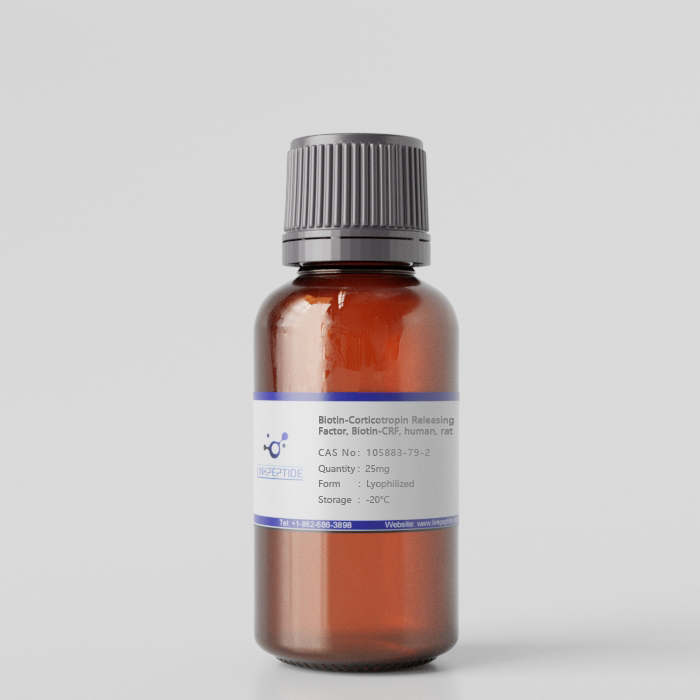
Product Name: Biotin-Corticotropin Releasing Factor, Biotin-CRF, human, rat
Sequence One Letter Code: Biotin-SEEPPISLDLTFHLLREVLEMARAEQLAQQAHSNRKLMEII-NH2
Sequence Three Letter Code: Biotin-Ser-Glu-Glu-Pro-Pro-Ile-Ser-Leu-Asp-Leu-Thr-Phe-His-Leu-Leu-Arg-Glu-Val-Leu-Glu-Met-Ala-Arg-Ala-Glu-Gln-Leu-Ala-Gln-Gln-Ala-His-Ser-Asn-Arg-Lys-Leu-Met-Glu-Ile-Ile-NH2
Cas No: 105883-79-2
Chemical Formula:C218H358N62O65S3
Molecular Weight: 4984.1
Purity: 95%
Form: Lyophilized
Storage Conditions: - 20 °C
Research Area: Endocrinology Disease Research
Source / Species: Human, rat
Conjugation: Conjugated
Conjugation Type: Biotins
Code Nacres: NA.26
Application: Biotin–Corticotropin Releasing Factor (Biotin-CRF) is a biotinylated form of the neuropeptide CRF, a central regulator of the hypothalamic–pituitary–adrenal (HPA) axis that coordinates endocrine, autonomic, and behavioral responses to stress. In addition to its neuroendocrine functions, CRF modulates cardiovascular activity, gastrointestinal physiology, and immune responses. Biotin conjugation enables sensitive detection, affinity purification, and receptor interaction studies using streptavidin-based platforms. This peptide supports biochemical and cell-based investigations of CRF receptor signaling, stress physiology, and neuroendocrine regulatory mechanisms.
Current Research: Biotin–Corticotropin Releasing Factor (Biotin-CRF) is a biotinylated derivative of corticotropin releasing factor (CRF), a 41–amino acid neuropeptide that functions as a principal regulator of the hypothalamic–pituitary–adrenal (HPA) axis. CRF orchestrates endocrine, autonomic, and behavioral responses to stress by stimulating adrenocorticotropic hormone (ACTH) release from the anterior pituitary, ultimately driving glucocorticoid secretion from the adrenal cortex. Biotin conjugation preserves receptor-binding capability while enabling high-sensitivity detection and affinity-based applications through streptavidin–biotin interactions. This modification makes Biotin-CRF a versatile probe for receptor pharmacology and neuroendocrine signaling studies. Biological Context CRF exerts its effects primarily through CRF receptor type 1 (CRFR1) and CRF receptor type 2 (CRFR2), both G protein–coupled receptors (GPCRs). Activation of these receptors initiates intracellular signaling cascades involving: cAMP/PKA pathways MAPK/ERK signaling Calcium mobilization CREB phosphorylation Beyond its canonical role in HPA axis activation, CRF influences: Cardiovascular regulation (heart rate, vascular tone) Gastrointestinal function (motility and secretion) Immune modulation (cytokine production, inflammatory responses) Behavioral stress responses These broad physiological roles position CRF as a central integrator of stress-related signaling networks. Functional Advantages of Biotin Conjugation Biotinylation enables multiple experimental applications without requiring secondary labeling steps. Key advantages include: High-affinity capture via streptavidin-coated surfaces Compatibility with ELISA, pull-down assays, and biosensor platforms Fluorescent detection using streptavidin-conjugated reporters Receptor binding and internalization tracking Because the biotin–streptavidin interaction is exceptionally strong (Kd ~10⁻¹⁵ M), Biotin-CRF is particularly suitable for stable immobilization and affinity purification workflows. Research Applications 1. Receptor Binding and Pharmacology Biotin-CRF can be used in competitive binding assays to evaluate CRFR1/CRFR2 affinity and ligand displacement. It supports quantitative analysis of receptor–ligand interactions using ELISA-based systems, surface plasmon resonance (SPR), or plate-based detection methods. 2. Receptor Localization and Internalization Studies In cell-based systems, biotinylated CRF allows investigation of receptor engagement, endocytosis, and trafficking. Detection with fluorescent streptavidin facilitates visualization by confocal microscopy or flow cytometry. 3. Affinity Purification and Protein Interaction Studies The peptide can be immobilized on streptavidin matrices to isolate CRF-binding proteins or receptor complexes from cellular extracts, enabling downstream biochemical characterization. 4. Stress Physiology and Signaling Pathway Analysis Biotin-CRF supports mechanistic studies of HPA axis regulation, GPCR signaling dynamics, and cross-talk between neuroendocrine and immune pathways. Experimental Considerations The position of biotin conjugation may influence receptor interaction kinetics; assay validation is recommended when comparing with native CRF. Optimal working concentrations should be determined empirically based on receptor expression levels and assay format. Inclusion of non-biotinylated CRF controls can help confirm functional equivalence in signaling assays.
Get a Quote
 LinkPeptide

![[Lys(Me3)79]-Histone H3 (69-89)-K(Biotin)](https://www.linkpeptide.com/wp-content/uploads/2026/05/LysMe379-Histone-H3-69-89-KBiotin.jpg "[Lys(Me3)79]-Histone H3 (69-89)-K(Biotin)")