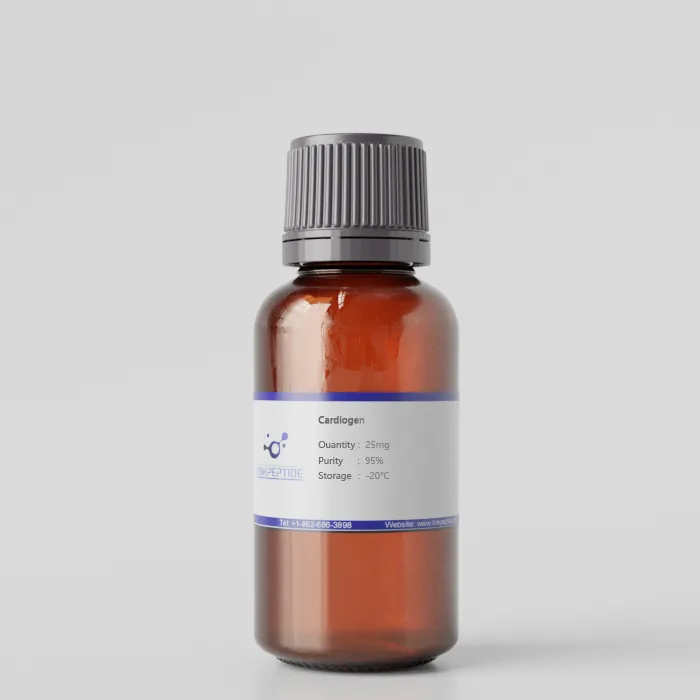
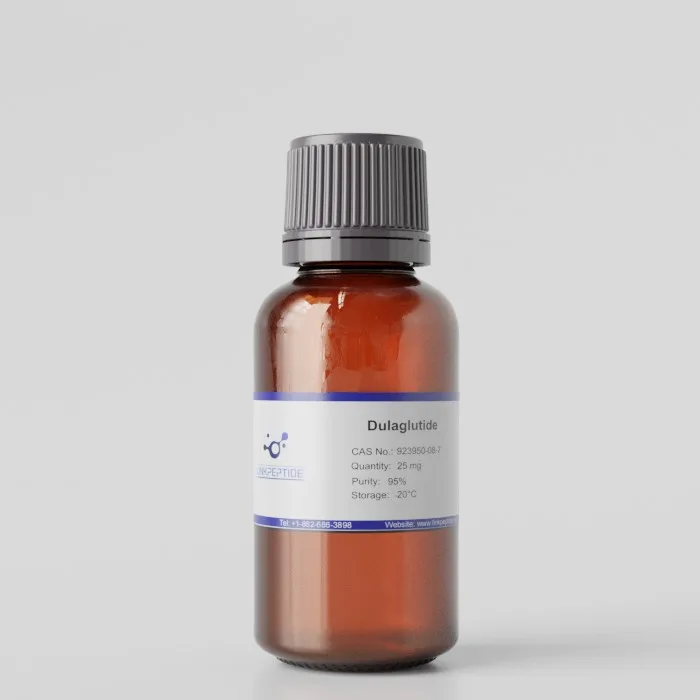
Product Name:Cardiogen
Purity:95%
Chemical Formula:C18H31N7O9
Molar Mass:489.5
IUPAC Name:(4S)-4-[[(2S)-2-aminopropanoyl]amino]-5-[[(2S)-3-carboxy-1-[[(1S)-1-carboxy-4-(diaminomethylideneamino)butyl]amino]-1-oxopropan-2-yl]amino]-5-oxopentanoic acid
SMILES:C[C@@H](C(=O)N[C@@H](CCC(=O)O)C(=O)N[C@@H](CC(=O)O)C(=O)N[C@@H](CCCN=C(N)N)C(=O)O)N
InChIKey:QXQARLZWUIQZPX-NAKRPEOUSA-N
InChI:InChI=1S/C18H31N7O9/c1-8(19)14(30)23-9(4-5-12(26)27)15(31)25-11(7-13(28)29)16(32)24-10(17(33)34)3-2-6-22-18(20)21/h8-11H,2-7,19H2,1H3,(H,23,30)(H,24,32)(H,25,31)(H,26,27)(H,28,29)(H,33,34)(H4,20,21,22)/t8-,9-,10-,11-/m0/s1
Storage:-20 degree Celsius
Sequence:AEDR
Application:Cardiogen is a novel research compound developed for investigating cardiovascular repair, protection, and remodeling. Designed to support studies in ischemic injury, myocardial regeneration, and vascular remodeling, Cardiogen acts on key pathways involved in cardiomyocyte survival, angiogenesis, and extracellular matrix stabilization. Its mechanism targets cellular energy regulation, oxidative stress reduction, and endothelial function enhancement, making it a versatile tool in preclinical models of heart failure, myocardial infarction, and cardiomyopathies. With high purity and bioactivity, Cardiogen is optimized for both in vitro and in vivo experimental applications. For research use only—Cardiogen is not intended for human or veterinary therapeutic use.
Current Research:ntroduction: Cardiovascular Damage and the Need for Regenerative Agents Cardiovascular diseases remain the leading cause of mortality globally, driven largely by ischemic injury, hypertensive heart disease, and cardiomyopathies. Traditional treatments focus on symptom management and slowing disease progression, but there is a growing interest in therapies that repair or regenerate damaged cardiac tissue. Cardiogen is one such investigational compound, increasingly studied for its pro-regenerative, anti-apoptotic, and angiogenic effects in cardiac tissue. Mechanism of Action: Supporting Cardiac Repair Cardiogen is believed to exert its therapeutic potential by modulating several biological pathways: AMPK activation and mitochondrial biogenesis – similar to AICAR or metformin, Cardiogen enhances energy metabolism, preserving ATP levels in stressed cardiomyocytes. PI3K/Akt and ERK signaling – these pathways are critical for cell survival and anti-apoptotic signaling during myocardial ischemia. VEGF induction and angiogenesis – Cardiogen promotes vascular regeneration by upregulating vascular endothelial growth factor, thereby improving blood supply to ischemic areas. Anti-fibrotic modulation – it suppresses TGF-β1 and fibronectin, limiting scar tissue formation post-injury. These effects together make Cardiogen a multifunctional cardioprotective agent in experimental settings. Applications in Ischemia-Reperfusion Injury In preclinical rat models of acute myocardial infarction (AMI), Cardiogen has been shown to: Reduce infarct size Improve left ventricular ejection fraction Enhance survival rates These effects are associated with reduced oxidative stress markers (e.g., MDA) and increased expression of antioxidant enzymes such as SOD and catalase. By limiting mitochondrial dysfunction, Cardiogen preserves cardiomyocyte viability under hypoxic stress, a major factor in improving outcomes after cardiac ischemia. Heart Failure and Ventricular Remodeling In chronic models of heart failure post-AMI, Cardiogen has demonstrated potential in: Reducing pathological hypertrophy Preventing left ventricular dilation Preserving myocardial wall thickness This remodeling prevention is due in part to the downregulation of matrix metalloproteinases (MMP-2 and MMP-9), which are involved in degrading the extracellular matrix and promoting maladaptive remodeling. Cardiogen’s role in preserving structural integrity of cardiac tissue makes it a candidate for anti-fibrotic and anti-remodeling interventions. Vascular Function and Endothelial Health Cardiogen has also been explored in vascular endothelial dysfunction models, particularly relevant to diabetes and hypertension. It appears to enhance nitric oxide bioavailability, promoting vasodilation and reducing vascular stiffness. In animal models, Cardiogen improved flow-mediated dilation and reduced arterial intima-media thickness, indicating potential benefit in early-stage atherosclerosis. Moreover, it may offer protection to endothelial progenitor cells (EPCs), which are vital for vascular regeneration. Studies have shown increased EPC mobilization and survival in the presence of Cardiogen, suggesting applications in both acute injury and chronic vascular disease. Synergistic Potential with Existing Therapies Interestingly, Cardiogen has shown synergistic effects when combined with standard therapies such as beta-blockers, ACE inhibitors, or statins. Its ability to target mitochondrial and inflammatory stress pathways complements the hemodynamic benefits of conventional drugs, offering a multi-pronged approach to cardiovascular protection. It may also enhance the efficacy of stem cell-based therapies, improving the survival and integration of transplanted cells in ischemic myocardium—a major hurdle in regenerative medicine. Conclusion: A Promising Tool for Cardiovascular Research Cardiogen represents a new class of cardioactive molecules with multifunctional roles in repair, protection, and regeneration. By targeting energy metabolism, apoptosis, angiogenesis, and fibrosis, it addresses multiple facets of heart disease progression. Although still in the research phase, Cardiogen’s versatility makes it a compelling compound for studies in cardiac ischemia, heart failure, endothelial dysfunction, and vascular aging. Future directions include elucidating its full signaling cascade, optimizing delivery routes (e.g., intramyocardial vs systemic), and potential use in combination therapeutics. As interest grows in regenerative cardiology, Cardiogen may help bridge the gap between experimental research and clinical innovation.
Reference:
Get a Quote
 LinkPeptide