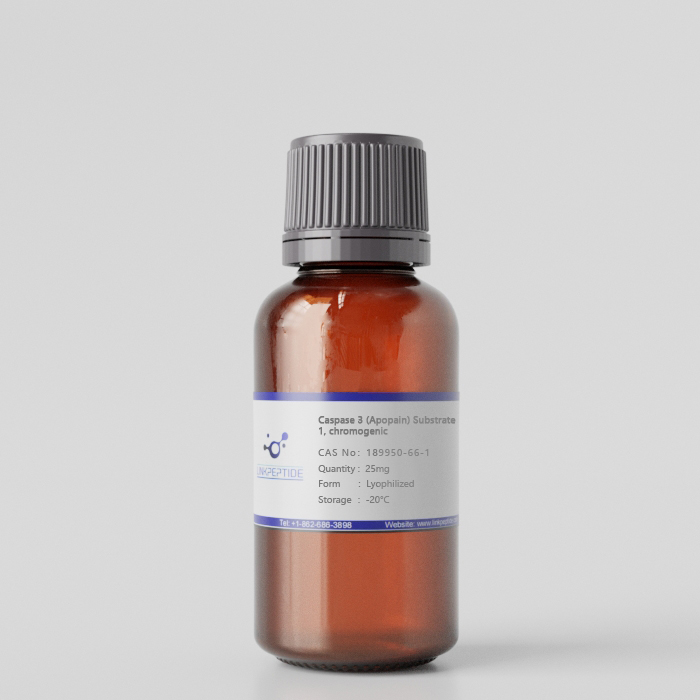
Product Name: Caspase 3 (Apopain) Substrate 1, chromogenic
Sequence One Letter Code: Ac-DEVD-pNA
Sequence Three Letter Code: Ac-Asp-Glu-Val-Asp-pNA
Cas No: 189950-66-1
Chemical Formula:C26H34N6O13
Molecular Weight: 638.6
Purity: 95%
Form: Lyophilized
Storage Conditions: - 20 °C Protected from light
Research Area: peptide substrate
Conjugation: Conjugated
Conjugation Type: Conjugates
Code Nacres: NA.26
Application: Caspase-3 (Apopain) Substrate 1, chromogenic, is a pNA-based peptide substrate developed for colorimetric quantification of caspase activity in apoptosis and inflammation research. It is efficiently cleaved by caspase-3 (Km ≈ 11 µM, kcat ≈ 2.4 s⁻¹), caspase-7 (Km ≈ 12 µM), and caspase-1 (Km ≈ 18 µM), enabling broad assessment of caspase activation profiles. Proteolytic cleavage releases 4-nitroaniline (pNA), which generates a measurable absorbance signal at 405–408 nm. This substrate supports kinetic characterization, inhibitor evaluation, and comparative analysis of caspase-mediated proteolytic pathways in biochemical assays.
Current Research: Caspase-3 (Apopain) Substrate 1, chromogenic is a peptide-based, pNA (4-nitroaniline)–conjugated substrate developed for colorimetric quantification of caspase activity in apoptosis and inflammation research. The peptide sequence incorporates a canonical caspase recognition motif linked to pNA at the C-terminus. Upon proteolytic cleavage, free pNA is released, producing a measurable absorbance signal at 405–408 nm, enabling straightforward spectrophotometric detection. This substrate is efficiently hydrolyzed by multiple caspases, including: Caspase-3 (Km ≈ 11 µM; kcat ≈ 2.4 s⁻¹) Caspase-7 (Km ≈ 12 µM) Caspase-1 (Km ≈ 18 µM) These kinetic parameters support reliable assessment of executioner and inflammatory caspase activity in biochemical assay systems. Biological Context Caspases are cysteine proteases that mediate programmed cell death and inflammatory signaling. Caspase-3 and caspase-7 are executioner caspases activated downstream of intrinsic and extrinsic apoptotic pathways. Caspase-1 functions primarily in inflammasome-mediated processing of pro-inflammatory cytokines such as IL-1β and IL-18. The ability of this chromogenic substrate to be cleaved by multiple caspases makes it suitable for comparative profiling of apoptotic and inflammatory proteolytic activity. Mechanism of Detection In its intact form, the peptide–pNA conjugate exhibits minimal absorbance at 405–408 nm. Upon cleavage at the caspase-specific recognition site: The peptide bond adjacent to pNA is hydrolyzed. Free 4-nitroaniline (pNA) is released. Accumulation of pNA generates a time-dependent increase in absorbance measurable by standard microplate readers. The rate of absorbance increase is directly proportional to enzymatic activity, enabling both endpoint and kinetic measurements. Research Applications 1. Apoptosis Quantification The substrate is widely used to measure caspase activation in cell lysates following treatment with chemotherapeutics, cytokines, oxidative stressors, or death receptor ligands. 2. Kinetic Characterization Purified caspase enzymes can be analyzed to determine Km, kcat, and catalytic efficiency, supporting mechanistic studies of enzyme function. 3. Inhibitor Screening Chromogenic detection is well suited for evaluating competitive or irreversible caspase inhibitors. Decreased pNA release reflects inhibitory potency and target engagement. 4. Comparative Caspase Profiling Because the substrate is cleaved by caspase-3, -7, and -1, it allows comparative assessment of apoptosis-related versus inflammation-related protease activity under defined conditions. Advantages Simple colorimetric readout Compatible with standard absorbance plate readers Continuous kinetic monitoring possible Suitable for purified enzyme and cell lysate assays No requirement for fluorescence detection equipment Experimental Considerations Optimal assay conditions typically include reducing agents (e.g., DTT) to maintain caspase catalytic activity. Substrate concentration should be selected relative to Km for accurate kinetic analysis. Inclusion of selective caspase inhibitors is recommended to confirm enzyme specificity, particularly when multiple caspases may be active in a sample.
Get a Quote
 LinkPeptide