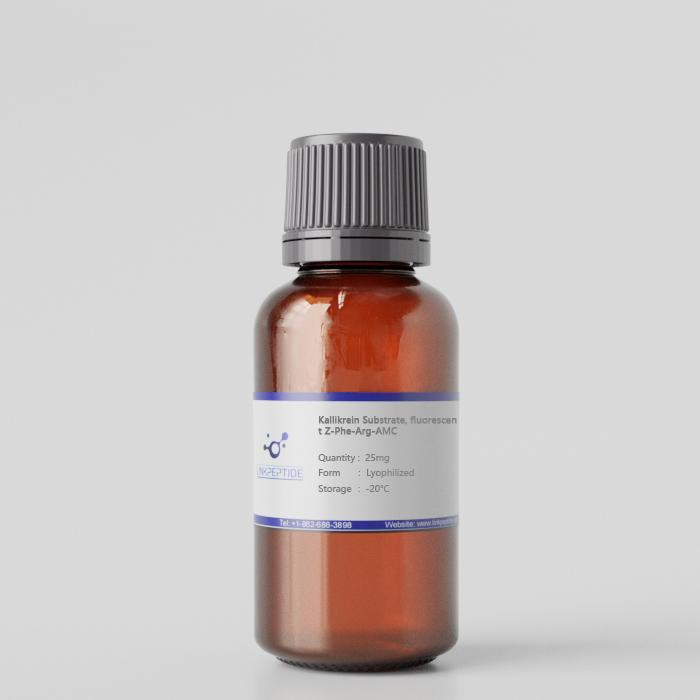
Product Name: Kallikrein Substrate, fluorescent Z-Phe-Arg-AMC - 10 mg
Sequence One Letter Code: Z-FR-AMC
Sequence Three Letter Code: Z-Phe-Arg-AMC
Chemical Formula:C33H36N6O6
Molecular Weight: 612.7
Purity: 95%
Form: Lyophilized
Storage Conditions: - 20 °C Protected from light
Research Area: peptide substrate
Source / Species: Synthetic construct
Conjugation: Conjugated
Conjugation Type: Fluorescent dyes
Code Nacres: NA.26
Application: Z-Phe-Arg-AMC is a fluorogenic peptide substrate designed for sensitive detection of kallikrein protease activity. Kallikreins are serine proteases involved in blood pressure regulation, inflammation, and tissue remodeling. Cleavage at the Arg residue releases the AMC fluorophore, producing a strong fluorescence signal detectable at Ex 353 nm and Em 442 nm. The substrate enables real-time monitoring of enzyme kinetics and is well suited for inhibitor screening and functional studies of kallikrein family members.
Current Research: Z-Phe-Arg-AMC is a fluorogenic peptide substrate developed for sensitive and quantitative detection of kallikrein serine protease activity. The substrate consists of a carbobenzoxy (Z)–protected dipeptide, Phe–Arg, conjugated to 7-amino-4-methylcoumarin (AMC). Upon enzymatic cleavage at the C-terminal arginine residue, free AMC is released, generating a strong fluorescent signal measurable at approximately Ex 353 nm and Em 442 nm. Because kallikreins preferentially cleave peptide bonds following basic residues such as arginine, Z-Phe-Arg-AMC serves as a convenient and sensitive reporter substrate for functional assays. Biological Context The kallikrein family comprises secreted serine proteases with diverse physiological roles, including: Blood pressure regulation via the kallikrein–kinin system Inflammatory signaling through bradykinin generation Coagulation and fibrinolysis modulation Extracellular matrix remodeling and tissue turnover Dysregulated kallikrein activity has been implicated in cardiovascular disorders, inflammatory diseases, cancer progression, and neurodegenerative conditions. Sensitive enzymatic detection tools are therefore essential for mechanistic and translational research. Mechanism of Detection In the intact substrate, fluorescence is minimal due to quenching within the peptide–AMC conjugate. Proteolytic cleavage proceeds as follows: Kallikrein recognizes the Phe–Arg sequence. The peptide bond at the Arg–AMC junction is hydrolyzed. Free AMC is released into solution. Fluorescence intensity increases proportionally to enzymatic activity. This design allows continuous, real-time monitoring of proteolytic activity without secondary detection reagents. Research Applications 1. Enzyme Kinetic Studies Z-Phe-Arg-AMC supports determination of kinetic parameters (Km, Vmax, kcat) for purified kallikrein isoforms under defined conditions. 2. Inhibitor Screening The substrate is well suited for evaluating competitive or irreversible inhibitors targeting kallikrein family members. Reduced AMC release indicates effective inhibition and facilitates IC₅₀ calculation. 3. Inflammatory and Cardiovascular Research Because kallikreins regulate bradykinin production and vascular tone, this substrate is commonly used in studies investigating blood pressure regulation, vascular permeability, and inflammatory cascades. 4. Cancer and Tissue Remodeling Studies Certain kallikrein-related peptidases (KLKs) are implicated in tumor progression and metastasis. Z-Phe-Arg-AMC enables functional assessment of proteolytic activity in conditioned media, tissue extracts, or recombinant enzyme systems. Advantages High sensitivity fluorescence readout Real-time kinetic monitoring capability Compatibility with standard fluorometers and microplate readers Suitable for purified enzymes and biological samples No requirement for coupled enzyme systems Experimental Considerations Assay performance depends on optimal pH and ionic conditions appropriate for the specific kallikrein isoform under investigation. Inclusion of selective serine protease inhibitors can confirm substrate specificity. Substrate concentration should be selected relative to expected Km values to ensure accurate kinetic analysis.
Get a Quote
 LinkPeptide