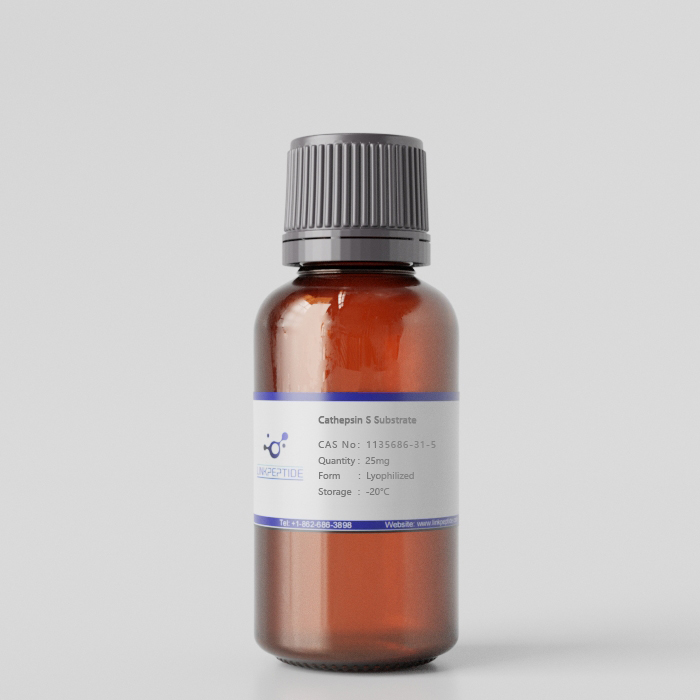
Product Name: Cathepsin S Substrate
Sequence One Letter Code: Ac-KQKLR-AMC
Sequence Three Letter Code: Ac-Lys-Gln-Lys-Leu-Arg-AMC
Cas No: 1135686-31-5
Chemical Formula:C41H66N12O9
Molecular Weight: 871.1
Purity: 95%
Form: Lyophilized
Storage Conditions: - 20 °C Protected from light
Research Area: peptide substrate
SMILES: CC1=CC(=O)OC2=C1C=CC(=C2)NC(=O)[C@H](CCCN=C(N)N)NC(=O)[C@H](CC(C)C)NC(=O)[C@H](CCCCN)NC(=O)[C@H](CCC(=O)N)NC(=O)[C@H](CCCCN)NC(=O)C.C(=O)(C(F)(F)F)O
IUPAC: (2S)-2-[[(2S)-2-acetamido-6-aminohexanoyl]amino]-N-[(2S)-6-amino-1-[[(2S)-1-[[(2S)-5-(diaminomethylideneamino)-1-[(4-methyl-2-oxochromen-7-yl)amino]-1-oxopentan-2-yl]amino]-4-methyl-1-oxopentan-2-yl]amino]-1-oxohexan-2-yl]pentanediamide;2,2,2-trifluoroacetic acid
INCHIKEY: LGRFFPYWSABBGE-SQLDAFDYSA-N
INCHI:
InChI=1S/C41H66N12O9.C2HF3O2/c1-23(2)20-32(40(61)51-30(12-9-19-47-41(45)46)36(57)49-26-13-14-27-24(3)21-35(56)62-33(27)22-26)53-38(59)29(11-6-8-18-43)50-39(60)31(15-16-34(44)55)52-37(58)28(48-25(4)54)10-5-7-17-42;3-2(4,5)1(6)7/h13-14,21-23,28-32H,5-12,15-20,42-43H2,1-4H3,(H2,44,55)(H,48,54)(H,49,57)(H,50,60)(H,51,61)(H,52,58)(H,53,59)(H4,45,46,47);(H,6,7)/t28-,29-,30-,31-,32-;/m0./s1
Conjugation: Conjugated
Conjugation Type: Fluorescent dyes
Code Nacres: NA.26
Application: Cathepsin S Fluorogenic Substrate (AMC-Labeled Peptide) is a sensitive fluorescent peptide substrate designed for selective measurement of cathepsin S protease activity. Cathepsin S is a cysteine protease involved in antigen presentation and immune regulation, and has been implicated in the pathogenesis of autoimmune diseases, atherosclerosis, cancer, and metabolic disorders. The peptide substrate contains a cleavage sequence recognized by cathepsin S and is labeled with 7-amino-4-methylcoumarin (AMC). Upon enzymatic cleavage, AMC is released, producing a fluorescence signal with excitation/emission at 354/442 nm. This substrate enables quantitative detection of cathepsin S activity in biochemical or cellular assays and is widely used for enzyme kinetics studies, inhibitor screening, and investigations of inflammatory and immune disease mechanisms.
Current Research: Proteolytic enzymes are essential regulators of cellular function, contributing to protein turnover, immune signaling, and tissue remodeling. Among these enzymes, cathepsin S is a lysosomal cysteine protease with important roles in immune regulation and antigen processing. Because abnormal cathepsin S activity has been linked to inflammatory and metabolic diseases, sensitive tools for measuring its activity are widely used in biomedical research. The Cathepsin S Fluorogenic Substrate (AMC-labeled peptide) is a fluorescence-based reagent specifically designed to detect cathepsin S enzymatic activity in biochemical and cellular assays. Biological Role of Cathepsin S Cathepsin S belongs to the papain-like family of cysteine proteases and is primarily localized in lysosomes and endosomal compartments. Unlike many other cathepsins, cathepsin S remains active over a relatively broad pH range, allowing it to function in both acidic intracellular environments and certain extracellular contexts. One of its most well-known functions is in antigen presentation within the immune system. Cathepsin S participates in the processing of the invariant chain associated with major histocompatibility complex class II (MHC II) molecules. By cleaving this chain, the enzyme allows antigenic peptides to bind MHC II molecules, which are then presented on the surface of antigen-presenting cells to activate CD4⁺ T lymphocytes. Beyond immune regulation, cathepsin S also contributes to: Extracellular matrix remodeling Inflammatory signaling pathways Lipid metabolism and vascular function Dysregulated activity of cathepsin S has been implicated in several disease processes, including autoimmune disorders, atherosclerosis, cancer progression, and metabolic disease. Design of the AMC-Labeled Fluorogenic Substrate The Cathepsin S Fluorogenic Substrate is designed as a synthetic peptide containing a cleavage site recognized by cathepsin S, coupled with a fluorescent reporter group. The peptide is labeled with 7-amino-4-methylcoumarin (AMC) at the C-terminus. In the intact substrate, the AMC fluorophore is covalently linked to the peptide and remains non-fluorescent or weakly fluorescent. When cathepsin S cleaves the peptide at the specific recognition sequence, the AMC molecule is released from the peptide backbone. This release produces a strong fluorescent signal that can be detected with standard fluorescence instrumentation. Fluorescence Detection Mechanism Once liberated from the peptide, AMC emits fluorescence with characteristic spectral properties. The released fluorophore typically exhibits excitation and emission maxima around 354 nm and 442 nm, allowing sensitive detection using fluorescence spectrometers or microplate readers. The increase in fluorescence intensity is directly proportional to the amount of substrate cleavage, providing a quantitative measure of cathepsin S enzymatic activity. Because the reaction can be monitored in real time, researchers can perform kinetic analyses and track enzyme activity continuously during the assay. Applications in Enzyme Activity Assays The AMC-labeled substrate is widely used in cathepsin S activity assays to measure protease function in purified enzyme systems or biological samples such as cell lysates and tissue extracts. Common applications include: Measurement of cathepsin S enzymatic activity Comparison of protease activity in different biological conditions Characterization of enzyme kinetics and catalytic efficiency Protease profiling in immune or inflammatory cells These assays help researchers understand how cathepsin S contributes to physiological and pathological processes. Use in Inhibitor Screening Because cathepsin S is considered a potential therapeutic target in inflammatory and metabolic diseases, many research programs focus on identifying compounds that inhibit its activity. The fluorogenic substrate provides a convenient platform for high-throughput screening of candidate inhibitors. In these experiments, enzyme reactions are monitored in the presence of different compounds. Effective inhibitors reduce substrate cleavage and therefore decrease the fluorescence signal. This approach enables rapid evaluation of compounds that may modulate cathepsin S function. Studying Immune and Inflammatory Pathways Cathepsin S plays a central role in immune system function and inflammatory signaling, making it an important subject of study in immunology and disease research. By measuring protease activity with fluorogenic substrates, researchers can investigate how cathepsin S contributes to antigen processing, immune cell activation, and inflammatory responses. Activity measurements can also reveal how enzyme levels change during disease progression, immune stimulation, or pharmacological intervention. Supporting Research on Protease Function Fluorescent peptide substrates provide powerful tools for studying enzyme activity in complex biological systems. The Cathepsin S Fluorogenic Substrate (AMC-labeled peptide) combines a selective protease recognition sequence with a sensitive fluorescent reporter, enabling accurate detection of cathepsin S activity. Through applications in enzyme kinetics studies, inhibitor screening, and investigations of immune and inflammatory mechanisms, this substrate continues to support research aimed at understanding the biological roles of cathepsin S and its involvement in human disease.
Get a Quote
 LinkPeptide