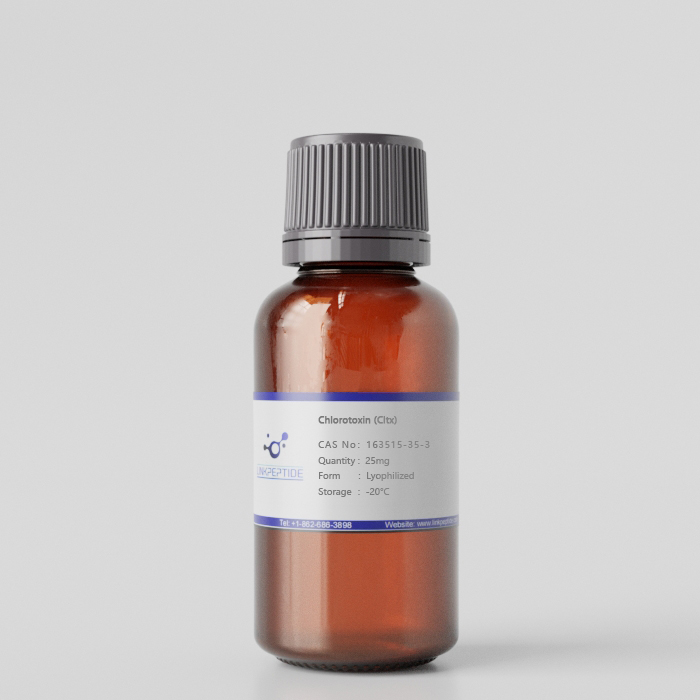
Product Name: Chlorotoxin (Cltx)
Sequence One Letter Code: MCMPCFTTDHQMARKCDDCCGGKGRGKCYGPQCLCR-NH2 (Disulfide bridge: 2-19,5-28,16-33,20-35)
Sequence Three Letter Code: H-Met-Cys-Met-Pro-Cys-Phe-Thr-Thr-Asp-His-Gln-Met-Ala-Arg-Lys-Cys-Asp-Asp-Cys-Cys-Gly-Gly-Lys-Gly-Arg-Gly-Lys-Cys-Tyr-Gly-Pro-Gln-Cys-Leu-Cys-Arg-NH2 (Disulfide bridge: 2-19,5-28,16-33,20-35)
Cas No: 163515-35-3
Chemical Formula:C158H249N53O47S11
Molecular Weight: 3995.9
Purity: 95%
Form: Lyophilized
Storage Conditions: - 20 °C
Research Area: Cancer Disease Research
SMILES: C[C@H]1C(=O)N[C@H](C(=O)N[C@H](C(=O)N[C@H]2CSSC[C@H]3C(=O)N[C@H](C(=O)N[C@@H](CSSC[C@H]4C(=O)NCC(=O)NCC(=O)N[C@H](C(=O)NCC(=O)N[C@H](C(=O)NCC(=O)N[C@H](C(=O)N[C@@H](CSSC[C@@H](C(=O)N[C@H](C(=O)N[C@H](C(=O)N[C@H](C(=O)N[C@H](C(=O)N[C@H](C(=O)N[C@H](C(=O)N[C@H](C(=O)N1)CCSC)CCC(=O)N)CC5=CNC=N5)CC(=O)O)[C@@H](C)O)[C@@H](C)O)CC6=CC=CC=C6)NC(=O)[C@@H]7CCCN7C(=O)[C@@H](NC(=O)[C@H](CSSC[C@@H](C(=O)N4)NC(=O)[C@@H](NC(=O)[C@@H](NC2=O)CC(=O)O)CC(=O)O)NC(=O)[C@H](CCSC)N)CCSC)C(=O)N[C@H](C(=O)NCC(=O)N8CCC[C@H]8C(=O)N[C@H](C(=O)N3)CCC(=O)N)CC9=CC=C(C=C9)O)CCCCN)CCCNC(=N)N)CCCCN)C(=O)N[C@@H](CCCNC(=N)N)C(=O)N)CC(C)C)CCCCN)CCCNC(=N)N
IUPAC: 2-[(1R,4R,5aR,8aS,9R,12S,17aS,18S,20aS,21R,24S,27S,30S,33S,36S,39S,42S,45S,48S,51S,54R,59R,62S,65S,74S,77R,80S,86S,92S)-51,80,92-tris(4-aminobutyl)-5a-[[(2S)-1-amino-5-carbamimidamido-1-oxopentan-2-yl]carbamoyl]-9-[[(2S)-2-amino-4-methylsulfanylbutanoyl]amino]-39,62-bis(3-amino-3-oxopropyl)-24-benzyl-48,86-bis(3-carbamimidamidopropyl)-20a,33-bis(carboxymethyl)-27,30-bis[(1R)-1-hydroxyethyl]-74-[(4-hydroxyphenyl)methyl]-36-(1H-imidazol-4-ylmethyl)-45-methyl-8a-(2-methylpropyl)-12,42-bis(2-methylsulfanylethyl)-a,3,7a,10,10a,13,15a,18a,19,21a,22,25,28,31,34,37,40,43,46,49,52,61,64,70,73,76,79,82,85,88,91,94,97-tritriacontaoxo-2a,3a,6,7,12a,13a,56,57-octathia-2,6a,9a,11,14,16a,19a,20,22a,23,26,29,32,35,38,41,44,47,50,53,60,63,69,72,75,78,81,84,87,90,93,96,99-tritriacontazahexacyclo[57.41.10.84,54.421,77.014,18.065,69]docosahectan-17a-yl]acetic acid
INCHIKEY: QPAKKWCQMHUHNI-GQIQPHNSSA-N
INCHI:
InChI=1S/C158H249N53O47S11/c1-77(2)55-96-138(241)205-105(144(247)186-86(125(165)228)28-18-47-173-156(166)167)70-264-262-68-103-131(234)177-63-115(217)176-64-116(218)183-87(25-12-15-44-159)128(231)178-65-117(219)184-88(29-19-48-174-157(168)169)129(232)179-66-118(220)185-89(26-13-16-45-160)133(236)202-107-72-267-269-75-110-149(252)195-98(56-81-23-10-9-11-24-81)143(246)208-124(80(5)213)154(257)209-123(79(4)212)153(256)199-102(61-122(226)227)141(244)196-99(58-83-62-172-76-181-83)139(242)189-92(37-39-113(163)215)136(239)190-94(42-53-260-7)132(235)182-78(3)126(229)187-91(30-20-49-175-158(170)171)134(237)188-90(27-14-17-46-161)135(238)203-108(73-266-265-71-106(146(249)193-96)204-137(240)93(38-40-114(164)216)191-151(254)111-31-21-50-210(111)119(221)67-180-130(233)97(194-147(107)250)57-82-33-35-84(214)36-34-82)148(251)198-100(59-120(222)223)140(243)197-101(60-121(224)225)142(245)206-109(150(253)201-103)74-268-263-69-104(200-127(230)85(162)41-52-259-6)145(248)192-95(43-54-261-8)155(258)211-51-22-32-112(211)152(255)207-110/h9-11,23-24,33-36,62,76-80,85-112,123-124,212-214H,12-22,25-32,37-61,63-75,159-162H2,1-8H3,(H2,163,215)(H2,164,216)(H2,165,228)(H,172,181)(H,176,217)(H,177,234)(H,178,231)(H,179,232)(H,180,233)(H,182,235)(H,183,218)(H,184,219)(H,185,220)(H,186,247)(H,187,229)(H,188,237)(H,189,242)(H,190,239)(H,191,254)(H,192,248)(H,193,249)(H,194,250)(H,195,252)(H,196,244)(H,197,243)(H,198,251)(H,199,256)(H,200,230)(H,201,253)(H,202,236)(H,203,238)(H,204,240)(H,205,241)(H,206,245)(H,207,255)(H,208,246)(H,209,257)(H,222,223)(H,224,225)(H,226,227)(H4,166,167,173)(H4,168,169,174)(H4,170,171,175)/t78-,79+,80+,85-,86-,87-,88-,89-,90-,91-,92-,93-,94-,95-,96-,97-,98-,99-,100-,101-,102-,103-,104-,105-,106-,107-,108-,109-,110-,111-,112-,123-,124-/m0/s1
Source / Species: Scorpion
Conjugation: Unconjugated
Code Nacres: NA.26
Application: Chlorotoxin (Cltx) is a 36–amino acid peptide originally isolated from the venom of Leiurus quinquestriatus. It selectively binds chloride channels and matrix-associated proteins expressed on certain tumor cells, including gliomas. Chlorotoxin has been extensively studied for its tumor-targeting properties and ability to inhibit cell migration and invasion. The peptide is widely used in neuro-oncology research to investigate ion channel function, tumor cell surface markers, and targeted imaging strategies. Conjugated forms have been explored for diagnostic and therapeutic applications in experimental cancer models.
Current Research: Chlorotoxin (Cltx) is a 36–amino acid disulfide-rich peptide originally isolated from the venom of the scorpion Leiurus quinquestriatus. It is characterized by a compact structure stabilized by four intramolecular disulfide bonds, which confer high conformational stability and resistance to proteolytic degradation. Chlorotoxin gained significant attention due to its selective binding to chloride channels and matrix-associated proteins expressed on certain tumor cells, particularly gliomas. Its tumor-targeting properties have made it a valuable tool in neuro-oncology research and translational cancer studies. Molecular Targets and Binding Properties Chlorotoxin has been shown to interact with chloride channel complexes and membrane-associated proteins such as matrix metalloproteinase-2 (MMP-2) and annexin A2 in glioma cells. These interactions are associated with tumor cell migration and invasion. The peptide’s selective binding profile enables preferential targeting of malignant cells over normal brain tissue in experimental systems. Chloride channels play important roles in maintaining membrane potential, regulating cell volume, and facilitating cellular motility. In glioma cells, chloride channel activity contributes to invasive behavior by enabling dynamic changes in cell shape and volume during migration through extracellular matrix spaces. Chlorotoxin binding can interfere with these processes, reducing tumor cell invasiveness. Effects on Tumor Cell Migration and Invasion Experimental studies demonstrate that Chlorotoxin inhibits glioma cell migration and invasion in vitro. By modulating chloride channel activity and interacting with MMP-associated complexes, it influences extracellular matrix degradation and cell motility. These properties have positioned Chlorotoxin as a molecular probe for investigating mechanisms underlying tumor invasiveness. In addition to gliomas, elevated expression of related molecular targets has been reported in other tumor types, broadening interest in Chlorotoxin-based targeting strategies. Applications in Neuro-Oncology Research Chlorotoxin is widely applied in: Investigation of chloride channel function in tumor cells Characterization of tumor-associated surface markers Studies of cell migration and invasion mechanisms Evaluation of matrix metalloproteinase activity Imaging of glioma cells in experimental models Its selective binding to glioma-associated proteins allows researchers to examine tumor-specific signaling pathways and cellular behaviors in controlled laboratory settings. Imaging and Targeted Delivery Strategies Conjugated forms of Chlorotoxin have been extensively explored for diagnostic imaging applications. Fluorescently labeled derivatives enable visualization of tumor margins in preclinical models. Radiolabeled and nanoparticle-conjugated versions have also been investigated for targeted imaging and potential therapeutic delivery. Because of its selective tumor-binding profile, Chlorotoxin has been incorporated into experimental systems aimed at improving tumor localization and targeted intervention strategies. Structural and Biophysical Features The peptide’s compact, disulfide-stabilized scaffold contributes to high binding specificity and stability. Its small size facilitates tissue penetration and functionalization through chemical conjugation. These characteristics make it suitable for diverse applications, including biosensor platforms and ligand-targeted delivery systems. Experimental Advantages Selective binding to glioma-associated targets Stable disulfide-rich structure Inhibitory effects on tumor cell migration Suitable for conjugation with imaging or therapeutic agents Applicable in in vitro and in vivo tumor models Research Significance Chlorotoxin (Cltx) is a well-established molecular probe in neuro-oncology research. By targeting chloride channel–associated complexes and tumor-specific surface proteins, it enables detailed investigation of glioma biology and invasive behavior. Its utility in targeted imaging and conjugation-based strategies continues to support translational research aimed at improving tumor detection and therapeutic precision in experimental cancer models.
Get a Quote
 LinkPeptide