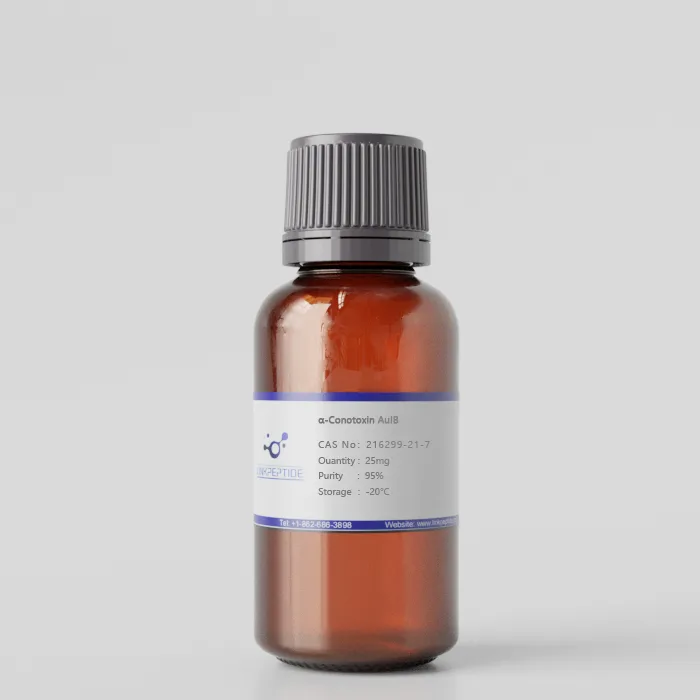
Product Name:α-Conotoxin AuIB
CAS No:216299-21-7
Purity:95%
Molar Mass:1572.76
Chemical Formula:C65H89N17O21S4
Storage:Store at -20 degrees Celsius
Sequence:GCCSYPPCFATNPDC
Target:α3β4 nicotinic acetylcholine
Application:
α-Conotoxin AuIB is a peptide toxin isolated from the venom of the Conus aulicus snail, known for its high specificity in targeting the α3β4 nicotinic acetylcholine receptor (nAChR). By selectively antagonizing this receptor subtype, it is a valuable tool in research focused on neurobiological processes such as pain perception, addiction, and autonomic nervous system regulation. α-Conotoxin AuIB is widely used to investigate the role of α3β4 nAChRs in various physiological and pathological conditions. Its precise receptor interaction has potential implications for developing novel therapies targeting nicotine addiction, chronic pain, and neurodegenerative diseases, offering new directions in neuropharmacology.
Current Research:
α-Conotoxin AuIB is a peptide toxin derived from the venom of the marine snail Conus aulicus. It exhibits high specificity for neuronal nicotinic acetylcholine receptors (nAChRs), particularly the α3β4 subtype. This selectivity makes it a valuable tool for probing the physiological and pathological roles of these receptors.
Structure and Specificity
Comprising 15 amino acids, α-Conotoxin AuIB features a characteristic disulfide-bonded framework that stabilizes its conformation. It selectively inhibits α3β4 nAChRs with an IC₅₀ of approximately 0.75 μM, while displaying minimal activity against other nAChR subtypes, such as α3β2, α4β2, and α4β4.
Mechanism of Action
By binding to the α3β4 nAChR, α-Conotoxin AuIB prevents acetylcholine from activating the receptor, thereby inhibiting ion flow across the neuronal membrane. This blockade modulates neurotransmitter release and neuronal excitability, impacting various physiological processes.
Biological Implications
The α3β4 nAChR subtype is implicated in several central and peripheral nervous system functions, including modulation of neurotransmitter release and involvement in pain pathways. Studies utilizing α-Conotoxin AuIB have demonstrated its ability to inhibit nicotine-evoked norepinephrine release from rat hippocampal synaptosomes, underscoring the role of α3β4 nAChRs in this process.
Research Applications
Due to its specificity, α-Conotoxin AuIB serves as a critical tool in:
Elucidating the physiological roles of α3β4 nAChRs in neurotransmission and neuromodulation.
Investigating the involvement of these receptors in neurological disorders, such as addiction and neurodegenerative diseases.
Developing therapeutic agents targeting α3β4 nAChRs for conditions like chronic pain and hypertension.
Modifications to the amino acid sequence of α-Conotoxin AuIB have been explored to enhance its potency and stability. For instance, substituting proline at position 7 with arginine significantly increased its inhibitory activity against GABA_B receptor-coupled N-type calcium channels, highlighting the potential for designing more effective analogs.
Conclusion
α-Conotoxin AuIB is a potent and selective inhibitor of α3β4 nAChRs, offering valuable insights into the function of these receptors in the nervous system. Its application in research continues to advance our understanding of nAChR-related physiology and holds promise for therapeutic development.
Reference:
Get a Quote
 LinkPeptide