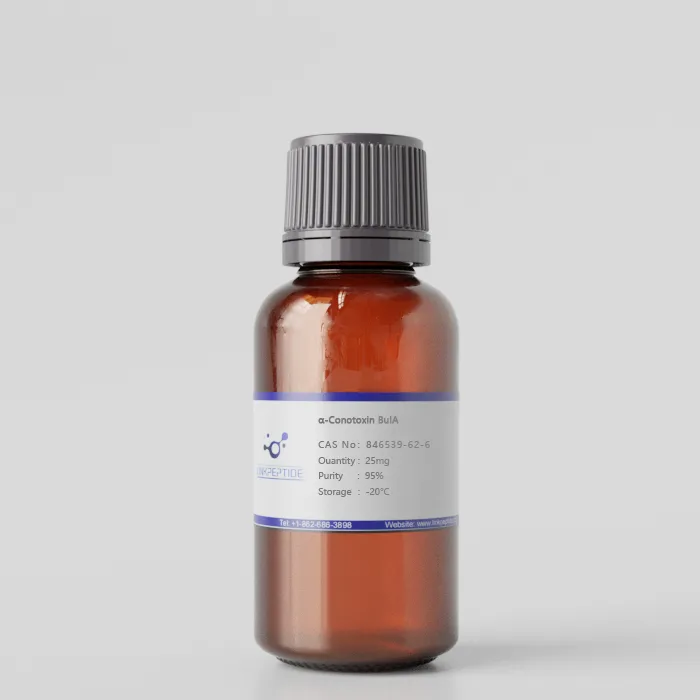
Product Name:α-Conotoxin BuIA
CAS No:846539-62-6
Purity:95%
Molar Mass:1311.57
Chemical Formula:C54H82N14O16S4
Storage:Store at -20 degrees Celsius
Sequence:GCCSTPPCAVLYC-NH2
Target:nAChR
Application:
α-Conotoxin BuIA is a peptide toxin derived from the venom of the cone snail Conus bullatus. It selectively targets and inhibits specific subtypes of nicotinic acetylcholine receptors (nAChRs), particularly the α6/α3β2β3 and α3β4 subtypes. These receptors play key roles in modulating neurotransmission in the central and peripheral nervous systems. By blocking these nAChR subtypes, α-Conotoxin BuIA helps researchers investigate cholinergic signaling involved in processes such as pain, addiction, and autonomic function. This toxin is a valuable tool for studying nAChR pharmacology and exploring therapeutic approaches for conditions such as nicotine addiction, neurodegenerative diseases, and pain management.
Current Research:
α-Conotoxin BuIA is a 13-amino-acid peptide toxin isolated from the venom of the marine cone snail Conus bullatus. It functions as a potent and selective antagonist of nicotinic acetylcholine receptors (nAChRs), particularly targeting neuronal subtypes.
Structural Characteristics
The amino acid sequence of α-Conotoxin BuIA is:
Gly-Cys-Cys-Ser-Thr-Pro-Pro-Cys-Ala-Val-Leu-Tyr-Cys-NH₂
This sequence includes two disulfide bonds, forming a characteristic α-conotoxin fold that is crucial for its receptor-binding specificity.
Mechanism of Action
α-Conotoxin BuIA acts as a competitive antagonist at neuronal nAChRs. By binding to the receptor's ligand-binding sites, it prevents acetylcholine from activating the receptor, thereby inhibiting synaptic transmission. This blockade can modulate neuronal signaling, highlighting its potential utility in studying neurological processes.
Pharmacological Profile
α-Conotoxin BuIA exhibits high affinity for specific nAChR subtypes, with reported half-maximal inhibitory concentration (IC₅₀) values of:
0.258 nM for α6/α3β2 nAChRs
1.54 nM for α6/α3β4 nAChRs
5.72 nM for α3β2 nAChRs
These values indicate a potency order of α6 > α3 > α2 > α4 for β2-containing nAChRs.
Research Applications
Due to its specificity for neuronal nAChRs, α-Conotoxin BuIA serves as a valuable tool in neuropharmacological research:
Receptor Characterization: It aids in elucidating the structural and functional dynamics of neuronal nAChRs, particularly in distinguishing between different receptor subtypes.
Drug Development: Insights into its interaction with nAChRs contribute to the design of novel therapeutics for neurological disorders and conditions involving dysfunctional cholinergic signaling.
Conclusion
α-Conotoxin BuIA is a potent and selective inhibitor of neuronal nAChRs, offering significant insights into synaptic transmission and potential therapeutic avenues for related disorders. Its applications extend from fundamental research to the development of novel pharmacological agents.
Reference:
Get a Quote
 LinkPeptide

![LEIUROTOXIN I [R7]-](https://www.linkpeptide.com/wp-content/uploads/2024/10/LEIUROTOXIN-I-R7-jpg-2.webp "LEIUROTOXIN I [R7]-")