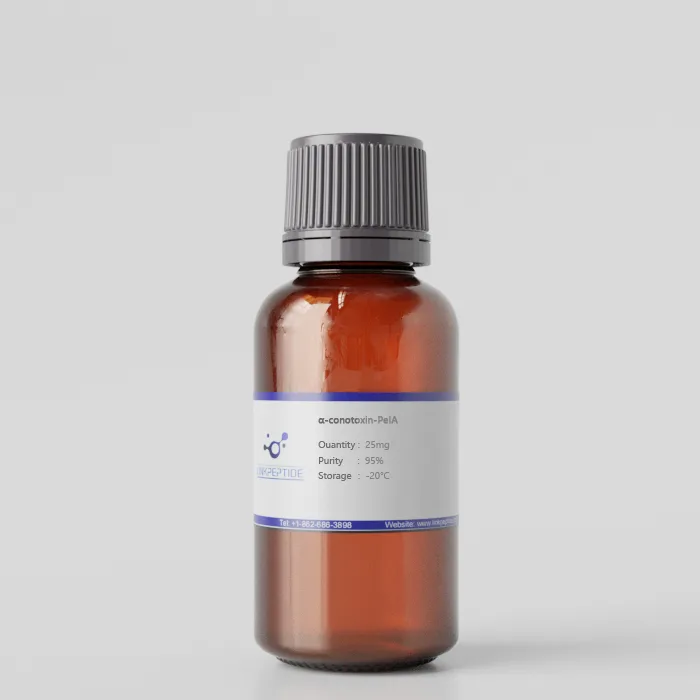
Product Name:α-conotoxin-PeIA
Purity:95%
Molar Mass:1651.9
Chemical Formula:C65H98N22O21S4
Storage:Store at -20 degrees Celsius
Sequence:Gly-Cys2-Cys3-Ser-His-Pro-Ala-Cys8-Ser-Val-Asn-His-Pro-Glu-Leu-Cys16-NH2
Target:AChRs
Application:
α-Conotoxin PeIA is a specialized peptide toxin from the cone snail Conus pergrandis. It selectively inhibits nicotinic acetylcholine receptors (nAChRs), particularly the α3β2 and α6-containing subtypes, disrupting acetylcholine-mediated signaling in the nervous system. Due to its high specificity, α-Conotoxin PeIA is a valuable tool for researching nAChR function in various physiological and pathological contexts, including addiction, neurodegenerative diseases, and pain management. Its ability to block specific receptor subtypes makes it a key molecule in studies of neuronal communication and a potential therapeutic candidate for developing treatments aimed at conditions driven by dysregulated cholinergic activity.
Current Research:
α-Conotoxin PeIA is a peptide toxin derived from the venom of Conus pergrandis, a species of marine cone snail. This 18-amino-acid peptide is a member of the α-conotoxin family, known for targeting nicotinic acetylcholine receptors (nAChRs). PeIA exhibits potent inhibitory activity against specific nAChR subtypes, notably α3β2 and α9α10, which are implicated in various neurological processes.
Structural Characteristics
PeIA adopts a characteristic α-conotoxin fold stabilized by two disulfide bonds, forming a compact structure essential for its receptor interactions. The peptide's sequence and conformation enable high-affinity binding to nAChR subtypes, thereby modulating their activity.
Mechanism of Action
By selectively binding to the ligand-binding domains of α3β2 and α9α10 nAChRs, PeIA acts as a competitive antagonist, inhibiting acetylcholine-induced ion flux. This blockade disrupts normal cholinergic signaling, affecting processes such as neurotransmitter release and neuronal excitability.
Pharmacological Effects
PeIA's inhibition of α3β2 and α9α10 nAChRs has been instrumental in studying the physiological roles of these receptors. Notably, PeIA has been shown to inhibit N-type calcium channels via GABA_B receptor activation, indicating a potential mechanism for analgesic effects.
Research Applications
Due to its specificity, PeIA serves as a valuable tool in neuropharmacological research:
Receptor Characterization: PeIA aids in elucidating the functional roles of α3β2 and α9α10 nAChRs in neuronal communication and disease states.
Drug Development: Insights gained from PeIA's interactions with nAChRs contribute to the design of novel therapeutics targeting these receptors for conditions like chronic pain and nicotine addiction.
Analogs and Enhancements
Structural modifications of PeIA have led to analogs with improved potency and selectivity. For instance, substituting serine residues with non-natural amino acids such as 2,3-diaminopropionic acid (Dap) has produced analogs like PeIA[S4Dap, S9Dap], which exhibit enhanced inhibition of human α9α10 nAChRs.
Conclusion
α-Conotoxin PeIA is a potent and selective inhibitor of specific nAChR subtypes, offering significant insights into cholinergic signaling and potential therapeutic avenues for neurological disorders. Its structural adaptability and efficacy make it a crucial molecule in neuropharmacological research.
Reference:
Get a Quote
 LinkPeptide