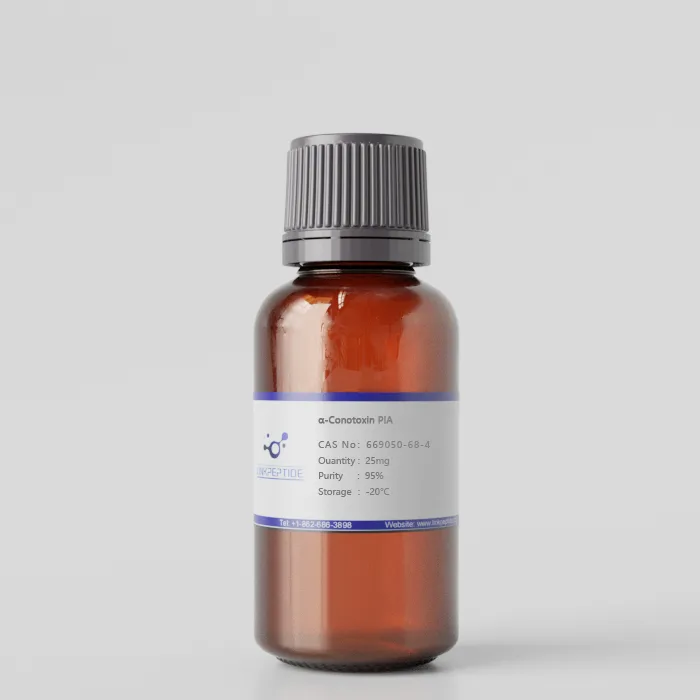
Product Name:α-Conotoxin PIA
CAS No:669050-68-4
Purity:95%
Molar Mass:1981.3
Chemical Formula:C79H125N27O25S4
Storage:Store at -20 degrees Celsius
Sequence:RDPCCSNPVCTVHNPQIC
Target:α6-containing nicotinic
Application:
α-Conotoxin PIA is a peptide toxin derived from the venom of the Conus purpurascens snail, known for its selective inhibition of the α6/α3β2β3 nicotinic acetylcholine receptor (nAChR). This receptor subtype plays a critical role in neurotransmission, particularly in dopamine release and related neural pathways. α-Conotoxin PIA is frequently utilized in neurobiological research to study the function of α6-containing nAChRs, which are implicated in conditions such as Parkinson's disease, nicotine addiction, and other neurodegenerative disorders. Its high specificity and potent activity make it an essential tool for advancing the understanding of receptor-mediated processes and exploring therapeutic applications in neuropharmacology.
Current Research:
α-Conotoxin PIA is a peptide toxin isolated from the venom of the marine snail Conus purpurascens. It functions as a potent and selective antagonist of nicotinic acetylcholine receptors (nAChRs), particularly those containing the α6 subunit. This specificity makes it a valuable tool for investigating the physiological roles of α6-containing nAChRs and their involvement in neurological processes.
Structural Characteristics
α-Conotoxin PIA is a member of the α-conotoxin family, characterized by their ability to inhibit nAChRs. These peptides typically consist of 12 to 20 amino acids and possess a conserved cysteine framework that forms disulfide bonds, stabilizing their three-dimensional structure. The unique sequence and disulfide connectivity of α-Conotoxin PIA confer its selectivity towards specific nAChR subtypes.
Receptor Specificity and Binding Affinity
Studies have demonstrated that α-Conotoxin PIA exhibits high affinity for nAChRs containing the α6 subunit. It effectively discriminates between closely related subunits, such as α6 and α3. For instance, α-Conotoxin PIA blocks rat α6/α3β2β3 nAChRs with an IC₅₀ of 0.95 nM, while its affinity for α3β2 nAChRs is significantly lower, with an IC₅₀ of 74.2 nM. This selectivity is crucial for studying the distinct functions of α6-containing nAChRs.
Physiological Implications
α6-containing nAChRs are predominantly expressed in dopaminergic neurons within regions such as the substantia nigra and ventral tegmental area. They play pivotal roles in modulating dopamine release, which is essential for motor control and reward pathways. Dysfunction of these receptors has been implicated in neurological disorders, including Parkinson's disease and nicotine addiction. By selectively inhibiting α6-containing nAChRs, α-Conotoxin PIA serves as a valuable probe for elucidating the contributions of these receptors to neuronal signaling and disease states.
Research Applications
The high specificity of α-Conotoxin PIA for α6-containing nAChRs makes it an indispensable tool in neuropharmacological research. It enables scientists to:
Investigate the functional roles of α6-containing nAChRs in neurotransmission and behavior.
Explore the involvement of these receptors in neurodegenerative diseases and substance dependence.
Develop targeted therapies aimed at modulating α6-containing nAChRs for therapeutic benefit.
Conclusion
α-Conotoxin PIA is a potent and selective antagonist of α6-containing nAChRs, offering significant utility in the study of cholinergic signaling and its implications in health and disease. Its application in research continues to advance our understanding of nAChR function and holds promise for the development of novel therapeutic strategies targeting neurological disorders.
Reference:
Get a Quote
 LinkPeptide

![[Nphe1]Nociceptin(1-13)NH2](https://www.linkpeptide.com/wp-content/uploads/2024/10/Nphe1Nociceptin1-13NH2-jpg-3.webp "[Nphe1]Nociceptin(1-13)NH2")