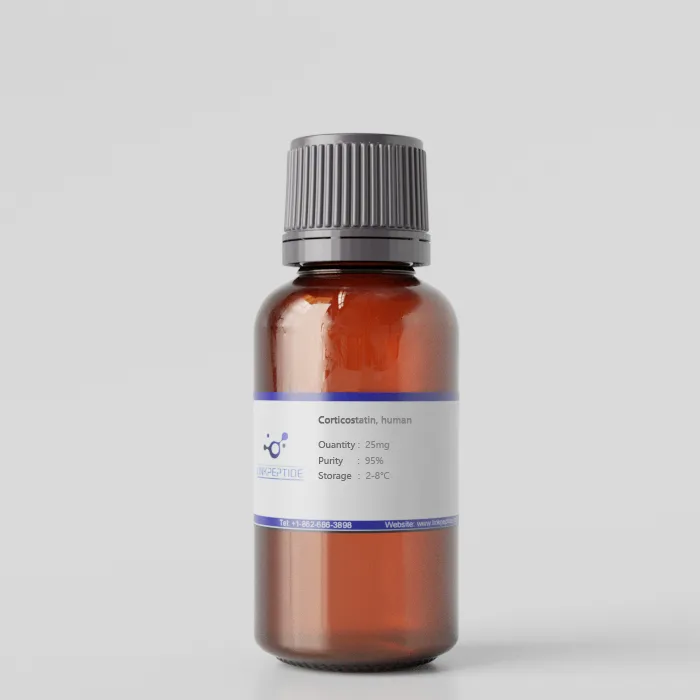
Product Name:Corticostatin, human
Form:TFA salt
Purity:95%
Storage:2-8 degree Celsius
Molar Mass:3715.5
Chemical Formula:C157H261N49O43S6
Sequence:Val-Cys-Ser-Cys-Arg-Leu-Val-Phe-Cys-Arg-Arg-Thr-Glu-Leu-Arg-Val-Gly-Asn-Cys-Leu-Ile-Gly-Gly-Val-Ser-Phe-Thr-Tyr-Cys-Cys-Thr-Arg-Val
Application:
Corticostatin, human is a peptide hormone that modulates corticosteroid production and immune responses. Unlike adrenocorticotropic hormone (ACTH), which stimulates glucocorticoid release, corticostatin exhibits an inhibitory effect on adrenal steroidogenesis, acting as a counter-regulatory factor in stress physiology. It also has potent immunomodulatory and anti-inflammatory properties, influencing cytokine production and immune cell activity. Corticostatin is studied for its role in hypothalamic-pituitary-adrenal (HPA) axis regulation, stress adaptation, and neuroimmune interactions. Researchers investigate its potential therapeutic applications in Cushing’s syndrome, inflammatory diseases, and autoimmune disorders, as well as its broader implications in endocrinology, neurology, and immunology.
Current Research:
Introduction
Corticostatin is a regulatory peptide that plays a critical role in balancing adrenal steroidogenesis, immune function, and neuroendocrine signaling. Unlike ACTH, which activates the adrenal cortex to produce glucocorticoids, corticostatin acts as an inhibitor, reducing excessive steroid production. In addition to its endocrine functions, corticostatin exhibits anti-inflammatory and immunomodulatory properties, suggesting its relevance in conditions involving stress, immune dysregulation, and inflammatory disorders.
Regulation of Adrenal Steroidogenesis
One of the primary functions of corticostatin is to inhibit glucocorticoid secretion, acting as a counterbalance to ACTH in the hypothalamic-pituitary-adrenal (HPA) axis. By downregulating corticosteroid synthesis, corticostatin may help prevent excessive stress hormone release, which is implicated in various metabolic and psychiatric disorders.
Current research focuses on its potential role in Cushing’s syndrome, a condition characterized by excess cortisol production, as well as adrenal insufficiency and glucocorticoid resistance syndromes. Understanding the mechanisms by which corticostatin regulates adrenal function could contribute to the development of targeted therapies for disorders involving HPA axis dysfunction.
Neuroendocrine and Neurological Effects
Corticostatin is also involved in neuroendocrine regulation, particularly in modulating stress responses, cognition, and mood regulation. Some studies suggest that it influences neurotransmitter systems, including dopamine, serotonin, and GABA, which play key roles in anxiety, depression, and cognitive function.
Its neuroprotective properties have sparked interest in its potential role in neurodegenerative diseases such as Alzheimer’s and Parkinson’s, where chronic stress and neuroinflammation contribute to disease progression. Additionally, corticostatin’s ability to regulate the HPA axis has implications for stress-related disorders, including post-traumatic stress disorder (PTSD) and major depressive disorder (MDD).
Immunomodulatory and Anti-Inflammatory Effects
Corticostatin exhibits potent anti-inflammatory and immune-modulating effects, making it an area of interest in autoimmune and chronic inflammatory diseases. Studies show that it can suppress pro-inflammatory cytokine production, such as TNF-α, IL-6, and IL-1β, reducing inflammation in conditions like rheumatoid arthritis, multiple sclerosis, and inflammatory bowel disease (IBD).
Furthermore, corticostatin has been investigated in sepsis and infection-induced inflammation, where excessive immune responses can cause organ damage and systemic dysfunction. By modulating immune cell activity, corticostatin may help restore immune balance and reduce inflammatory damage in conditions driven by cytokine storms.
Metabolic and Endocrine Research
Beyond its neuroendocrine and immunological roles, corticostatin has been explored for its impact on metabolic regulation, including glucose homeostasis, insulin sensitivity, and lipid metabolism. Given its interactions with the melanocortin system, some researchers hypothesize that corticostatin could play a role in obesity, metabolic syndrome, and type 2 diabetes, where glucocorticoid excess contributes to disease progression.
Conclusion
Corticostatin, human, is a key regulatory peptide with broad implications in adrenal function, neuroendocrine balance, immune modulation, and metabolic regulation. Its ability to inhibit corticosteroid synthesis, regulate inflammatory responses, and modulate stress pathways makes it a promising candidate for research into Cushing’s syndrome, autoimmune diseases, neurodegenerative disorders, and metabolic conditions. As research continues, corticostatin may emerge as a novel therapeutic target in endocrinology, neurology, and immunology.
Get a Quote
 LinkPeptide