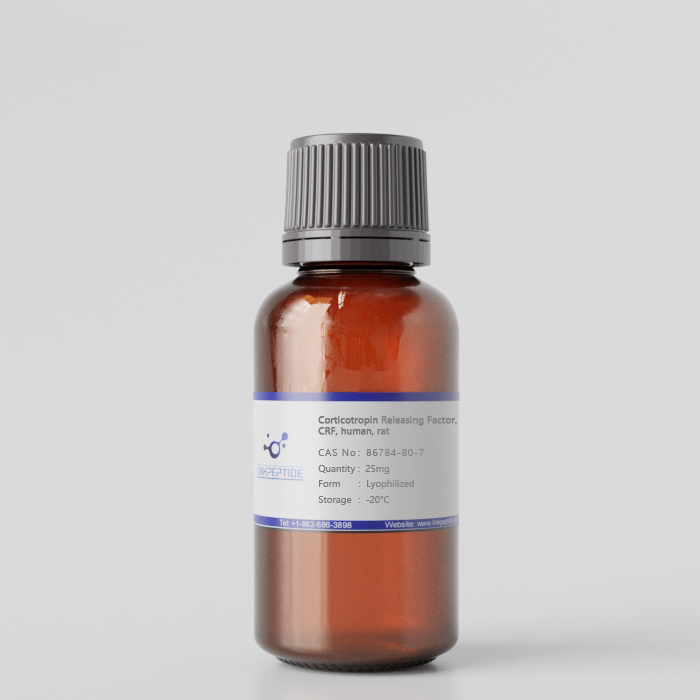
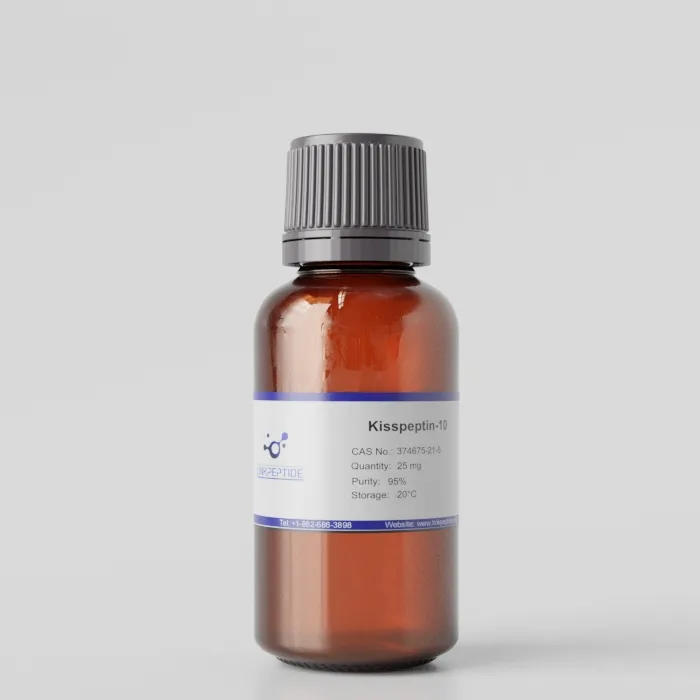
Product Name: Corticotropin Releasing Factor, CRF, human, rat
Sequence One Letter Code: SEEPPISLDLTFHLLREVLEMARAEQLAQQAHSNRKLMEII-NH2
Sequence Three Letter Code: H-Ser-Glu-Glu-Pro-Pro-Ile-Ser-Leu-Asp-Leu-Thr-Phe-His-Leu-Leu-Arg-Glu-Val-Leu-Glu-Met-Ala-Arg-Ala-Glu-Gln-Leu-Ala-Gln-Gln-Ala-His-Ser-Asn-Arg-Lys-Leu-Met-Glu-Ile-Ile-NH2
Cas No: 86784-80-7
Chemical Formula:C208H344N60O63S2
Molecular Weight: 4757.8
Purity: 95%
Form: Lyophilized
Storage Conditions: - 20 °C
Research Area: Endocrinology Disease Research
Source / Species: Human, rat
Conjugation: Unconjugated
Code Nacres: NA.26
Application: Corticotropin Releasing Factor (CRF) is a conserved neuroendocrine peptide that functions as the principal regulator of the hypothalamic–pituitary–adrenal (HPA) axis. By stimulating adrenocorticotropic hormone release, CRF coordinates systemic responses to stress and modulates endocrine, autonomic, and behavioral processes. Beyond stress regulation, CRF influences cardiovascular, gastrointestinal, and immune functions. It is widely utilized in neuroendocrinology and stress biology research to investigate CRF receptor signaling, neuroimmune interactions, and mechanisms underlying stress-related disorders.
Current Research: Corticotropin Releasing Factor (CRF) is a 41–amino acid neuropeptide that serves as the principal upstream regulator of the hypothalamic–pituitary–adrenal (HPA) axis, the central neuroendocrine system governing stress adaptation. Synthesized primarily in the paraventricular nucleus of the hypothalamus, CRF is released into the hypophyseal portal circulation, where it stimulates secretion of adrenocorticotropic hormone (ACTH) from anterior pituitary corticotrophs. ACTH subsequently drives glucocorticoid release from the adrenal cortex, coordinating systemic physiological responses to stress. Because of its pivotal regulatory role, CRF is extensively used in neuroendocrinology, stress biology, and neuroimmune research. Receptor Signaling and Molecular Mechanisms CRF exerts its biological effects through two class B G protein–coupled receptors: CRF receptor 1 (CRFR1) CRF receptor 2 (CRFR2) Both receptors primarily couple to Gs proteins, activating: Adenylyl cyclase and increasing intracellular cAMP Protein kinase A (PKA) signaling CREB phosphorylation MAPK/ERK pathways CRFR1 is widely implicated in stress-related behavioral and endocrine responses, whereas CRFR2 contributes to cardiovascular regulation and stress recovery mechanisms. Physiological and Pathophysiological Roles 1. Stress Adaptation CRF integrates central and peripheral stress responses, influencing: Cortisol production Sympathetic nervous system activation Behavioral adaptations to environmental stressors Dysregulation of CRF signaling has been linked to anxiety disorders, depression, and post-traumatic stress disorder (PTSD). 2. Cardiovascular Regulation CRF modulates heart rate, vascular tone, and cardiac contractility, particularly during stress exposure. 3. Gastrointestinal Function CRF affects gut motility, permeability, and inflammatory signaling. Altered CRF activity is associated with stress-related gastrointestinal disorders such as irritable bowel syndrome (IBS). 4. Immune Modulation CRF influences cytokine production and immune cell activation, supporting cross-talk between the neuroendocrine and immune systems. This neuroimmune interaction is central to understanding inflammatory and stress-related disease processes. Research Applications Neuroendocrine Signaling Studies CRF is used to evaluate receptor activation, downstream signaling kinetics, and GPCR regulatory mechanisms in recombinant or native receptor systems. Behavioral and Stress Models In vivo administration of CRF supports investigation of anxiety-like behavior, stress reactivity, and endocrine output in animal models. Drug Discovery and Receptor Pharmacology CRF serves as a reference agonist in the development of CRFR antagonists aimed at treating stress-related psychiatric and inflammatory disorders. Neuroimmune Interaction Studies CRF is employed to dissect molecular pathways linking stress signaling with immune activation and inflammatory cascades. Experimental Considerations CRF is sensitive to proteolytic degradation; appropriate handling and storage conditions are recommended. Functional assays should account for receptor subtype expression and potential desensitization with prolonged exposure.
Get a Quote
 LinkPeptide