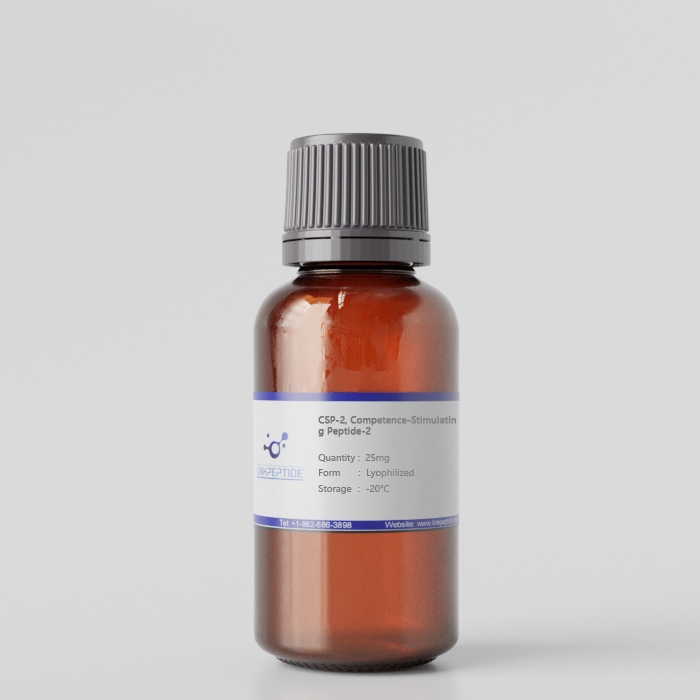
Product Name: CSP-2, Competence-Stimulating Peptide-2
Sequence One Letter Code: EMRISRIILDFLFLRKK
Sequence Three Letter Code: H-Glu-Met-Arg-Ile-Ser-Arg-Ile-Ile-Leu-Asp-Phe-Leu-Phe-Leu-Arg-Lys-Lys-OH
Chemical Formula:C101H172N28O23S1
Molecular Weight: 2178.8
Purity: 95%
Form: Lyophilized
Storage Conditions: - 20 °C
Research Area: Bacterial
Source / Species: streptococcus
Conjugation: Unconjugated
Code Nacres: NA.26
Application: CSP-2 is a bacterial pheromone peptide that regulates genetic competence in Streptococcus pneumoniae, S. mitis, and S. oralis. Competence-stimulating peptides coordinate quorum-sensing pathways that control DNA uptake and horizontal gene transfer within bacterial populations. CSP-2 represents a strain-specific variant that activates competence-associated gene expression and transformation efficiency. This peptide is widely used to study quorum sensing, bacterial communication, and regulatory circuits governing genetic exchange. It supports microbiology research focused on population dynamics, genetic diversity, and mechanisms contributing to antimicrobial resistance development.
Current Research: Bacteria are not solitary organisms; many species coordinate their behavior through chemical communication systems that allow populations to respond collectively to environmental changes. One of the most important mechanisms for this coordination is quorum sensing, a process in which bacteria produce and detect small signaling molecules to monitor population density and regulate gene expression. In Streptococcus species, quorum sensing plays a critical role in controlling genetic competence, a physiological state that allows cells to take up extracellular DNA from their environment. Among the signaling molecules responsible for this process are competence-stimulating peptides (CSPs). CSP-2 is one such peptide pheromone that activates competence pathways in Streptococcus pneumoniae, Streptococcus mitis, and Streptococcus oralis, making it an important tool for studying bacterial communication and horizontal gene transfer. Quorum Sensing in Streptococci Quorum sensing enables bacterial populations to synchronize gene expression across communities of cells. Bacteria release signaling molecules—often small peptides or autoinducers—into the surrounding environment. As the bacterial population grows, the concentration of these molecules increases. Once the signal reaches a threshold level, it binds to specific receptors that trigger regulatory cascades controlling gene expression. In Streptococcus species, quorum sensing is frequently mediated by peptide pheromones that interact with membrane-associated receptors and two-component regulatory systems. These pathways regulate a wide range of biological processes, including biofilm formation, virulence factor production, and competence development. The competence system is particularly important because it allows bacteria to acquire genetic material from their surroundings, contributing to adaptation and genetic diversity. Genetic Competence and Horizontal Gene Transfer Genetic competence is a specialized physiological state in which bacteria become capable of importing exogenous DNA from their environment. Once inside the cell, this DNA may recombine with the bacterial genome, introducing new genetic traits. This process, known as natural transformation, is one of the major mechanisms of horizontal gene transfer in bacteria. In streptococci, competence development is tightly regulated and typically occurs only under specific conditions. Activation of competence involves a coordinated expression of genes responsible for DNA binding, uptake, and recombination. The process allows bacterial populations to exchange genetic information efficiently, which can enhance adaptability to environmental stresses or antimicrobial pressure. Role of Competence-Stimulating Peptides Competence-stimulating peptides are central regulators of this transformation process. These peptides are secreted by bacterial cells and accumulate in the extracellular environment as the population grows. When CSP concentration reaches a critical threshold, it binds to a membrane-bound receptor kinase, triggering a signaling cascade that activates competence-associated genes. The signaling system often involves a two-component regulatory pathway, consisting of a sensor kinase and a response regulator. Upon CSP binding, the receptor kinase undergoes autophosphorylation and transfers the phosphate group to a response regulator protein. This regulator then activates transcription of genes involved in competence development, including those responsible for DNA uptake and recombination. Through this mechanism, CSP signaling ensures that competence is activated only when sufficient cell density is present, maximizing the likelihood that extracellular DNA from related cells will be available. CSP-2 as a Strain-Specific Signaling Molecule Different Streptococcus strains produce distinct variants of competence-stimulating peptides. CSP-2 represents one such strain-specific pheromone, capable of activating the competence signaling pathway in specific bacterial lineages. These variants often differ slightly in sequence but retain the ability to bind their corresponding receptors and trigger competence gene expression. The presence of strain-specific CSP variants reflects the diversity of quorum-sensing systems within streptococcal populations. Such diversity can influence how bacterial communities communicate and regulate genetic exchange within mixed microbial environments. Applications in Microbiology Research Synthetic CSP-2 peptides are widely used in laboratory studies to experimentally induce competence in streptococcal cultures. By adding the peptide to bacterial cultures, researchers can reliably activate the competence regulatory system and promote DNA uptake. This capability makes CSP-2 a valuable tool for studying several aspects of bacterial biology, including: Quorum-sensing signaling pathways Regulation of competence-associated gene expression Mechanisms of natural transformation Population-level bacterial communication Controlled induction of competence allows researchers to examine how gene regulatory networks respond to signaling peptides and how environmental factors influence bacterial communication systems. Implications for Genetic Diversity and Antimicrobial Resistance Horizontal gene transfer plays a major role in the evolution of bacterial pathogens. Through competence-mediated DNA uptake, bacteria can acquire genes that confer antibiotic resistance, metabolic capabilities, or virulence traits. Understanding the mechanisms that regulate competence is therefore important for studying how bacterial populations evolve and adapt. CSP-2-based studies have helped reveal how quorum sensing influences genetic exchange within microbial communities. These insights are particularly relevant for pathogenic streptococci, where horizontal gene transfer can contribute to the emergence of antibiotic-resistant strains. A Tool for Studying Bacterial Communication CSP-2 serves as an important experimental reagent for exploring the molecular mechanisms underlying bacterial communication, quorum sensing, and genetic competence. By enabling controlled activation of competence pathways, the peptide supports investigations into how bacterial populations coordinate collective behaviors and exchange genetic information. As microbiology research continues to examine the complex dynamics of microbial communities, competence-stimulating peptides like CSP-2 remain valuable tools for understanding the regulatory networks that shape bacterial population structure, genetic diversity, and evolutionary adaptation.
Get a Quote
 LinkPeptide