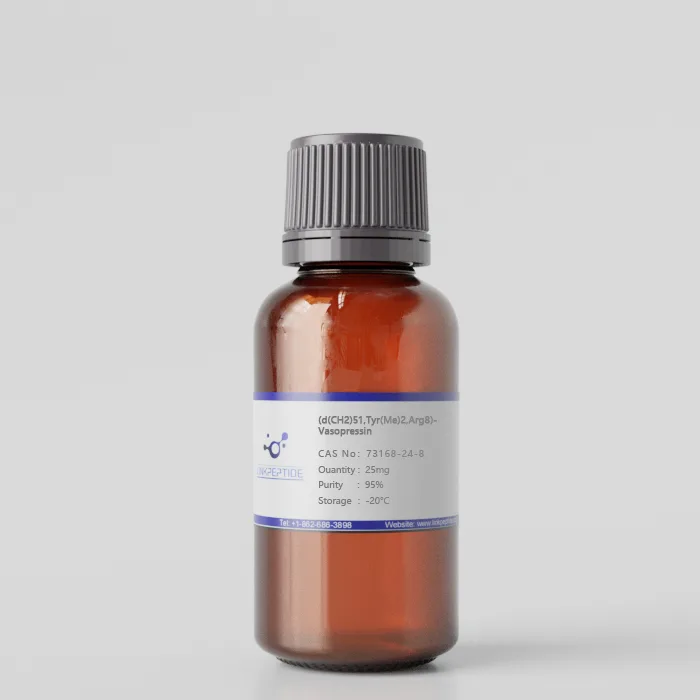
Product Name:(d(CH2)51,Tyr(Me)2,Arg8)-Vasopressin
CAS No:73168-24-8
Purity:95%
Molar Mass:1151.38
Chemical Formula:C52H74N14O12S2
Storage:Store at -20 degrees Celsius
Sequence:XYFQNCPRG
Target:vasopressin V1A
Application:
(d(CH2)51,Tyr(Me)2,Arg8)-Vasopressin, often referred to as a modified vasopressin analog, features specific amino acid substitutions that enhance its pharmacological properties. The substitution of the fifth amino acid with a d-(CH2)5 group, along with Tyr(Me)2 and Arg8 modifications, improves its receptor selectivity and resistance to enzymatic degradation. This peptide primarily acts as a selective antagonist for vasopressin V1a and V2 receptors, making it useful for studying vasopressin-related pathways involved in blood pressure regulation, water balance, and kidney function. It has applications in cardiovascular research and in exploring the roles of vasopressin in various physiological and pathological conditions.
Current Research:
The peptide (d(CH₂)₅¹,Tyr(Me)²,Arg⁸)-Vasopressin, commonly known as [d(CH₂)₅¹,Tyr(Me)²,Arg⁸]-Vasopressin, is a synthetic analog of arginine vasopressin (AVP). This analog is engineered to function as a potent and selective antagonist of the vasopressin V₁A receptor, which plays a crucial role in vasoconstriction and blood pressure regulation.
Structural Modifications and Selectivity
This peptide incorporates specific modifications to enhance its receptor selectivity and stability:
d(CH₂)₅¹: The substitution of the first position with a dicarba analog, replacing the disulfide bridge with a methylene (-CH₂-)₅ linker, increases metabolic stability.
Tyr(Me)²: Methylation of the tyrosine residue at position 2 enhances binding affinity and receptor selectivity.
Arg⁸: Retention of arginine at position 8 maintains interaction with the V₁A receptor.
These structural alterations result in a peptide that selectively antagonizes the V₁A receptor, with minimal activity at V₂ receptors, which are primarily involved in renal water reabsorption.
Pharmacological Profile
As a V₁A receptor antagonist, [d(CH₂)₅¹,Tyr(Me)²,Arg⁸]-Vasopressin inhibits vasopressin-induced vasoconstriction, leading to vasodilation and potential reductions in blood pressure. This makes it a valuable tool in research focused on cardiovascular functions and disorders.
Research Applications
This peptide is utilized in various research contexts, including:
Cardiovascular Studies: Investigating the role of V₁A receptors in blood pressure regulation and vascular tone.
Renal Physiology: Exploring the differential effects of vasopressin receptor subtypes on kidney function.
Endocrinology: Studying the systemic effects of vasopressin and its analogs on hormone secretion and action.
Conclusion
[d(CH₂)₅¹,Tyr(Me)²,Arg⁸]-Vasopressin serves as a potent and selective V₁A receptor antagonist, offering significant utility in the study of vasopressin's physiological and pathological roles, particularly concerning cardiovascular regulation.
Reference:
Get a Quote
 LinkPeptide