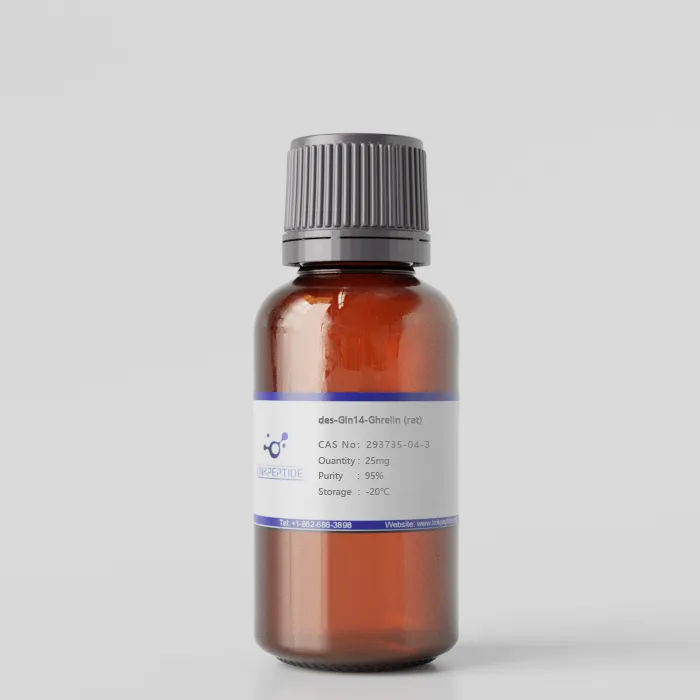
Product Name:des-Gln14-Ghrelin (rat)
CAS No:293735-04-3
Purity:95%
Molar Mass:3186.7
Chemical Formula:C142H237N43O40
Storage:Store at -20 degrees Celsius
Sequence:GSXFLSPEHQKAQRKESKKPPAKLQPR
Application:
des-Gln¹⁴-Ghrelin (rat) is a synthetic analog of the rat ghrelin peptide, modified by the removal of the glutamine residue at position 14. Ghrelin is a hormone primarily produced in the stomach, known for its role in stimulating appetite, promoting growth hormone release, and regulating energy balance. The des-Gln¹⁴ modification does not significantly alter ghrelin's biological activity, allowing it to retain its function as an orexigenic agent and growth hormone secretagogue. This analog is often used in research to study the physiological effects of ghrelin, including its roles in metabolism, appetite regulation, and potential therapeutic applications for metabolic disorders and growth deficiencies.
Current Research:
Des-Gln14-Ghrelin is an endogenous peptide ligand for the growth hormone secretagogue receptor (GHS-R1a), produced through alternative splicing of the rat ghrelin gene. This 27-amino acid peptide lacks the glutamine residue at position 14 found in native ghrelin, resulting in the sequence:
Gly-Ser-Ser(n-octanoyl)-Phe-Leu-Ser-Pro-Glu-His-Gln-Lys-Ala-Gln-Arg-Lys-Glu-Ser-Lys-Lys-Pro-Pro-Ala-Lys-Leu-Gln-Pro-Arg
The absence of glutamine at position 14 does not significantly alter its biological activity compared to ghrelin. Des-Gln14-Ghrelin potently induces intracellular calcium release in cells expressing GHS-R1a, with an effective concentration (EC₅₀) of approximately 2.4 nM. In vivo studies demonstrate that des-Gln14-Ghrelin stimulates growth hormone release, indicating its role in regulating growth hormone secretion.
The discovery of des-Gln14-Ghrelin highlights the complexity of ghrelin gene expression and the existence of multiple endogenous ligands for GHS-R1a. Understanding the distinct physiological roles of these ligands is crucial for developing targeted therapies for metabolic disorders and growth deficiencies.
For research purposes, des-Gln14-Ghrelin is available as a synthetic peptide. It is typically supplied as a lyophilized powder and should be stored at -20°C to maintain stability. Reconstitution can be performed using sterile water or appropriate buffers, depending on experimental requirements.
In summary, des-Gln14-Ghrelin is a significant endogenous ligand for GHS-R1a, contributing to the regulation of growth hormone secretion. Its study provides valuable insights into the physiological functions of ghrelin-related peptides and their potential therapeutic applications.
Reference:
Get a Quote
 LinkPeptide