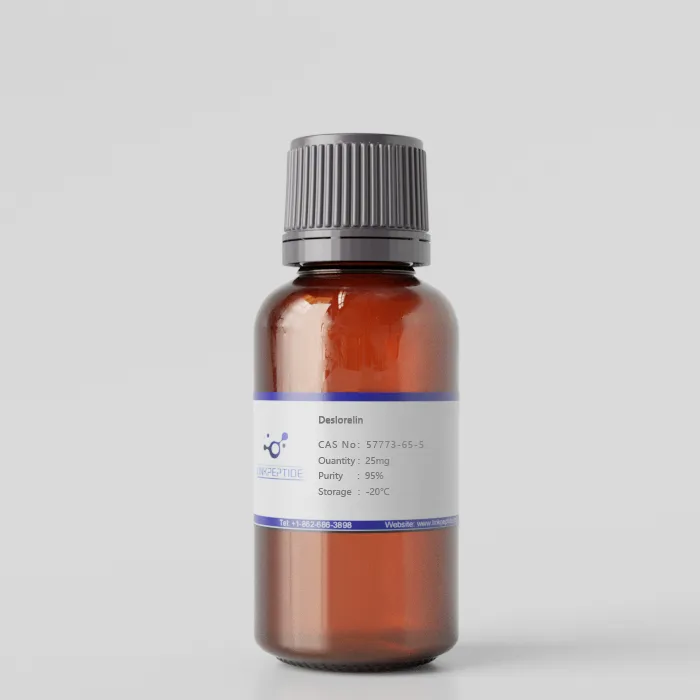
Product Name:Deslorelin
Form:Acetate salt
Purity:95%
Storage:-20oC
Cas No:57773-65-5
Molar Mass:1282.47
Chemical Formula:C64H83N17O12
IUPAC Name:(2S)-N-ethyl-1-(((S)-5-oxopyrrolidine-2-carbonyl)-L-histidyltryptophyl-L-seryl-L-tyrosyl-D-tryptophyl-L-leucyl-L-arginyl)pyrrolidine-2-carboxamide
SMILES:CCNC(=O)[C@@H]1CCCN1C(=O)[C@H](CCCN=C(N)N)NC(=O)[C@H](CC(C)C)NC(=O)[C@@H](CC2=CNC3=CC=CC=C32)NC(=O)[C@H](CC4=CC=C(C=C4)O)NC(=O)[C@H](CO)NC(=O)[C@H](CC5=CNC6=CC=CC=C65)NC(=O)[C@H](CC7=CN=CN7)NC(=O)[C@@H]8CCC(=O)N8.CC(=O)O
InChIKey:GJKXGJCSJWBJEZ-XRSSZCMZSA-N
InChI:InChI=1S/C64H83N17O12/c1-4-68-62(92)53-16-10-24-81(53)63(93)46(15-9-23-69-64(65)66)74-56(86)47(25-35(2)3)75-58(88)49(27-37-30-70-43-13-7-5-11-41(37)43)77-57(87)48(26-36-17-19-40(83)20-18-36)76-61(91)52(33-82)80-59(89)50(28-38-31-71-44-14-8-6-12-42(38)44)78-60(90)51(29-39-32-67-34-72-39)79-55(85)45-21-22-54(84)73-45/h5-8,11-14,17-20,30-32,34-35,45-53,70-71,82-83H,4,9-10,15-16,21-29,33H2,1-3H3,(H,67,72)(H,68,92)(H,73,84)(H,74,86)(H,75,88)(H,76,91)(H,77,87)(H,78,90)(H,79,85)(H,80,89)(H4,65,66,69)/t45-,46-,47-,48-,49+,50-,51-,52-,53-/m0/s1
Application:Deslorelin is a synthetic gonadotropin-releasing hormone (GnRH) agonist that regulates reproductive hormone secretion by initially stimulating, then downregulating, the release of luteinizing hormone (LH) and follicle-stimulating hormone (FSH). It is primarily used in veterinary medicine for fertility control, estrus suppression, and hormone-responsive disorders in animals. In humans, it is being investigated for prostate cancer, endometriosis, and precocious puberty. By inducing reversible suppression of gonadal function, Deslorelin has potential applications in contraception, transgender hormone therapy, and hormone-sensitive cancers. Ongoing research explores its role in reproductive endocrinology, neuroendocrine regulation, and metabolic disorders.
Current Research:Deslorelin is a high-potency gonadotropin-releasing hormone (GnRH) agonist that modulates the hypothalamic-pituitary-gonadal (HPG) axis. It initially stimulates the release of luteinizing hormone (LH) and follicle-stimulating hormone (FSH), leading to a temporary increase in testosterone and estrogen levels, followed by sustained downregulation of gonadotropin secretion due to receptor desensitization. While widely used in veterinary reproductive medicine, research is expanding its applications into oncology, endocrinology, and metabolic disorders. Veterinary Applications: Fertility Control and Reproductive Management Deslorelin is extensively used in animal reproduction and hormone regulation: Fertility control and estrus suppression: In mares, dogs, and cats, Deslorelin is used to suppress estrus cycles and manage breeding programs. Chemical castration: Long-acting Deslorelin implants provide a reversible alternative to surgical neutering in male dogs and ferrets. Ovulation induction: It is used in artificial insemination (AI) programs to enhance fertility in livestock and exotic animals. Human Medical Applications: Endocrine and Reproductive Health Deslorelin is being investigated for its role in hormone-sensitive conditions: Prostate cancer treatment: Similar to Leuprorelin and Goserelin, Deslorelin suppresses testosterone production, slowing tumor growth in androgen-dependent prostate cancer. Endometriosis and uterine fibroids: By reducing estrogen levels, Deslorelin may help alleviate symptoms and slow disease progression. Central precocious puberty (CPP): Research supports its use in delaying early puberty in children through gonadotropin suppression. Transgender Hormone Therapy and Contraception Puberty suppression in transgender individuals: Deslorelin is being studied as a GnRH agonist therapy to delay puberty in gender-diverse youth before hormone transition. Non-surgical contraception: Investigational research is evaluating its potential as a long-term contraceptive option for both men and women by suppressing gonadal function. Emerging Research Areas: Neuroendocrine and Metabolic Disorders Cognitive function and neuroprotection: Some studies suggest GnRH modulation may play a role in neurodegenerative diseases like Alzheimer??s. Metabolic syndrome and weight regulation: Research is assessing whether GnRH analogs influence fat metabolism and insulin sensitivity. Hormone-responsive cancers: Besides prostate cancer, Deslorelin??s anti-estrogenic effects are being explored in breast cancer treatment. With expanding research, Deslorelin is emerging as a versatile therapeutic agent in reproductive health, endocrinology, and metabolic medicine, offering potential applications in fertility control, hormone therapy, and oncology.
Get a Quote
 LinkPeptide