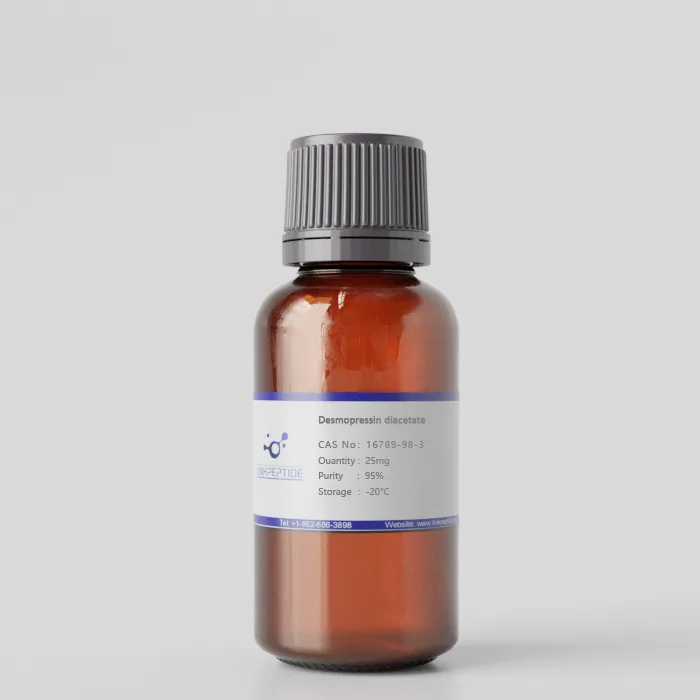
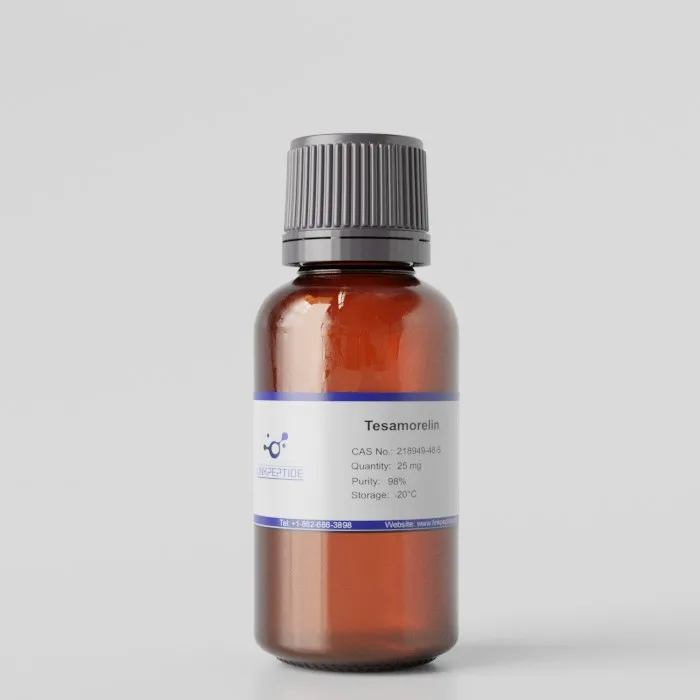
Product Name:Desmopressin diacetate
Form:Acetate salt
Purity:95%
Storage:-20oC
Cas No:16789-98-3
Molar Mass:1189.3
Chemical Formula:C50H72N14O16S2
Synonyms:1-Deamino-8-D-arginine-vasopressin diacetate
IUPAC Name:acetic acid;(2S)-N-[(2R)-1-[(2-amino-2-oxoethyl)amino]-5-(diaminomethylideneamino)-1-oxopentan-2-yl]-1-[(4R,7S,10S,13S,16S)-7-(2-amino-2-oxoethyl)-10-(3-amino-3-oxopropyl)-13-benzyl-16-[(4-hydroxyphenyl)methyl]-6,9,12,15,18-pentaoxo-1,2-dithia-5,8,11,14,17-pentazacycloicosane-4-carbonyl]pyrrolidine-2-carboxamide
SMILES: CC(=O)O.CC(=O)O.C1C[C@H](N(C1)C(=O)[C@@H]2CSSCCC(=O)N[C@H](C(=O)N[C@H](C(=O)N[C@H](C(=O)N[C@H](C(=O)N2)CC(=O)N)CCC(=O)N)CC3=CC=CC=C3)CC4=CC=C(C=C4)O)C(=O)N[C@H](CCCN=C(N)N)C(=O)NCC(=O)N
InChIKey:GNASTRMPURYAFJ-VCCVNBJCSA-N
InChI:InChI=1S/C46H64N14O12S2.2C2H4O2/c47-35(62)15-14-29-40(67)58-32(22-36(48)63)43(70)59-33(45(72)60-18-5-9-34(60)44(71)56-28(8-4-17-52-46(50)51)39(66)53-23-37(49)64)24-74-73-19-16-38(65)54-30(21-26-10-12-27(61)13-11-26)41(68)57-31(42(69)55-29)20-25-6-2-1-3-7-25;2*1-2(3)4/h1-3,6-7,10-13,28-34,61H,4-5,8-9,14-24H2,(H2,47,62)(H2,48,63)(H2,49,64)(H,53,66)(H,54,65)(H,55,69)(H,56,71)(H,57,68)(H,58,67)(H,59,70)(H4,50,51,52);2*1H3,(H,3,4)/t28-,29+,30+,31+,32+,33+,34+;;/m1../s1
Sequence:CYFQNCPRG
Application:Desmopressin diacetate is a synthetic analog of vasopressin (antidiuretic hormone, ADH) used to regulate water balance and blood clotting. It is primarily prescribed for diabetes insipidus, nocturnal enuresis (bedwetting), and bleeding disorders such as hemophilia A and von Willebrand disease. By acting on V2 receptors in the kidneys, it reduces urine output and increases water reabsorption, preventing dehydration. Additionally, Desmopressin stimulates clotting factor release, making it a valuable treatment in hematology. Ongoing research explores its potential in cognitive function, cardiovascular health, and sepsis management, positioning it as a versatile therapeutic agent in endocrinology, nephrology, and hematology.
Current Research:Desmopressin diacetate (DDAVP) is a synthetic vasopressin analog with antidiuretic and hemostatic properties. It is widely used in diabetes insipidus, nocturnal enuresis, and bleeding disorders, but emerging research is expanding its applications into cognitive enhancement, cardiovascular regulation, and critical care medicine. Endocrine and Renal Applications Desmopressin is an essential therapy for central diabetes insipidus (DI), a condition characterized by excessive urination and thirst due to ADH deficiency. Water balance regulation: It acts on V2 receptors in the renal collecting ducts, promoting water reabsorption and reducing urine output. Nocturnal enuresis treatment: It is a first-line therapy for bedwetting in children and adults, effectively reducing nighttime urine production. Chronic kidney disease (CKD): Some studies suggest Desmopressin may help manage nocturnal polyuria in CKD patients, improving quality of life. Hematological and Clotting Disorder Applications Desmopressin plays a vital role in increasing clotting factors, particularly in bleeding disorders. Hemophilia A and von Willebrand disease (VWD): Desmopressin stimulates the release of von Willebrand factor (vWF) and factor VIII, improving coagulation in mild to moderate cases. Surgical and trauma settings: It is used preoperatively in patients with bleeding disorders to prevent excessive hemorrhage. Platelet function disorders: Emerging research explores its potential in treating platelet dysfunction-associated bleeding. Neurological and Cognitive Research Desmopressin??s role in cognitive function and memory is gaining attention. Memory enhancement: Studies suggest it may improve short-term memory and cognitive processing, possibly by modulating brain vasopressin pathways. Alzheimer??s disease and neurodegeneration: Research is exploring whether Desmopressin affects neuropeptide regulation in cognitive disorders, potentially improving cerebral perfusion and memory function. Cardiovascular and Critical Care Applications Desmopressin??s effects on vascular tone and fluid balance have led to research in cardiovascular medicine and critical care. Hyponatremia management: While Desmopressin reduces urine output, improper dosing may cause water retention and dilutional hyponatremia, prompting research into safer dosing regimens. Sepsis and vasodilatory shock: Some studies are evaluating Desmopressin??s role in modulating vasodilation and inflammatory responses in sepsis, improving hemodynamic stability. Blood pressure regulation: Ongoing research investigates its potential impact on orthostatic hypotension and vasopressor support in critical care patients. Emerging Research Areas Sleep disorders: Some research suggests that Desmopressin may influence circadian rhythms and sleep regulation, with potential applications in insomnia and shift work disorder. Bladder control and urology: It is being explored for reducing nocturia (frequent nighttime urination) in elderly patients and those with overactive bladder syndrome. Anti-inflammatory effects: Some studies suggest Desmopressin may modulate inflammatory cytokines, opening potential applications in autoimmune disorders. With ongoing research, Desmopressin diacetate is expanding beyond its traditional use in fluid balance and hemostasis, with promising applications in neurology, nephrology, and cardiovascular medicine.
Get a Quote
 LinkPeptide