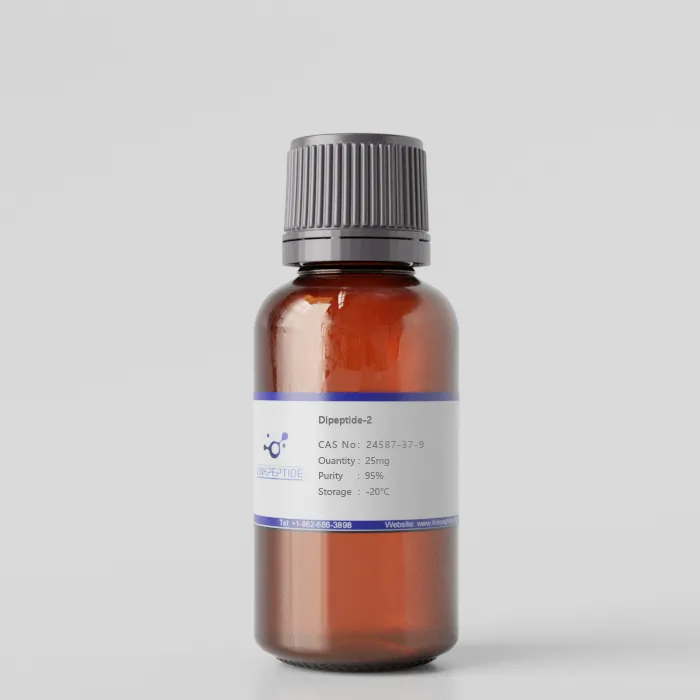
Product Name: Dipeptide-2
Cas No: 24587-37-9
Purity: 95%
Storage: Keep in dark and cool dry place -5~8 degree Celsius
Sequence: H-Val-Tyr-OH
Molar Mass: 303.36
Chemical Formula: C16H21N3O3
Synonyms: L-Tryptophan, L-valyl-; L-Valyl-L-tryptophan; valyltryptophan
IUPAC Name: (2S)-2-[[(2S)-2-amino-3-methylbutanoyl]amino]-3-(1H-indol-3-yl)propanoic acid
SMILES: CC(C)[C@@H](C(=O)N[C@@H](CC1=CNC2=CC=CC=C21)C(=O)O)N
InChIKey: LZDNBBYBDGBADK-KBPBESRZSA-N
InChI: InChI=1S/C16H21N3O3/c1-9(2)14(17)15(20)19-13(16(21)22)7-10-8-18-12-6-4-3-5-11(10)12/h3-6,8-9,13-14,18H,7,17H2,1-2H3,(H,19,20)(H,21,22)/t13-,14-/m0/s1
Application:
Dipeptide-2 is a short bioactive peptide known for its ability to help reduce the appearance of puffiness and improve the look of delicate skin, particularly in the eye area. Composed of two amino acids, it supports cosmetic research focused on enhancing microcirculation, promoting smoother texture, and revitalizing fatigued-looking skin. Dipeptide-2 is commonly used in formulations targeting under-eye bags and early signs of aging, making it a popular component in eye serums, creams, and targeted treatments. Its excellent stability and compatibility with gentle skincare systems make it ideal for promoting a fresher, more awakened appearance.
Current Research:
Dipeptide-2: Research Overview
Dipeptide-2 is a small bioactive dipeptide used in cosmetic science, chemically identified as N-valyl-L-tryptophan. It consists of the amino acids valine and tryptophan linked by a peptide bond, with the empirical formula C??H??N?O? and a molecular weight of approximately 303 Da. The molecule combines a branched-chain aliphatic residue (valine) with an aromatic indole residue (tryptophan), giving it amphiphilic properties and moderate hydrophobicity, which are relevant to its interaction with biological membranes and transport systems.
Dipeptide-2 has been characterized as a substrate-type inhibitor of angiotensin-converting enzyme (ACE), acting on both ACE I and ACE II in biochemical assays. ACE is a central component of the renin–angiotensin system (RAS), catalyzing the conversion of angiotensin I to angiotensin II and modulating bradykinin degradation. Inhibition of ACE leads to reduced angiotensin II formation and a shift toward vasodilation, decreased vascular tone, and altered regulation of fluid balance.
In the context of dermal microcirculation, ACE activity is linked to capillary perfusion, vascular permeability, and interstitial fluid accumulation. By partially inhibiting ACE, Dipeptide-2 is proposed to modulate local hemodynamics and fluid homeostasis in the periorbital and superficial dermal microvascular networks. This mechanistic role underpins its use in cosmetic research on periorbital edema and fluid-related puffiness.
Experimental work on RAS-modulating peptides has shown that reduced angiotensin II signaling can influence:
Capillary permeability, affecting extravasation of plasma into the interstitial compartment
Precapillary sphincter tone, impacting microvascular perfusion
Venous and lymphatic return, with consequences for tissue edema
Dipeptide-2 is used in formulations designed to study the decongestion of periorbital tissues, particularly in relation to eye-bag formation, which is associated with a combination of lipid herniation, weakened connective tissue, and chronic interstitial fluid accumulation. In such systems, the peptide is often evaluated alongside flavonoids and other peptides that target capillary resistance and lymphatic function.
In vitro and ex vivo models describing Dipeptide-2–containing complexes report improvements in capillary integrity markers and reductions in experimentally induced extravascular fluid pooling. Although these data are typically generated in proprietary or combined-ingredient systems, they support the mechanistic interpretation that ACE inhibition by a small dipeptide contributes to more controlled microvascular permeability and improved tissue fluid handling.
Beyond fluid regulation, Dipeptide-2 has been explored in the context of extracellular matrix (ECM) preservation. Angiotensin II and RAS signaling can influence matrix metalloproteinase (MMP) expression in vascular and dermal cells. ACE inhibition has been associated in several model systems with reduced MMP-1 activity and better maintenance of collagen networks.
Supplier and secondary research sources attribute to Dipeptide-2:
Modest reduction in MMP-1 expression in fibroblast cultures
Preservation of collagen and elastin fibers in experimental photoaging or stress models
Classification as a peptide with anti-aging relevance via indirect ECM-protective effects
These observations are consistent with the broader concept that local modulation of RAS signaling may have downstream effects on dermal structure, particularly in microvessel-rich regions such as the periorbital area.
Dipeptide-2 is listed in cosmetic ingredient inventories as a skin-protecting and skin-conditioning agent. Toxicological overviews include oral and dermal acute toxicity, skin and eye irritation, sensitization, phototoxicity, genotoxicity, and repeated-dose studies. Within the concentration ranges reported for rinse-off and leave-on applications, no significant safety concerns have been identified in standard cosmetic-use scenarios.
The ingredient appears in multiple national and regional databases as a permitted cosmetic raw material, with usage patterns concentrated in eye-area formulations, serums, and anti-fatigue products. Safety assessments emphasize the absence of specific risk impurities and support its use within established concentration limits.
As a small dipeptide composed of valine and tryptophan, Dipeptide-2 shows:
Moderate hydrophobicity due to the aromatic indole ring and aliphatic side chain
Limited water solubility in its free form, leading to use in solubilized or buffered systems
Stability under typical cosmetic pH conditions when protected from excessive heat and oxidation
To optimize delivery, Dipeptide-2 is frequently included in emulsions, micellar systems, or peptide complexes designed to enhance penetration toward the superficial microvasculature of the dermis and periorbital region.
Current research interest in Dipeptide-2 centers on:
Its role as a cosmetic ACE inhibitor and the impact on local microcirculation
The relationship between RAS modulation, perivascular fluid balance, and visible edema
Potential contributions to matrix preservation and anti-aging endpoints via indirect effects on MMP activity and collagen maintenance
Taken together, these lines of investigation define Dipeptide-2 as a low–molecular-weight peptide with primary relevance to microvascular fluid regulation and dermal protection, particularly in anatomical regions susceptible to chronic mild edema and structural weakening.
Get a Quote
 LinkPeptide