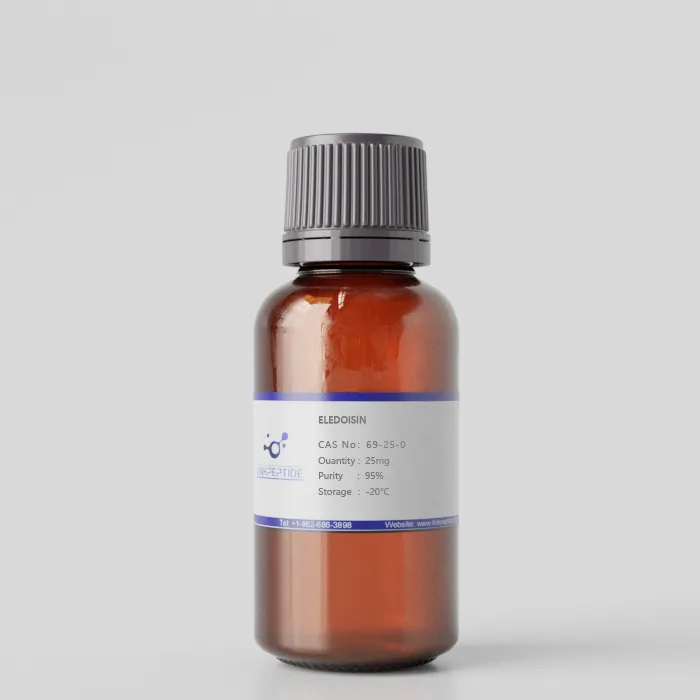
Product Name:ELEDOISIN
Form:TFA salt
Purity:95%
Storage:-20oC
Cas No:69-25-0
Molar Mass:1188.4
Chemical Formula:C54H85N13O15S
IUPAC Name:(3S)-3-[[(2S)-6-amino-2-[[(2S)-3-hydroxy-2-[[(2S)-1-[(2S)-5-oxopyrrolidine-2-carbonyl]pyrrolidine-2-carbonyl]amino]propanoyl]amino]hexanoyl]amino]-4-[[(2S)-1-[[(2S)-1-[[(2S,3S)-1-[[2-[[(2S)-1-[[(2S)-1-amino-4-methylsulfanyl-1-oxobutan-2-yl]amino]-4-methyl-1-oxopentan-2-yl]amino]-2-oxoethyl]amino]-3-methyl-1-oxopentan-2-yl]amino]-1-oxo-3-phenylpropan-2-yl]amino]-1-oxopropan-2-yl]amino]-4-oxobutanoic acid
SMILES:CC[C@H](C)[C@@H](C(=O)NCC(=O)N[C@@H](CC(C)C)C(=O)N[C@@H](CCSC)C(=O)N)NC(=O)[C@H](CC1=CC=CC=C1)NC(=O)[C@H](C)NC(=O)[C@H](CC(=O)O)NC(=O)[C@H](CCCCN)NC(=O)[C@H](CO)NC(=O)[C@@H]2CCCN2C(=O)[C@@H]3CCC(=O)N3
InChIKey:AYLPVIWBPZMVSH-FCKMLYJASA-N
InChI:InChI=1S/C54H85N13O15S/c1-7-30(4)44(53(81)57-27-42(70)60-36(24-29(2)3)49(77)61-33(45(56)73)20-23-83-6)66-50(78)37(25-32-14-9-8-10-15-32)63-46(74)31(5)58-48(76)38(26-43(71)72)64-47(75)34(16-11-12-21-55)62-51(79)39(28-68)65-52(80)40-17-13-22-67(40)54(82)35-18-19-41(69)59-35/h8-10,14-15,29-31,33-40,44,68H,7,11-13,16-28,55H2,1-6H3,(H2,56,73)(H,57,81)(H,58,76)(H,59,69)(H,60,70)(H,61,77)(H,62,79)(H,63,74)(H,64,75)(H,65,80)(H,66,78)(H,71,72)/t30-,31-,33-,34-,35-,36-,37-,38-,39-,40-,44-/m0/s1
Sequence:XPSKDAFIGLM
Application:Eledoisin is a tachykinin peptide derived from the salivary glands of cephalopods, specifically Eledone octopuses. It acts as a potent vasodilator, smooth muscle contractor, and neurotransmitter modulator, affecting vascular, respiratory, and gastrointestinal systems. Eledoisin interacts with neurokinin (NK) receptors, primarily NK-1 and NK-2, leading to increased vascular permeability, hypotension, and smooth muscle activation. It has been investigated for its cardiovascular, neurogenic, and pain-modulating properties, with potential therapeutic applications in hypertension, sexual dysfunction, neuroinflammation, and pain management. Current research explores its role in cardiovascular diseases, sensory processing disorders, and novel drug development.
Current Research:Eledoisin is a bioactive tachykinin peptide with vasodilatory, smooth muscle-stimulating, and neuromodulatory properties. It binds to neurokinin receptors (NK-1, NK-2, and NK-3), influencing vascular tone, neurotransmission, and pain perception. While originally isolated for its cardiovascular and smooth muscle effects, emerging research explores its applications in neurology, pain management, and inflammatory diseases. Cardiovascular and Vasodilatory Effects Eledoisin is a potent vasodilator, making it a subject of interest in hypertension and vascular research. Blood pressure regulation: Studies suggest that Eledoisin can reduce arterial pressure by inducing vascular relaxation, potentially benefiting patients with hypertension and vascular dysfunction. Microvascular circulation improvement: Research is evaluating its effects on enhancing blood flow in ischemic tissues, with potential applications in peripheral artery disease (PAD) and Raynaud??s phenomenon. Heart failure and cardiac output: Preclinical studies suggest that Eledoisin may enhance cardiac output by modulating vascular resistance and myocardial perfusion. Pain Modulation and Neurogenic Research Eledoisin interacts with NK-1 receptors, which play a significant role in pain processing and neurogenic inflammation. Chronic pain management: Researchers are investigating its potential role in neuropathic pain conditions, such as fibromyalgia and diabetic neuropathy. Migraine treatment: Given its effects on neuropeptide release and vasodilation, Eledoisin is being studied as a potential target for migraine therapy, similar to substance P antagonists. Neurodegenerative disorders: Studies are exploring Eledoisin??s role in modulating neuroinflammation and synaptic transmission, with possible applications in Alzheimer??s disease and Parkinson??s disease. Gastrointestinal and Smooth Muscle Stimulation Eledoisin has strong effects on smooth muscle contraction, influencing gut motility and secretion. Irritable bowel syndrome (IBS) and gut motility disorders: Research is evaluating its role in enhancing colonic transit and reducing visceral pain, particularly in IBS and chronic constipation. Sexual dysfunction: Eledoisin has been studied for its potential to increase erectile function through its smooth muscle-relaxing effects in penile vasculature. Emerging Research Areas Inflammatory and immune modulation: Some studies suggest that Eledoisin regulates inflammatory cytokine release, making it a candidate for autoimmune disease research. Wound healing and tissue repair: Research indicates it may enhance angiogenesis and cell regeneration, aiding in wound healing and skin repair therapies. Potential in cancer research: Preliminary studies are assessing whether tachykinin pathways, including those affected by Eledoisin, influence tumor growth and metastasis. With its broad pharmacological effects, Eledoisin is emerging as a potential therapeutic peptide in cardiovascular health, neurogenic pain, and gastrointestinal disorders, warranting further clinical investigation.
Get a Quote
 LinkPeptide