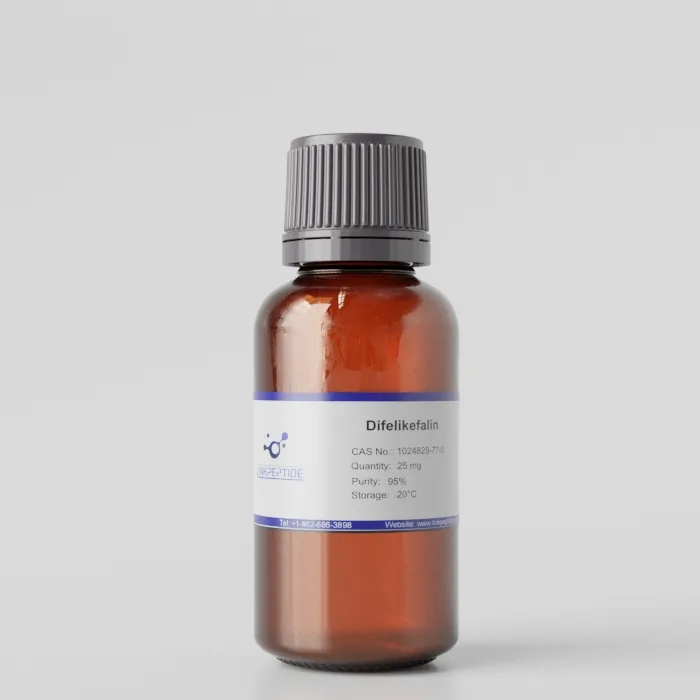
Product Name: Difelikefalin
Form: Free base
CAS No: 1024828-77-0
Molar Mass: 679.85
Chemical Formula: C36H53N7O6
Synonyms: CR-845; FE-202845
Storage: Store at -20℃
Target: kappa opioid receptor
Application:
Difelikefalin (CAS: 1024828-77-0) is a synthetic opioid peptide that selectively targets the kappa-opioid receptor (KOR). It acts as an analgesic by binding to KORs in the central nervous system, resulting in the modulation of pain transmission pathways. Difelikefalin has shown efficacy in the management of chronic pruritus (itch) associated with conditions such as chronic kidney disease undergoing hemodialysis and cholestatic liver disease. In pharmaceutical chemistry, difelikefalin's selective targeting of KOR represents a novel approach to treating pruritus, offering an alternative to traditional antipruritic medications with fewer adverse effects. Its application highlights its importance in addressing the unmet medical need for effective treatments for chronic pruritus, particularly in patients with underlying systemic diseases.
Current Research:
Difelikefalin is a selective kappa-opioid receptor agonist developed for the treatment of pruritus (itching) associated with chronic kidney disease (CKD), particularly in patients undergoing hemodialysis. Chronic kidney disease can lead to significant skin itching, a condition known as uremic pruritus, which greatly impacts patients' quality of life. Difelikefalin works by binding to kappa-opioid receptors in the central nervous system, which are involved in modulating the sensation of itch. By targeting this specific receptor, Difelikefalin helps to alleviate the itching without causing the side effects typically associated with opioid therapies, such as sedation or dependence.
Mechanism of Action
Difelikefalin exerts its therapeutic effects through selective agonism of the kappa-opioid receptor (KOR). The KOR is involved in the regulation of itch sensation, and its activation can modulate the pruritic response. Difelikefalin’s selective action at the KOR, without significant activation of other opioid receptors (such as the mu-opioid receptor), results in a reduction in itching while minimizing the risk of common opioid side effects like respiratory depression, euphoria, or addiction. This makes Difelikefalin particularly useful for managing pruritus in patients with chronic conditions, such as CKD, where alternative treatments may not be effective or may carry significant risks.
Indications and Uses
Difelikefalin is primarily indicated for the treatment of moderate to severe pruritus associated with chronic kidney disease in patients undergoing hemodialysis. Uremic pruritus is a prevalent and debilitating symptom in CKD patients, leading to sleep disturbances, decreased quality of life, and an increased burden of disease. Difelikefalin is administered intravenously, typically once every month during dialysis sessions, providing long-lasting relief from itching. It is generally used in patients who do not respond adequately to other treatments for pruritus, such as antihistamines, topical therapies, or systemic treatments like gabapentin.
Efficacy and Clinical Benefits
Clinical studies have demonstrated that Difelikefalin significantly reduces pruritus in patients with CKD undergoing hemodialysis. In pivotal trials, Difelikefalin was shown to provide substantial improvements in the severity of itching, as measured by patient-reported outcomes and clinician assessments. The drug has been associated with a rapid onset of action, with many patients reporting relief from itching within a few days of starting treatment. The clinical benefits of Difelikefalin go beyond just alleviating symptoms; by reducing pruritus, it helps to improve patients' sleep quality, overall comfort, and quality of life, which are significantly affected by chronic itching in CKD.
Safety and Tolerability
Difelikefalin is generally well tolerated, with the most common side effects being mild to moderate in nature. The most frequently reported adverse events are gastrointestinal symptoms, including diarrhea, nausea, and vomiting, which are typically transient and resolve with continued treatment. Other side effects may include headache or dizziness, but these are also usually mild. Because of its selective action on the kappa-opioid receptor, Difelikefalin does not carry the risk of the more serious side effects associated with traditional opioids, such as respiratory depression, sedation, or addiction. However, as with any medication, patients should be monitored for any adverse effects, and dose adjustments may be required in cases of severe side effects.
Advantages and Limitations
One of the major advantages of Difelikefalin over other treatments for uremic pruritus is its targeted mechanism of action, which specifically addresses the underlying itch without causing the systemic opioid side effects that often accompany other therapies. The intravenous formulation, while offering effective relief, may limit its use in patients who prefer oral treatments or those who do not undergo regular hemodialysis. Additionally, while Difelikefalin has been shown to be effective in improving pruritus, its role in addressing other symptoms of CKD, such as inflammation or metabolic imbalances, is still under investigation. Furthermore, the drug is relatively expensive, which could be a barrier for some healthcare systems or patients.
Future Directions
Ongoing research is focused on exploring the long-term safety and efficacy of Difelikefalin, particularly in different stages of CKD and in broader patient populations. Further studies are also examining its potential use in other pruritic conditions, such as those associated with liver disease or dermatological disorders, where the kappa-opioid receptor may also play a role in regulating itching. Additionally, there is interest in combining Difelikefalin with other treatments for CKD, such as phosphate binders or erythropoiesis-stimulating agents, to improve overall patient management and outcomes. Further development of oral formulations may also enhance its convenience and broaden its accessibility for patients.
Reference:
Deeks, E. D. (2021). Difelikefalin: first approval. Drugs, 81(16), 1937-1944.
Get a Quote
 LinkPeptide