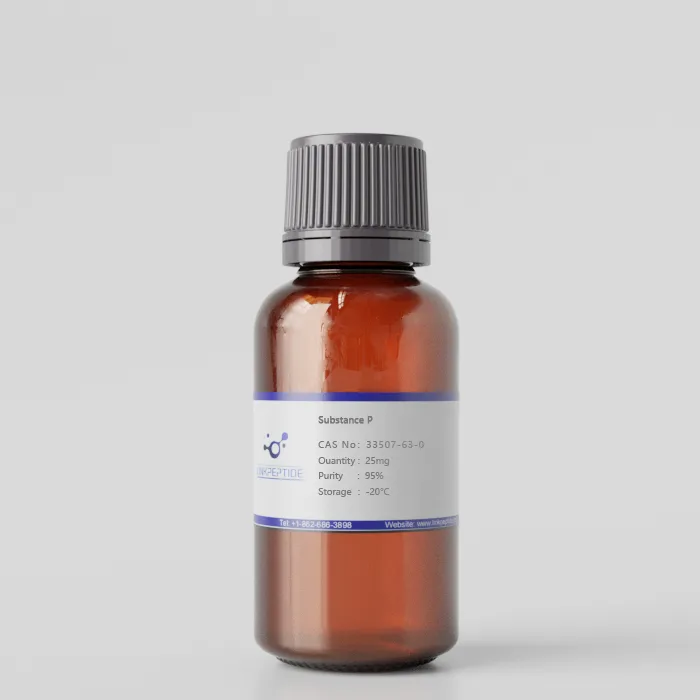
Product Name:Substance P
CAS No:33507-63-0
Purity:95%
Molar Mass:1347.6
Chemical Formula:C63H98N18O13S
Storage:Store at -20 degrees Celsius
Sequence:RPKPQQFFGLM
Application:
Substance P is a neuropeptide that functions as a neurotransmitter and neuromodulator in the human body. It is part of the tachykinin neuropeptide family and is composed of 11 amino acids. Substance P is primarily associated with the transmission of pain signals from peripheral nerves to the central nervous system, playing a crucial role in the perception of pain. Beyond pain modulation, it is involved in various physiological processes, including inflammation, stress response, mood regulation, and gastrointestinal function. Due to its diverse functions, Substance P is a subject of interest in research areas such as chronic pain management, psychiatric disorders, and inflammatory diseases.
Current Research:
Substance P is an 11-amino acid neuropeptide with the sequence Arg-Pro-Lys-Pro-Gln-Gln-Phe-Phe-Gly-Leu-Met-NH?, belonging to the tachykinin family. It is widely distributed in the central and peripheral nervous systems, where it functions as a neurotransmitter and neuromodulator. Substance P is involved in various physiological processes, including pain transmission, inflammation, and stress response.
Mechanism of Action
Substance P primarily exerts its effects by binding to the neurokinin-1 receptor (NK1R), a G protein-coupled receptor (GPCR). Upon receptor activation, intracellular signaling pathways, including phospholipase C (PLC), protein kinase C (PKC), and mitogen-activated protein kinase (MAPK), are triggered, leading to diverse cellular responses such as vasodilation, smooth muscle contraction, and increased permeability of blood vessels.
Research Applications
Pain and Neuroinflammation Studies:
Substance P plays a critical role in pain perception by enhancing nociceptive signaling in the spinal cord. It is frequently used in studies investigating the mechanisms of chronic pain and neuroinflammation.
Inflammatory Disorders:
As a key mediator in neurogenic inflammation, Substance P is employed in research on conditions like arthritis, asthma, and inflammatory bowel disease, where it contributes to immune cell recruitment and cytokine release.
Cancer Research:
Elevated levels of Substance P and NK1R expression are linked to tumor growth and metastasis in various cancers. It is used to explore the role of the NK1R signaling pathway in oncogenesis and to identify potential therapeutic targets.
Neuropsychiatric Disorders:
Substance P is implicated in stress, anxiety, and depression, making it a valuable tool for studying neuropsychiatric conditions and testing NK1R antagonists for therapeutic applications.
Conclusion
Substance P is a pivotal neuropeptide in pain, inflammation, and stress-related processes. Its broad physiological relevance and role in disease mechanisms make it a key target in biomedical research and drug development.
Reference:
Get a Quote
 LinkPeptide